How is the housing market shaping pet outcomes?
In April of last year, after losing her Knoxville home in a real estate scam, former paralegal Cheri Byrd spent 10 months living in her truck with her adult son – a situation that ultimately forced her to surrender two of her three cats.
At the time, Byrd also had three dogs – one large and two small – and another cat that went missing after escaping from a motel. Before deciding to surrender her two remaining cats, Byrd attempted to find a foster to care for them.
“[Fostering them] turned out to be a bad situation, so I made the heartbreaking decision to surrender them to a shelter,” Byrd said. “It ripped my heart out.”
On Feb. 19 of this year, Byrd qualified for public housing with her Pomeranian and Shih Tzu, the latter of which she had to claim as an emotional support animal to keep two pets in the home. After surrendering her two cats, Byrd’s son surrendered her large dog as well after it attacked her Pomeranian.
In 2025, Knoxville’s rental-heavy housing market continues to be a driving factor behind a majority of the city’s animal surrenders according to Tonia Russell, a veterinary technician at Young Williams Animal Center’s Pet Resource Center.
Young Williams, whose animal services branch is responsible for all animal control services in the City of Knoxville and Knox County, has seen an increase in surrendered animals due to homelessness “just this year,” Russell said.
“I think it’s where they just can’t afford their rent anymore,” she said. “Maybe they’re going up on it, or, I know a lot of people are selling their properties in Knoxville, and it’s displacing those people that are living in those homes.”
According to the Knoxville mayor’s Roundtable on Homelessness, rising rental costs in Knox County are leading to less affordable rental homes, which is leaving more of these units to sit vacant.
The county’s median rent has risen faster than comparable cities since 2020, increasing from $1,611 to $1,806.77 between October 2022 and August of this year. With that, Knox County’s occupancy rate has decreased by 1.5% since a peak in 2021, with more available properties remaining empty.
Additionally, according to the Knox Community Dashboard on Homelessness, 51% of people in the third quarter of 2025 reported that a lack of affordable housing led to their homelessness.
This housing inequality leads many Knoxville residents, like Byrd, to surrender their animals to Young Williams and other Tennessee shelters.
Young Williams’ director of animal services, Rachel Ide, said the other main factors behind animal arrivals at the shelter include financial strain and high medical costs – for both the pet and the owner.
Strain due to medical costs, including for common procedures like spay and neuter, has increased in recent years, according to Tori Fugate, director of communications at national shelter data organization Shelter Animals Count. She also said this issue is affected by the shortage of veterinarians across the country.
“It used to be, you know, a couple hundred dollars you could get [the spay/neuter procedure] done,” Fugate said. “And now if you go to a private vet, it’s going to be upwards around $1,000, and the average family’s like, ‘that’s a lot of money.’ At the same time, vet clinics are closing, they’re getting bought out by corporations, there’s this whole compounding factor that plays into all of this. It’s interesting because people sometimes forget that what impacts people impacts their pets.”
The Association for Animal Welfare Advancement’s 2025 State of the Shelter Pet Adoption report found that 48% respondents cited overall pet ownership costs as the biggest barrier – a 5% increase from last year. Time and maintenance, adoption and food costs, and access to pet-friendly housing were also noted.
Pet owners in the Knoxville area echo this sentiment. Air Force veteran Gaylynn Wolfe said that the medical costs for her pets are “pretty astronomical.”
“With my German Shepherd and my corgi, taking them down to UT Emergency three or four times – every time it’s been at least $1,000 – it can build up really quick,” she said.
However, shelter staff say financial strain is only part of the issue, as housing restrictions are now keeping more surrendered pets in shelters longer.
Limits that keep pets waiting
While housing insecurity is one of the driving factors behind animal intakes at Young Williams, other housing-related struggles – including homeowners’ association and landlord pet restrictions – are keeping animals in the shelter and playing a part in Young Williams’ high occupancy, according to Ide.
While animal intakes at Tennessee’s 374 sheltering organizations dropped 7%, which is 3% more than the national trend, in early 2025 versus the same time in 2024, “shelters are still feeling the strain of capacity,” Fugate said.
Fugate attributed this strain to increased lengths of stay for dogs of all sizes across the country, with large dogs spending the most time waiting to be adopted. The median length has roughly doubled since 2019, according to Fugate, and is up to 23 days for large dogs depending on the type of shelter.
Young Williams, which has achieved “no-kill status” since 2018, is experiencing the same phenomenon and links these extended stays to homeowner pet restrictions.
“Because of the housing, more of Knoxville rents than doesn’t, which is a fairly unique market, and there are size restrictions on a lot of those [properties],” Ide said. “So, we do see a lot of large dog surrenders or large dog strays, and we have a harder time adopting those out.”
Restrictions on large dogs for weight and breed often limit accessible housing for Knoxville pet owners.
27-year-old Shelby Harris, a staff member on the behavior team at Young Williams, has struggled to find a rental home with her two dogs, Ludo and Jane, due to these restrictions. With Jane, a bully breed, and Ludo, a shar-pei and pit bull mix, Harris said that “searching for housing has always been a challenge.”
In March of last year, Harris toured a property managed by Pittman Properties, which has referred to itself as striving to be “Knoxville’s most pet friendly landlord” on its social media. Pittman Properties, which currently has about 150 rentals, is owned by Young Williams’ board of directors’ chair, Bill Pittman.

The Pittman Properties logo is featured outside of a kennel at Young Williams Animal Center. November 18, 2025.
Although Harris understood Pittman Properties to be pet-friendly – and knew someone who rented from it with a German Shepherd – the company informed her that pit bulls were prohibited under its insurance agreement.
“I’m used to companies discriminating against ‘pit bull type’ dogs,” Harris said. “I was extremely disappointed to find out Pittman Properties discriminates by choosing an insurance company that does so. … You’d think providing a potential rental without worrying about a person’s dog being heavily judged based on breed stigmatism would be important to someone who appears to care so much about pets.”
Although the home was already rented, Pittman Properties told Harris she might qualify for a similar place if she obtained emotional support animal paperwork for Jane. She got the ESA letter, but didn’t follow up after never hearing about other openings.
“It is wild to me that someone on the animal shelter board directly contributes to the problem by restricting breeds in their rental homes,” Harris said. “I understand that it might be trickier or more expensive to find an insurance that doesn’t have restrictions, but people do it.”
Struggles with landlord pet requirements extend outside of Knoxville’s unique market and into similar East Tennessee cities. Riley Pickett, a senior communications major at the University of Tennessee at Chattanooga, was unable to find a rental until two weeks before she moved in because of restrictions for her dog, Ranger.
“I called so many places, and there were very few places that were less than, like, $1,800 a month that would allow Ranger,” she said. “I live in Chattanooga. It’s in the inner city a little bit, but not like New York. I shouldn’t be paying New York prices for an apartment in Chattanooga, right?”
In her current home, Pickett pays roughly $800 per month but decided to have Ranger – an American Staffordshire terrier with lease aggression – registered as an ESA. The registration cost Pickett $200 and must be renewed yearly.
“I do understand the reasons that they don’t allow certain types of dogs in these facilities,” Pickett said. “… But it’s also not fair at the same time, because, even if I did get him to work out all his kinks, and he was the perfect dog, had no issues at all, it’s kind of breedist in a way.”
As these restrictions continue to limit adoptions and lengthen shelter stays, Young Williams is increasing community support to reduce animal surrenders.
How the shelter steps in
To combat surrenders due to housing and financial instability, programs at Young Williams are in place to assist Knoxville-area animal owners.
One of the main efforts is the shelter’s Pet Resource Center, which began in 2018 as part of the initiative to achieve no-kill status according to Amy Buttry, Young Williams’ director of outreach programs. She said the center works as a “safety net” for owners with hopes of reducing shelter surrenders and keeping animals in their homes.
The center keeps a list of pet-friendly housing and medical assistance locations for individuals in need, as well as provides free supplies like crates, leashes and clothing.
Pet food is the top need for Knoxville pet owners, according to Buttry. To address the issue, Young Williams offers free pet food through its Pet Food Pantry, which reallocates donated food to owners in need.
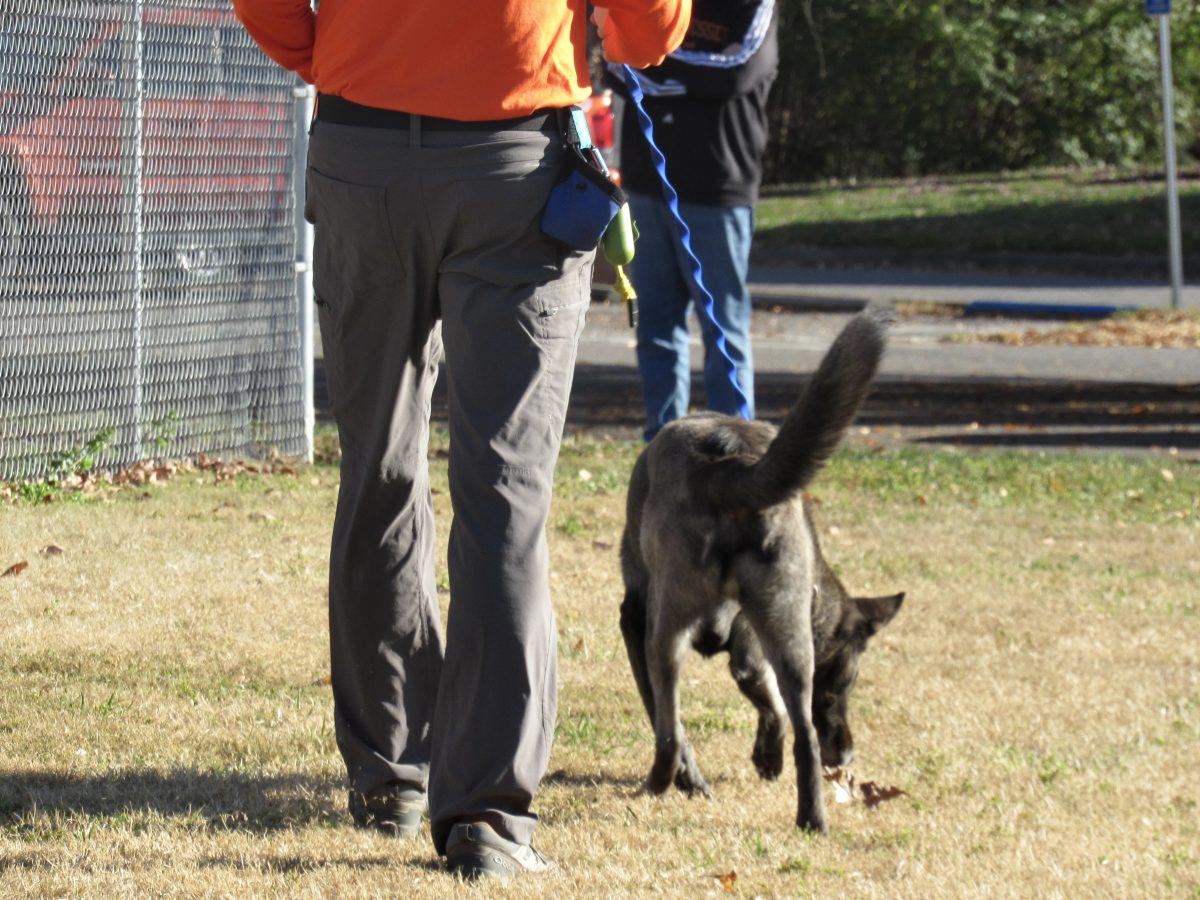
To support Young Williams, volunteers help exercise dogs at the shelter, alongside community donations of pet food, bedding and supplies. November 18, 2025.
Young Williams charges a fee for animals that are surrendered, but owners can work with the PRC to waive it; this process often starts by listing the animal on partnered rehoming platforms like Home to Home and Adopt-a-Pet.
Access to affordable veterinary care is another part of the shelter’s approach to reducing surrenders. In partnership with Humane World for Animals’ Pets for Life program, owners can qualify for Young Williams’ Low-Cost Care Clinic, which offers services like spaying, neutering and vaccinations.
“We met so many people that needed medical care for their pets, and many of them had never been able to afford a vet,” Buttry said. “So, we are trying to provide that kind of wellness care as cheaply as possible for people that need it for their pets.”
The clinic – which is partnering with the University of Tennessee – is currently open one day a week. Buttry said expanding the Low-Cost Care Clinic is a “top priority,” and that the shelter is trying to increase operations to four days a week in 2026. UT students, veterans and residents in government housing are among those eligible for pet care at the clinic.
“We’re seeing that once people are aware of the help that exists, they understand why vets may recommend these things,” Buttry said. “We’re helping to educate and help people realize what it takes to have a healthy pet.”
She added that the increase in spay and neuter procedures is reducing pet overpopulation and shelter intake, resulting in healthier animals that live longer.
Young Williams is focused on supporting the people who care for their pets, using every resource to help families avoid that last resort.
“We’re just trying to make sure people know that we do have resources,” Buttry said. “We can’t necessarily solve every problem the way people want it to be. A lot of people want us to just take the animal to the shelter, but that is not the answer. The shelter is the worst place for an animal. It’s stressful, there’s disease – it’s just not ideal. So, our goal is, if they do have to come into the shelter, we get them out here as fast as we can, either into foster, to a rescue or adoption.”