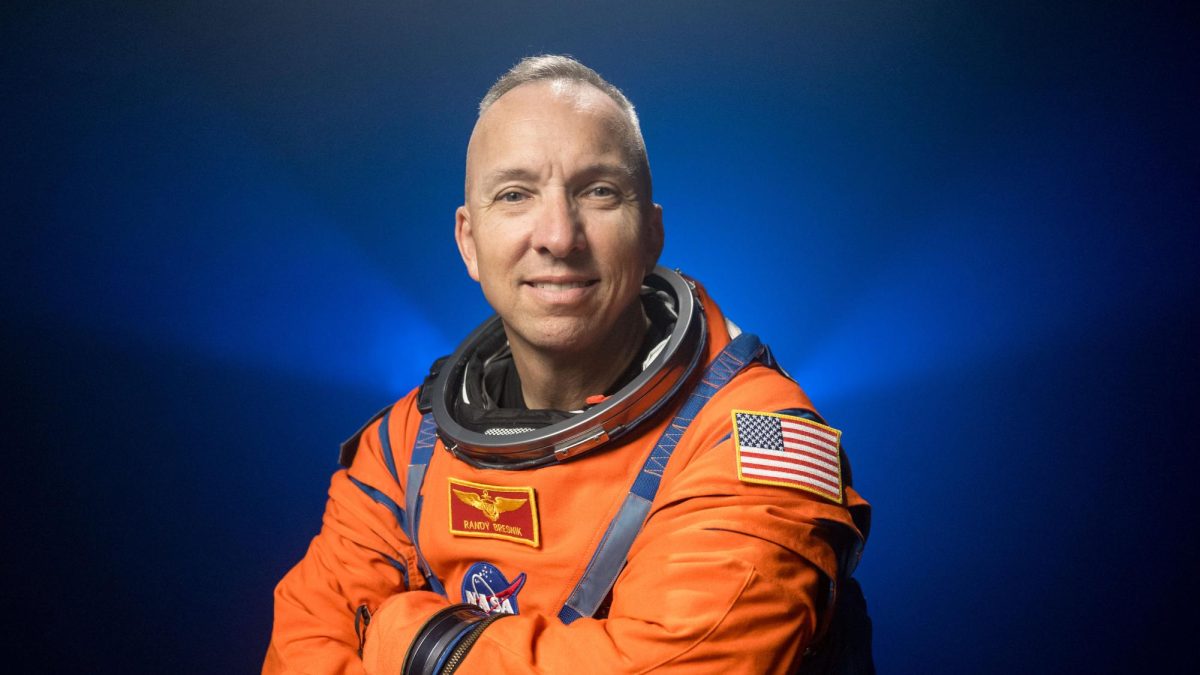
UT’s very own Randy “Komrade” Bresnik was selected as the Artemis III mission Commander.
Prior to Bresnik’s career as an astronaut, he was in the U.S. military where he became an F/A-18 test pilot. He has logged more than 7,000 hours in 95 different aircrafts along with 3,600 additional hours in a spacecraft.
He was selected as an astronaut back in 2004 and served two missions on the STS 129 and ISS Expedition 52/53 space missions. Here he’s completed a total of five spacewalks, as well as a total of 32 hours in the vacuum of space.
Bresnik graduated from the University of Tennessee back in 2002 with a master’s in aviation systems.
The UT Space Institute (UTSI) is a part of the Tickle College of Engineering on a satellite campus in Tullahoma. This program is a graduate institution research unit where students have the opportunity to get hands-on experience with their degree.
Graduates may enter careers such as lead engineering and science, military or may go on the path to become an astronaut. UTSI has seen a total of 12 students be selected as astronauts for NASA. Executive director of the UT Space Institute and Associate Dean of the Tickle College of Engineering, John Schmisseur, went into detail about the goals of the aerospace program.
“I think a key thing that we do to prepare students is give them the essential graduate training along the way,” Schmisseur said. “Almost all of our astronauts come from a military pilot background and require a master’s degree to move forward in the ranks. We help them by giving them the ability to get a relevant master’s degree in either aviation systems or aerospace science that is beneficial to their professional development.”
One of UTSI’s graduates Sam Dougherty has made a career at NASA’s Marshall Space Flight Center. He currently serves as the propulsion alternate discipline lead engineer for the Artemis program’s space launch system. Dougherty goes into more detail about the progress on the Artemis III mission.
“The New Glenn Blue Origin lander had an explosion a couple weeks ago. So we are in the process of rebuilding, recovery or maybe choosing a different vehicle,” Dougherty said. “Hopefully both of them will go as planned in 2027. If one of them is not, we will complete Artemis III anyways with just one that is able to do the mission.”
Artemis III plans to launch in mid-2027 and their goals are similar to the Apollo IX mission. The crew of Artemis III will fly in low earth orbit, testing docking of the human landing systems. Those systems include the Blue Origin and SpaceX landers. This mission is the gateway to landing humans on the moon again.
“We are not going to the moon with Artemis III,” Dougherty said. “We will with Artemis IV and V but it’s after we have proven the systems and everything is okay.”
Bresnik will fly alongside European Space Agency pilot Luca Parmitano, and NASA mission specialists Frank Rubio and Andre Douglas.
“We are very proud of him from the University of Tennessee as our graduate,” Dougherty said. “I know the program that they went through and what their degree was. I took some of the same courses myself at UTSI.”