Although dirt serves as an antidepressant and can strengthen the immune system, college students rarely have an opportunity to get into contact with it. UT’s Grow Lab offers a unique chance to get anyone who is connected to the university outside and playing with dirt, all while learning.
“We want to get everyone involved in nature,” Samantha Daulton, Grow Lab coordinator, said. She studied environmental policy at Loyola University and officially took over the Grow Lab in January 2024.
Currently nestled between a few frat houses and the Early Learning Center located on Lake Avenue, the Grow Lab is a pleasant getaway from the bustle of campus.
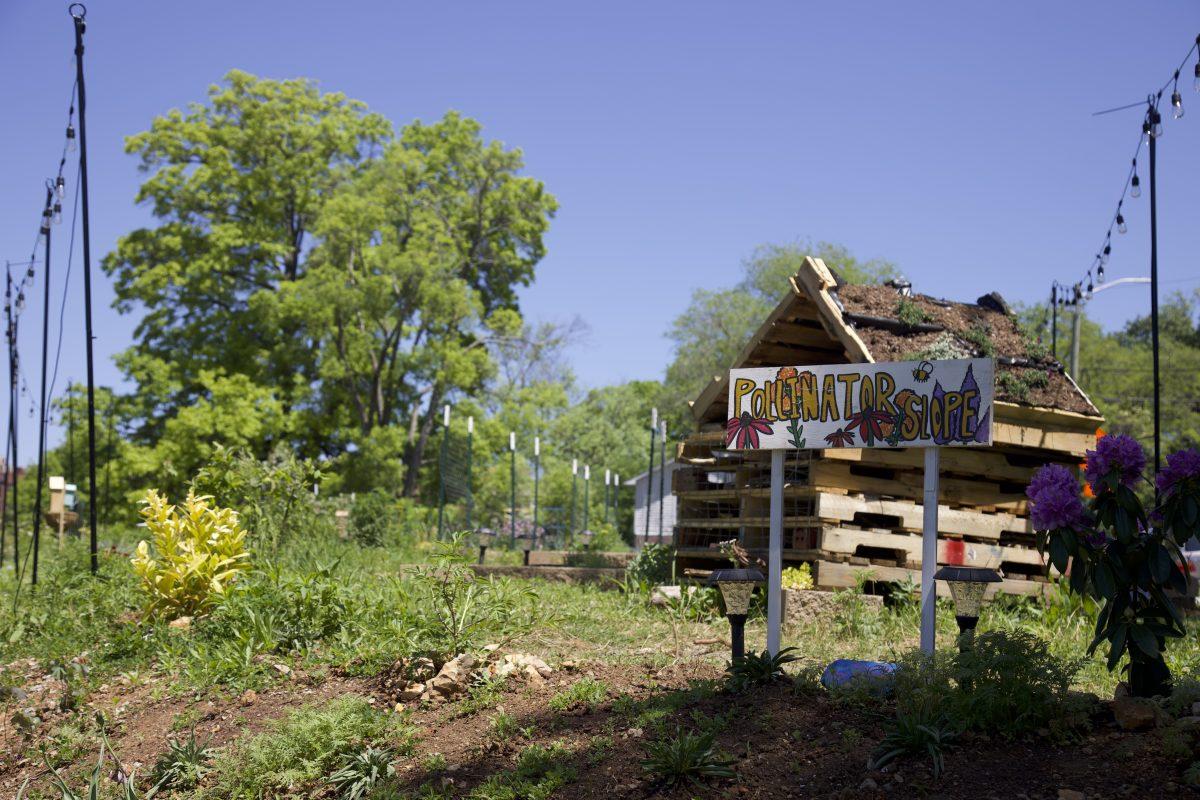
Upbeat music quietly resonates from a small speaker nestled into the grass. Twenty-two raised gardening beds host collections of various plants or soil. Small trees in the beginning stages of growth pepper the bottom of the slope, while at the very top, four concrete blocks have been painted to say, “Growing a greener UTK.”
Daulton said the Grow Lab was designed to be a living laboratory. Her job includes a variety of duties, including outreach, event planning and experimental planting.
“Part of the whole laboratory part of it is, even if I’m just growing strawberries, I’m gonna try to grow six different kinds of strawberries because we don’t know what strawberries are gonna do best here,” Daulton said.
She takes into account the East Tennessee climate as well as the microclimate of urban university life. Constant nearby construction and the rising wind speeds keep her constantly aware of outside factors.
Although the Grow Lab is supportive of all pollinators, there can be challenges with what many would label “pests.” Daulton hesitates to label anything interacting with the Grow Lab as a pest, but she is quick to control their impact. If rabbits begin to harm the plants, she might fence the crops but wouldn’t act against them in any way.
The lab is also situated on a steep hillside that poses its own problems.
Originally, the lab’s location was a private residence that was eventually torn down, but the old building materials weren’t fully cleared. Now, as volunteers work to clear the rocky hillside, they often come across concrete blocks, blinds and even door frames.
The slope is also littered with invasive plants that volunteers are working to remove.
“It’s been a lot of literal blood, sweat and tears,” Daulton said, explaining that invasives taking up root on the slope — like tree of heaven — can serve to attract even more invasives, like the spotted lantern fly.
“As soon as you notice one, they’re everywhere,” Daulton said. “Tennessee is officially under lantern fly watch, meaning we absolutely need to get rid of tree of heaven before they show up on our campus.”
The Grow Lab donates all of its produce to the Big Orange Pantry where it is immediately accessible to students, faculty and staff.
Giuliana Castillo was the last student garden manager for the Grow Lab. She oversaw multiple beds and worked to cultivate plants throughout the seasons. Castillo said during the summer she would harvest almost every single day, and donating to the Big Orange Pantry was a highlight.
The Grow Lab was a valuable experience for Castillo’s senior year as she worked to finish a degree in economics with a minor in plant science.
“I loved it. It was the best job because I just got to have my own little garden,” Castillo said. “I hope that (the Grow Lab) gets more awareness. I think it’s a great space. … I think Sam is doing a great job.”
The Native American Student Association also plays a part in the Grow Lab, and their beds are always the most successful, according to Daulton. Led by associate professor Lisa King, members of NASA cultivate beds of native plants.
“My favorite part of the Grow Lab is that it’s a way to put knowledge into practice, and it’s such a flexible space that we can work there as we can (as opposed to getting locked out of buildings or struggling to find a room to meet in),” King said.
This next season, plans are being made to include Native languages through signs naming different plants.
“It’s another way of knowledge sharing between NASA members and also anyone else who visits the garden,” King said.
The Grow Lab harvests include a variety of produce, including spinach, beets, peppers, basil, okra and tomatoes. The new postage stamp orchard — which just refers to its small size — supports over 13 native trees, including persimmon and apple. Native plants will have far more success because they are meant for that environment.
Daulton has big plans for the Grow Lab. She works to get the wider Knoxville community involved through events like Pollinator Parties, and she hopes to gain approval for the Grow Lab as a master gardener site. With the approval, anyone pursuing or maintaining certification as a master gardener could spend their volunteer hours in the lab.
Daulton’s enthusiasm and love for the Grow Lab is evident.
“It’s really nice because it feels like it gives a common ground for groups that don’t normally interact. … And it’s a common ground about plants,” Daulton said. “Like, we all eat, we all need things from the ground, so it’s a really nice equalizer.”