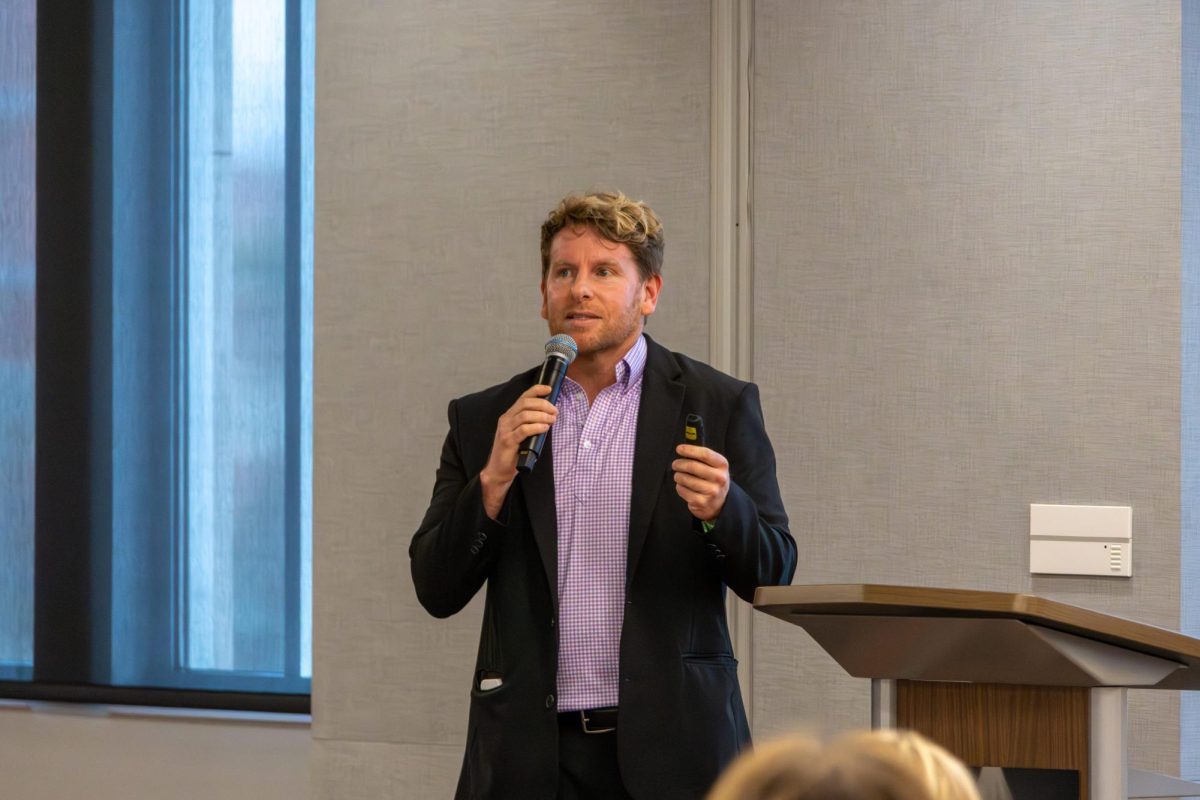
Known for humorous social media skits, assistant professor of advertising Matthew Pittman doesn’t usually cover heavy topics.
But his latest work is contributing to a research initiative that could help survivors of human trafficking rebuild their lives.
Every year, approximately 27.6 million people worldwide are human-trafficked, many for forced labor or sex. While many states allow survivors to vacate, expunge or seal criminal records tied to their exploitation, there are limits on what can be sealed.
In many cases, survivors are only allowed to expunge prostitution and drug charges, failing to account for other offenses they were forced to commit. This often prevents survivors from successfully rebuilding their lives.
“If I would’ve seen someone that had a prostitution charge or a drug possession charge, and I owned a small business like a bakery, I’m not gonna hire her. She’s a criminal. But a lot of these women were put in a bad situation,” Pittman said.
That’s why Pittman, alongside his sister, Margaret “Meg” Kelsey, formed a partnership between Regent University School of Law’s Center for Global Justice and UT’s Tombras School of Advertising and Public Relations.
Pittman and Kelsey, a clinical professor and director of the center, have received a $25,000 grant by the Sociological Initiatives Foundation to conduct a two-year research study to gather data about human trafficking cases and how they are treated in the criminal justice system.
The study will include two surveys — the first for survivors, asking about their experiences with the criminal justice system, including whether they were arrested, convicted, identified or supported during their interactions.
The second survey will be distributed to the general public to gauge their perception about human trafficking. By combining these survey results, they will move beyond anecdotes to provide lawmakers with the empirical data necessary to push legislative reform.
While Kelsey’s expertise and experience allows her to handle the legal side, she reached out to Pittman to utilize his skills in survey science and data analytics to help turn personal stories into data, which they hope will help challenge narrow ideas about what human trafficking is.
They aim to advocate for lawmakers in Washington, D.C., and Virginia to pass legislation making it easier to expunge records.
“We were using the Virginia law and realized it was much too narrow. And when we were going to lawmakers to try and explain why the law needed to be expanded, we had individual stories, but anecdotes really only get you so far,” Kelsey said. “One-off stories or even a dozen stories isn’t really enough to convince them that this is happening at scale, and so I realized we needed better data to get better laws passed.”
This grant research comes at a pivotal moment — Virginia, where Pittman and Kelsey grew up, signed a new law expanding “vacatur,” the legal process that allows survivors to have certain crimes removed from their records.
Despite the recent win, many laws remain narrow. Kelsey, who worked as a criminal prosecutor before being named director, believes that the narrowness is due to the struggle of recognizing instances of trafficking.
“It’s really hard to get data when everything is so hidden and survivors or people who are being exploited often don’t identify themselves as victims of human trafficking,” Kelsey said. “They don’t know that what’s happening to them counts as trafficking.”