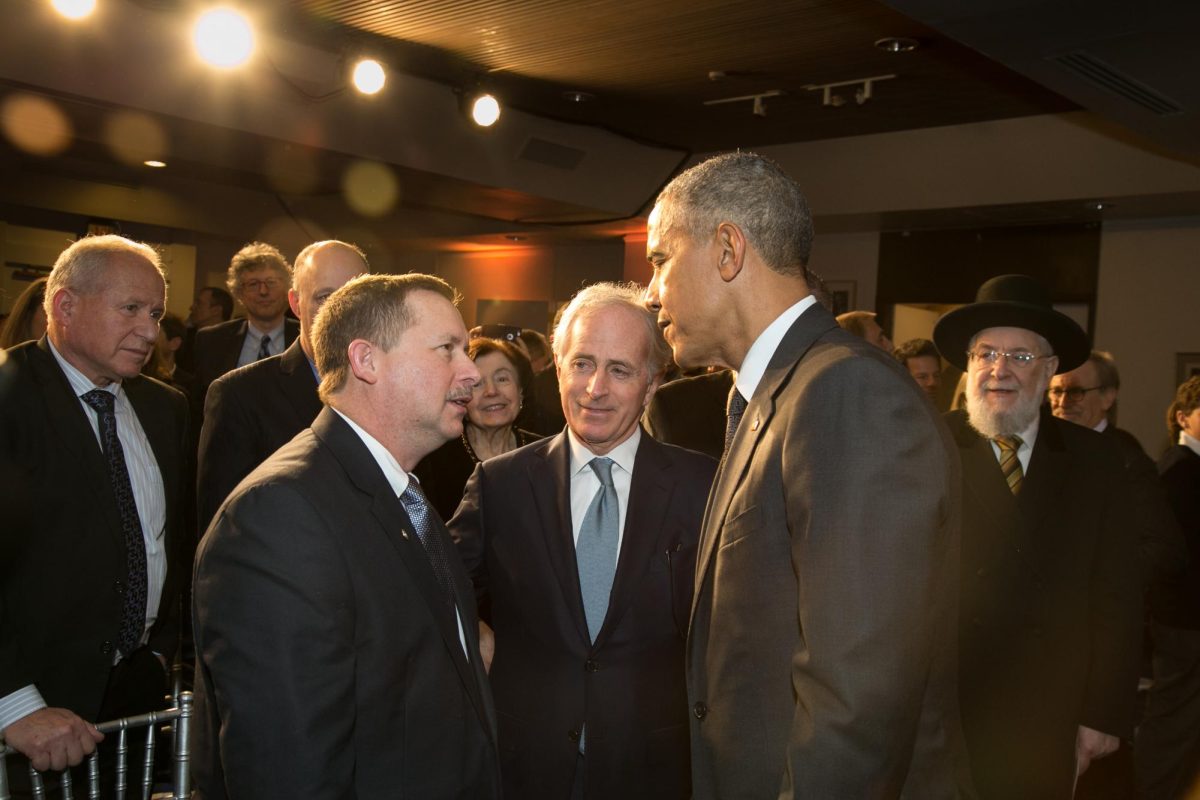
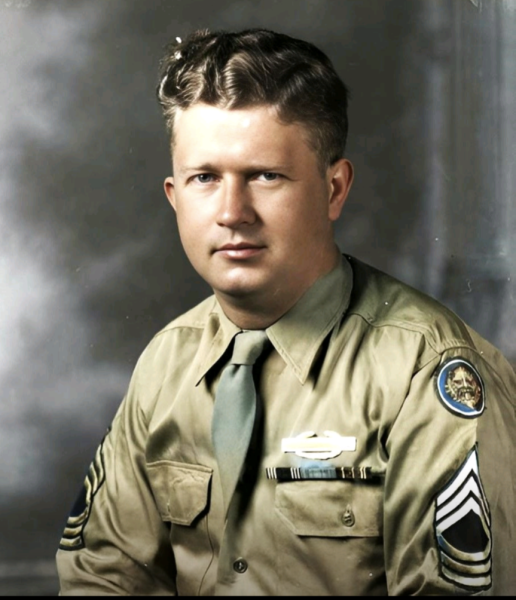
Lifelong Knoxvillian Roddie Edmonds was awarded the Medal of Honor at a White House ceremony in March.
For his actions during the Second World War, Master Sgt. Edmonds became the most recent in a long list of East Tennesseans stretching back over 100 years to receive the Medal of Honor — America’s highest military award.
“We’re grateful for Dad, but he was just a good ol’ East Tennessee boy,” Chris Edmonds said of his father, Roddie Edmonds. “He had moral clarity and moral courage. You know, he loved the good Lord, and he followed the good book.”
Roddie Edmonds grew up just across the Tennessee River from the University of Tennessee campus on Redwine Street, a location from which he could often smell the scent of fresh baked bread from Kern’s Bakery or hear the whistles and shouts of coach Robert Neyland’s legendary football teams practicing at Shields-Watkins Field.
Roddie Edmonds passed away in 1985, but his legacy and moral code have lived on through his son, as well as the men who served with him.
Through the work of Chris Edmonds and other friends like Staff Sgt. Lester Tanner, Roddie Edmonds received the recognition of the Medal of Honor — a process that lasted nearly 13 years. Standard procedure calls for the award recommendation to be submitted within three years of the relevant action. Outside of this window, a special act of Congress is required, which further complicates the already strenuous process.
Former President Abraham Lincoln established the Medal of Honor in July 1862 and first awarded it to a group of Union soldiers who escaped from captivity in Chattanooga after taking part in the Great Locomotive Chase.
The criteria to be a Medal of Honor recipient is someone who “distinguishes himself conspicuously by gallantry and intrepidity at the risk of his life above and beyond the call of duty.” Since 1862, it has been awarded to just 3,552 out of the millions who have served in the United States Armed Forces.
For those who were there with Roddie Edmonds on the frigid morning of Jan. 27, 1945, the criteria were most certainly met. Chris Edmonds retold his father’s story, using friends’ accounts and his own recollection of Roddie Edmonds’ tales.
Germany had been captured during the German winter offensive known colloquially as the Battle of the Bulge in December 1944, and Roddie Edmonds found himself incarcerated at the Stalag IXA prisoner-of-war camp in Ziegenhain.
“Late on the evening of Jan. 26, the Germans sent orders to my father that only the Jewish Americans were to report for the next morning’s roll call,” Chris Edmonds said. “Just the Jews, no one else. All who disobeyed would be shot, were the orders.”
Roddie Edmonds found the proposition unacceptable.
“Without hesitation, (Roddie Edmonds) turned to all of us men and said, ‘We’re not doing that. Tomorrow morning, we all fall out.’ He said he sent orders to the other four barracks of Americans,” Chris Edmonds said, recounting Tanner’s account.
The next morning, Maj. Ziegmund, a German officer who had arrived at the camp to acquire the Jewish prisoners, met with the whole American contingent of 1,300 soldiers. He stood there, incredulous.
“He’s issued the orders, he’s there to take the Jews away like he has been doing in the other POW camps, and no one has ever disobeyed his orders, and so he’s … he’s irate,” Chris Edmonds said. “So, Ziegmund walks over to my father, gets up in his face, and he screams, ‘They can’t all be Jews.’ To which my father declared, ‘We are all Jews here.’”
Roddie Edmonds’ act of defiance stunned the major and the men. He continued to resist, offering only his name, rank and serial number, items required under the Geneva Conventions.
This further enraged the German officer, who snapped and thrust his pistol into Roddie Edmonds’ forehead with his finger on the trigger.
“‘But even with the gun to his head,’ (Tanner) said, ‘Your father leaned into the major, ensured eye contact, and he, and he spoke,’” Chris Edmonds said. “He said, ‘Major, you can shoot me, but you’ll have to kill all of us, because you’ll be a war criminal when we win this war, and you will pay.’”
Maj. Ziegmund turned white as a ghost upon hearing this, and the arm holding the gun to Roddie Edmonds’ head began to quiver ever so slightly.
“(Tanner) said (they) didn’t know what was going to happen, just, it just seemed like time froze, and there was no movement, no sounds, nothing. He said just the smoke-like puffs of breath, frozen breath rising toward heaven. And (Tanner) said … ‘I’m sure everybody that saw what was happening was praying,’” Chris Edmonds said.
The major suddenly took his finger off of the trigger, slammed the pistol back into his holster and left. The gathered American POWs soon returned to their barracks where they hailed Roddie Edmonds as a hero.
But the ordeal did not end there. Two long months enduring the horrors of a prisoner-of-war camp in a collapsing Third Reich stood between them and liberation.
“They survived another two months starving to death. They lose a pound a day, on average. Most of those men will lose 80 to 100 pounds,” Chris Edmonds said.
Tanner credits their survival over the ensuing two months to Roddie Edmonds’ leadership. During the process of their capture, he had managed to sneak a Bible into the camp, which members of every religious group — from Catholics to Jews — used as part of their religious services.
“It was just really a source of strength for us, and they said there was … in the camp, there were ‘down guys.’ We call them ‘down guys’ because they just didn’t care if they lived or not, and they just wanted to die,” Chris Edmonds said, recollecting Tanner’s account. “And then there were those like me who were ‘up guys.’ (Roddie Edmonds) pulled all the ‘up guys’ together one day and said, ‘Hey, you guys, you guys want to live, right? …OK, well, you gotta go find one of these guys that are down and your job now is to make sure they survive.’”
As the American forces under Gen. George Patton drew nearer to the camp, the sounds of war could be heard in the distance. The hour of liberation seemed imminent.
“The Germans were getting really nervous, so they issued orders again,” Chris Edmonds said.
The Germans were ready to move out and leave camp.
By this time, there were dozens of men in the camp suffering from serious illness and malnutrition. Many could not even get out of bed to stand at roll call, let alone be marched deeper into Germany. In order to sell the state of his men even further, Roddie Edmonds instructed those who were willing to eat dirt, grass and anything else that could make them more obviously sick to get the Germans to give up.
“They just refused to go, and the Germans were irate,” Chris Edmonds said, “They marched all the other nationalities out — the British, the French, the Russians, the Serbs — they all marched them out, but the Americans stayed in the camp.”
The next day, American troops from the Sixth Armored Division arrived at the camp.
“Patton’s army came in, but they actually self-liberated themselves,” Chris Edmonds said. “And (Tanner) said, ‘We sent the Nazis packing.’”
Chris Edmonds credits his father’s bravery to his strong faith and moral code. Lester said that even back then, Roddie Edmonds held his convictions so deeply that they called it “Roddie’s Code.”
After his military service, Roddie Edmonds returned to Knoxville and lived a quiet life with few, if any, aware of his heroic exploits in the face of Nazi brutality. Chris Edmonds believes that his father would not have had it any other way. Roddie Edmonds believed that he had served God the way he had been called to and would not have cared for the praise and fanfare that accompanies the Medal of Honor.
In addition to the Medal of Honor, Roddie Edmonds is one of just five Americans who have been named Righteous Among the Nations by Yad Vashem, the World Holocaust Remembrance in Israel. It is estimated that there are 22,000 descendants of the Jewish soldiers who were protected by Roddie Edmonds’ heroism in Stalag IXA that cold January morning.
Chris Edmonds, who is a class of 1981 University of Tennessee graduate, is the interim pastor at Oakwood Baptist Church in Fountain City, runs the non-profit Roddie’s Code and wrote the book “No Surrender,” through which he recounts his father’s actions and promotes his legacy of faith and selfless service to others.