‘Undermined the mission’
According to UT Faculty Senate Faculty Affairs Committee Co-Chairs John Butler and Eva Cowell, sections 3.12.3.2 and 3.12.3.4 of the Faculty Handbook have been bypassed by UT administration in the proceedings against anthropology professor Tamar Shirinian, and the university is now invoking the Expedited Procedure as written in 3.12.3.8.
Who’s calling the shots
Chief Academic Officer and UT Provost John Zomchick did not invoke this procedure. Instead, Chancellor Donde Plowman did.
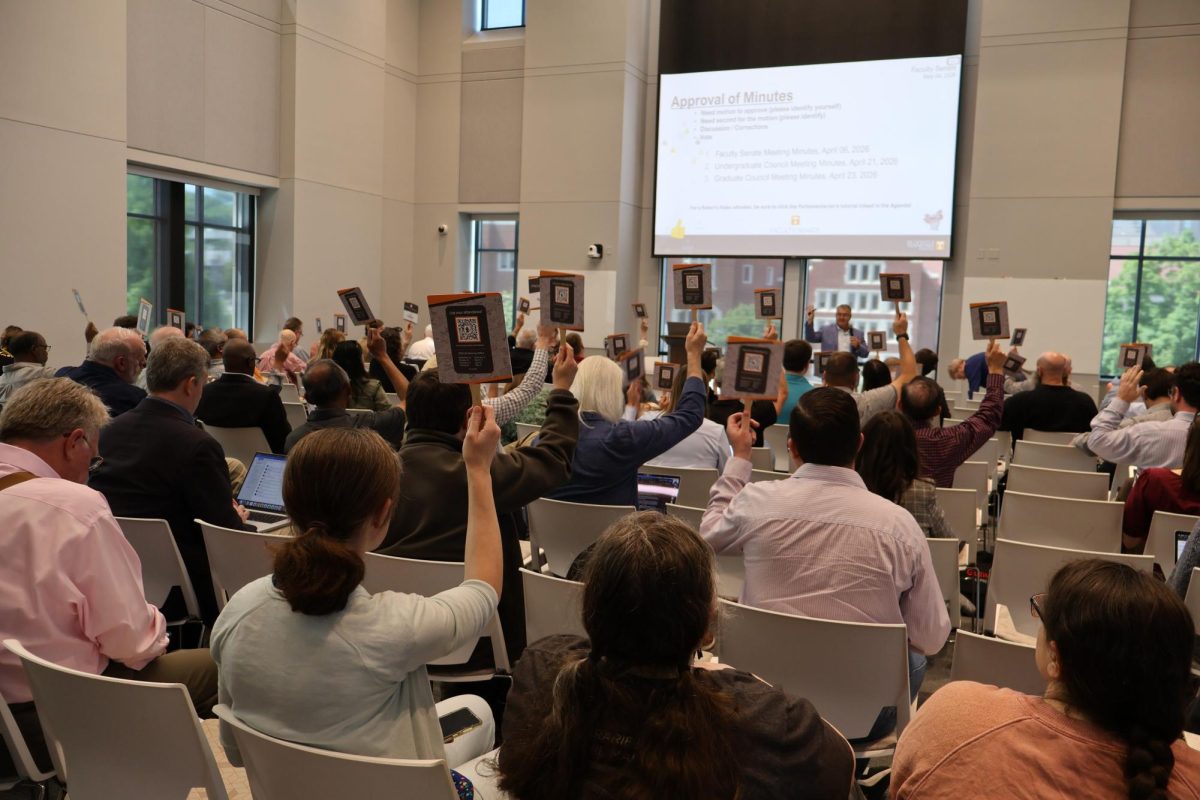
In an academic freedom discussion on Oct. 16, Zomchick responded to faculty questions and expounded on the chancellor’s actions.
“You’re absolutely right that the policy for expedited termination — the policy for any termination — says that the chief academic officer has a role to play,” Zomchick said. “In this case, the chancellor took on that role.”
Zomchick said he could not cite a policy allowing Plowman to do so.
Termination pursued
Plowman provided faculty with three reasons why termination proceedings were initiated in a Faculty Senate meeting Sept. 22. Certain cases of alleged misconduct are outlined in 3.12.3.8.
“In my view, the faculty member, one, violated the university’s expectations for civil and professional engagement, and respectful conduct.
“The faculty member undermined the mission and the focus of the university through her misconduct.
“And number three, harmed the reputation of the university. Our reputation is something we have built over the years, and I’m the steward — as are all of you, I would say — of that reputation. Our brand, our reputation as a land-grant university is something that we take seriously, and I thought that action actually harmed the reputation of the university considerably.”
Communication with Shirinian
In her letter to Shirinian outlining the grounds for termination, Plowman cited BT0006, Article 1. Plowman also included part of BT0006, Article 2, writing, “The administration is responsible for enforcing all Board and campus policies applicable to faculty members. It is the duty of the administration … to remove from the faculty any faculty member who has been found, through proper procedures, seriously derelict in his or her responsibilities as a member of the academic community.”
The ellipsis replaces a line in the handbook listing which administrative officers can initiate the process.
Related policies, Faculty Handbook
As outlined in a memorandum written by Butler and Cowell, “The University is pursuing the termination of Tamar Shirinian under Faculty Handbook section 3.12.3 (Termination Procedures for Misconduct).” The university may terminate a tenured or tenure-track faculty member “for misconduct within the definition of Adequate Cause” under Faculty Handbook policy 3.12.3. The process for termination for misconduct includes 3.12.3.3, 3.12.3.4 and a final decision by the chief academic officer (3.12.3.5), or these policies can be bypassed via expedited termination (3.12.3.8).
The following are excerpts from UTK’s Faculty Handbook, effective Sept. 8, 2025, section 3.12: Procedures for Terminating Tenured Faculty. Read the full handbook here.
3.12.3.2 Consultation with the tenured faculty
The department head shall consult with the departmental tenured faculty before making a recommendation regarding whether a faculty member’s alleged misconduct constitutes Adequate Cause for termination.
3.12.3.4 Dean’s recommendation
If the dean concludes that a faculty member’s alleged misconduct constitutes Adequate Cause for termination, he or she shall forward a written recommendation and the reasoning supporting the recommendation to the chief academic officer.
3.12.3.8 Expedited Procedure for Termination or Suspension without Pay in Certain Cases of Misconduct
In the following cases of alleged misconduct by a faculty member, the chief academic officer, after consulting with the chancellor, the president, and the President of the faculty senate or the Faculty Senate Executive Committee (or campus equivalent), may invoke an expedited procedure to accomplish termination or suspension without pay, with comprehensive due process procedures to be offered after termination or suspension without pay:
A. alleged misconduct involving:
1. acts or credible threats of harm to a person or university property; or
2.theft or misappropriation of university funds, property, services, or other resources
The following are excerpts from the UT System Policies, under the Board of Trustees and Human Resources categories. Read the full policies here.
BT0006 Article I: Academic Freedom and Responsibility of the Faculty Member
When, as a citizen, a faculty member speaks outside the classroom or writes for publication, he or she should be free, as a citizen, to express his or her opinions. Each faculty member should conduct himself or herself professionally, should be accurate, should exercise appropriate restraint, should show respect for the opinions of others, and should make clear that he or she speaks for himself or herself and not for the University.
BT0006 Article II: Academic Freedom and Responsibility of the University Administration
The administration is responsible for enforcing all Board and campus policies
applicable to faculty members. It is the duty of the administration — beginning with department heads, deans, and chief academic officers — to remove from the faculty any faculty member who has been found, through proper procedures, seriously
derelict in his or her responsibilities as a member of the academic community.
Board of Trustees policy HR0580 states that “discriminatory, abusive, insulting, or offensive language, including threats, derogatory remarks, epithets, sexually explicit jokes, or jokes that demonstrate insensitivity to a particular group” may violate the Code of Conduct. This includes “abusive or irresponsible behavior on social media that violates any provision of this Code of Conduct.”
Read more:
Faculty affairs committee memorandum addresses university dealings with Tamar Shirinian
Faculty panel answers legal questions regarding academic freedom, university terminations
Provost Zomchick responds candidly to faculty concerns about Shirinian’s termination
Controversial instructor incidents: A look back through the years
UT professor terminated over Kirk comment apologizes, appeals to chancellor
Faculty raise concerns over free speech, academic liberty to Provost John Zomchick