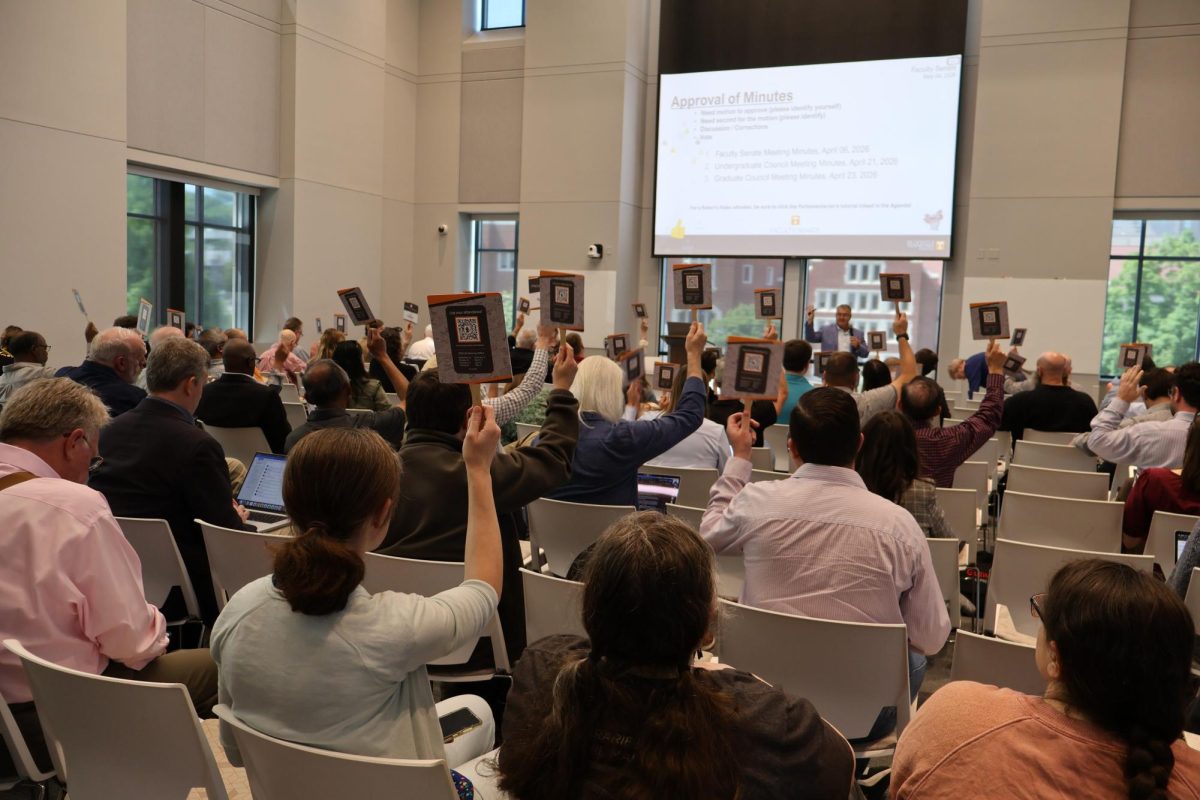
Faculty members met with Provost and Senior Vice Chancellor John Zomchick on Thursday, Sept. 25, over concerns of faculty free speech and recent termination proceedings that have begun against assistant professor Tamar Shirinian.
Organizers of the Coffee and Conversation event scheduled it in advance for a secluded room, tucked down a long, windowless hallway on the third floor of the Student Union building.
Sept. 14, Shirinian made a comment online about Charlie Kirk’s assassination.
“The world is better off without him in it,” Shirinian said.
In an email from the Office of the Chancellor Sept. 15, Donde Plowman wrote that the university was taking action against Shirinian for “endorsing violence and murder on social media.”
The administration’s decision to terminate Shirinian prompted backlash from some faculty at UT.
As professors left the meeting with Zomchick, the Beacon asked them why they were in attendance and what their primary concerns were. While many faculty members declined to speak, citing uneasiness or potential backlash, a few did leave comments on the record.
“Here’s a case where someone was clearly acting as a private citizen, and they’re blurring the lines here by saying that’s actionable for termination. Which means we don’t have private lives. So that’s a big concern,” Elizabeth Cooper, a professor in the Department of Psychology and Neuroscience, said.
Cooper sees the termination as an infringement on faculty’s right to express their own opinions.
“Between what we say in the privacy of our own time, in our own forums, versus our responsibilities as faculty, those should be separate. They’re terminating someone for being a private citizen and that’s a problem,” Cooper said.
Martin Griffin, a professor of literature and culture at the Department of English, echoed similar concerns as Cooper.
“The essence of free speech rights is really that you don’t have to like the speech that was expressed,” Griffin said. “First amendment rights would mean nothing if it were only speech we actually approve of. That’s an issue I think the university needs to address.”
Griffin identified actions that he views as troubling regarding academic protections for faculty.
“I’m very concerned about a tendency to start policing faculty members, syllabi and what happens in the classroom, which we’ve been told, even now, is protected,” Griffin said. “But we’ve had some incidents in which there have been rumors about a professor saying something in the classroom which has triggered an administrative action. And that’s something we haven’t really faced before.”
Laurie Knox, a retired lecturer in the English Department, saw the firing of Shirinian as detrimental to the university’s mission.
“The long term reputation of the university as a place that upholds free speech, and upholds faculty members’ rights to act in their private lives as citizens, has been harmed in this case,” Knox said.
Knox blamed political pressure on UT System President Randy Boyd for the university’s quick and steadfast handling of Shirinian’s termination.
“I would guess that the Chancellor deep inside regrets her decision, and she acted in the moment based on her concern about UT’s brand, and I think there’s a big difference between the University’s brand and its long-term reputation as a center for higher education,” Knox said.
Anne Langendorfer, an associate professor in the English Department now wonders if courts would find Shirinian protected from termination or not.
“The question is, at least right now, will the courts uphold the right of faculty to free speech on their own time when they’re not being paid?” Langendorfer said. “When do you get to speak freely as a person? When are you on the clock, when are you off the clock? Is there such a thing as a clock?”
While many members of the faculty confronted Zomchick today with pressing concerns about academic freedom and the rights to self expression, the conversation — and potential legal process — are far from over. Some hope to see a reversal of the administration’s decision and renewed protections for faculty.
“The administration is holding us accountable for being respectful of, I believe, the brand, and I would like to hold them accountable for upholding the long term principles of academic freedom and freedom of speech,” Knox said. “That will matter the most in the long run.”
Provost Zomchick commented, saying, “I am grateful for the constructive dialogue on Thursday with faculty, who thoughtfully shared their concerns on questions about faculty rights and responsibilities. I host Coffee and Conversation with our faculty several times a semester to hear from them regarding any issues they would like to discuss. I look forward to continuing dialogue around issues of importance to the campus.”