“I don’t think that we can take academic freedom for granted,” UT Provost John Zomchick said in a discussion of academic freedom with College of Arts and Sciences faculty on Wednesday.
Faculty members asked Zomchick questions regarding academic freedom following recent controversy over UT assistant anthropology professor Tamar Shirinian, who faces termination for making an online comment about the assassination of Charlie Kirk.
“I know that recent events on campus have made people angry,” Zomchick said. “I know that people feel passionate about those events, and I know people are questioning the university’s commitment to defend academic freedom.”
Arts and Sciences Dean Robert Hinde and the college’s three divisional deans — Gina Owens, Beauvais Lyons and Kate Jones — accompanied Zomchick on the stage of the Student Union auditorium. The provost clarified that he could not directly discuss Shirinian’s termination because it is an ongoing personnel matter.
Some faculty members took issue with the legality of Shirinian’s termination in accordance with UT’s guidelines on termination.
“As I read the policy, you are the one who has the authority to initiate termination proceedings,” Paul Gellert, professor of sociology, said to the provost. “As I understand, what happened two weeks ago, the chancellor initiated those proceedings.”
Zomchick confirmed he carries the responsibility of initiating termination.
“You’re absolutely right that the policy for expedited termination — the policy for any termination — says that the chief academic officer has a role to play,” Zomchick said. “In this case, the chancellor took on that role.”
Gellert asked what it meant for the chancellor to take on a role that is not enumerated in the faculty handbook.
“That’s a great question,” Zomchick said, prompting laughter from the stage and the audience.
Gellert then asked the provost to cite a policy justifying Plowman’s termination action.
“I cannot,” Zomchick said. “There isn’t one.”
Gellert finally asked if the chancellor took action against Shirinian independent of Zomchick.
“I won’t comment on that,” Zomchick said in response.
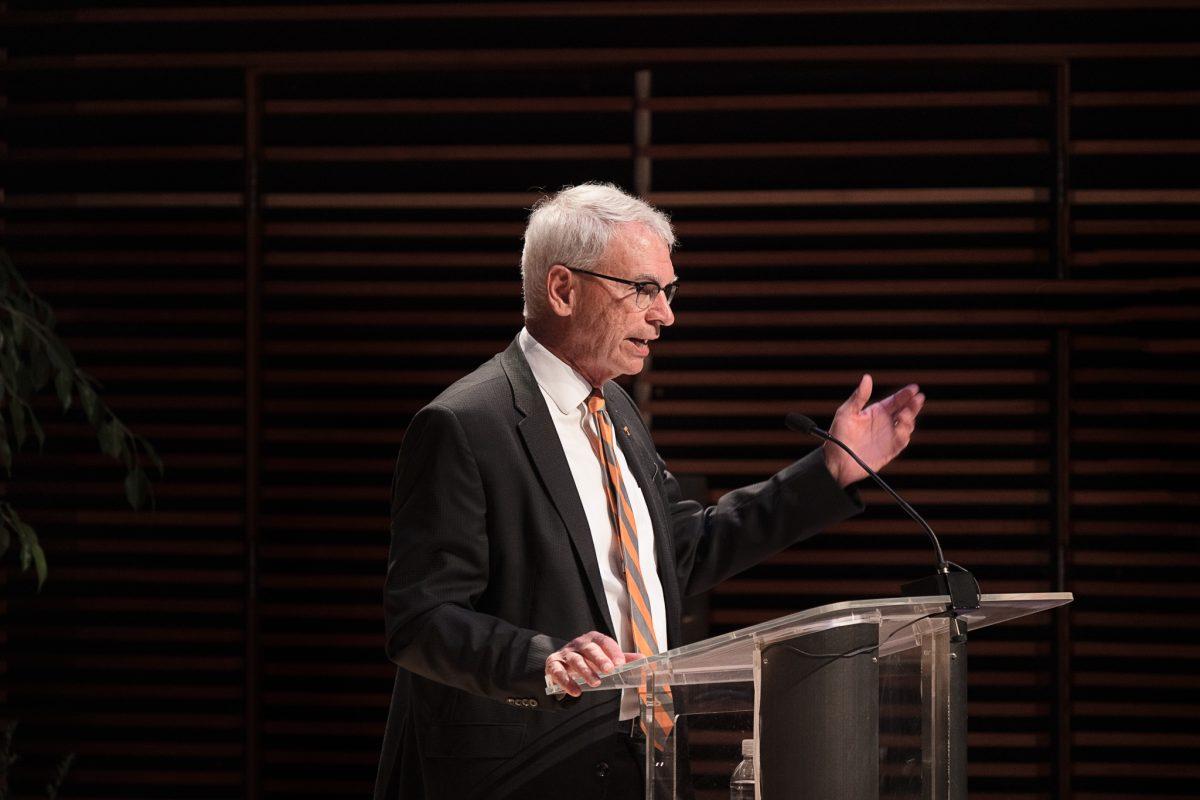
KNOXVILLE, TN - Provost John Zomchick introduces Donde Plowman preceding her Chancellor's Flagship Address in the Powell Recital Hall of Natalie L. Haslam Music Center, on Thursday Sep. 29, 2022.
The provost also said he did not have a definitive answer to whether or not Shirinian’s hearing will be public.
Other faculty members presented cases defending Shirinian’s position by referencing Tennessee’s Campus Free Speech Protection Act.
“You can’t yell ‘fire’ in a crowded theater. You can’t incite violence. Those are violations of specific federal laws,” Dylan Bloy, lecturer in classics, said. “But anything short of that is protected.”
Much of the confusion over academic freedom and free speech, faculty members said, comes from the change in the university’s distinction between acceptable and punishable speech.
“The question that young faculty are bringing to me is, ‘Where is the line?’” Jon Shefner, professor of sociology, said. “I know the line has shifted.”
Zomchick acknowledged the room for confusion.
“I agree with you. The line has shifted,” Zomchick said. “There is increased interest in what we teach and how we teach.”
Not only has the line of what speech is acceptable shifted, faculty members said, but so has the line between public and private speech on and off campus.
“It’s great to know that you have our back in the classroom,” Michael Gilchrist, associate professor of ecology and evolutionary biology, said. “But I am very concerned about you having our back in a broader sense.”
Zomchick stood behind the university’s decision, saying rising external pressures push university leadership to act in more protective ways.
“I acknowledge that you have a very strong position here, but I also acknowledge that the university is under threat from many different positions, and this is where the balancing act comes in,” Zomchick said to Gilchrist. “We are under intense scrutiny in ways that I have not experienced over the course of my career here at the University of Tennessee, and my entire career has been spent here at the University of Tennessee.”
Amid rising political temperatures, faculty members expressed their desire to see UT leadership stand up to government pressure, rather than buckle under it.
“I understand that there’s a ton of political pressure, and that the university is facing an unusual level of external pressures,” Kirstin Widner, associate professor of political science, said. “I just want to note that giving in to bullies is not the way to stop bullies from being bullies.”
Zomchick emphasized shielding UT’s reputation as a public university, echoing sentiments the chancellor conveyed at September’s faculty senate meeting. This prompted faculty to raise questions over other facets of UT’s reputation.
“What’s not being considered is the effect on the reputation of the university of caving to political pressure,” Matthew Pamental, philosophy lecturer, said. “Obviously, academic morale is also being seriously depleted here, so there’s a third reputation that’s also being tanked here, which is the reputation of the university as an employer.”
Multiple faculty members brought up the Trump Compact, which all universities now have the opportunity to sign. The compact offers universities preferential federal funding in exchange for complying with certain guidelines regarding admissions, hiring and tuition. Faculty members urged the provost to refuse the compact if it is extended to UT and asked whether or not UT leadership had discussed it.
“We have not discussed the compact,” Zomchick said. “It hasn’t come up at all.”
At the end of the discussion, Zomchick promised to relay the faculty’s concerns to Chancellor Plowman and reminded faculty that the purpose of the discussion was to share their input with UT leadership.
“The goal of the university is to protect the core mission and to protect our faculty’s rights for academic freedom,” Zomchick said.
Zomchick also noted the low faculty turnout, explaining that of around 700 faculty members invited to the event, fewer than 50 showed. Some faculty members in attendance saw the low turnout as a sign of fear.
“I do think the question is really appropriate to think about why people don’t come,” Shefner said. “I think it’s really important when the provost said he wished more of us were here that he doesn’t interpret the absence of people as, somehow, acquiescence because it’s not. It’s probably fear.”
Dawn Coleman, head of the English department, said she valued the voices of those who did attend.
“I really appreciate that my colleagues across the arts and sciences showed up with some wonderful questions — and some strong legal precedents — that call into question the legality of the chancellor’s recent decision, and I also do appreciate the provost’s reassurances that he will protect academic freedom,” Coleman said.
Zomchick and Dean Hinde declined to provide additional comment after the meeting.