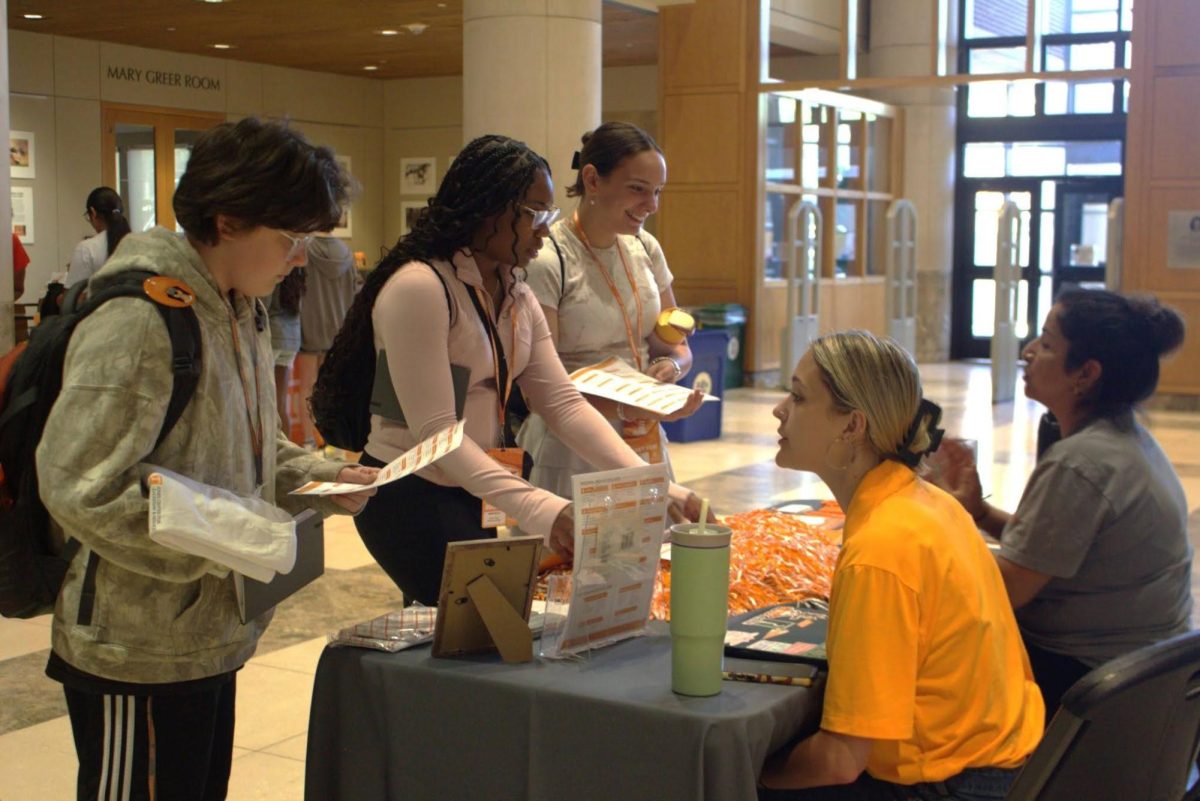
Students and faculty discussed academic freedom once again at a panel hosted by UT’s chapter of the American Association of University Professors.
The AAUP hosted the discussion as an educational opportunity for faculty to clear up confusion after the ouster of UT assistant professor Tamar Shirinian following comments she made on social media about Charlie Kirk.
“I know a lot of faculty — non-tenure track faculty, even tenure faculty like myself — who are afraid, on the one hand, definitely uncertain about where we stand with free speech laws on and off campus, and in some cases angry,” Todd Freeberg, professor of psychology and neuroscience and UT’s AAUP president, said.
The panel consisted of head of the Department of Educational Leadership and Policy Studies Robert Kelchen, Executive Director of the Baker School’s Institute of American Civics Josh Dunn and law professor William Mercer.
Each professor agreed that the shifting political climate, and differences between university policy and the administration’s actions, have led to confusion over how much freedom faculty members truly have.
“Things are changing pretty rapidly around us,” Kelchen said. “Some people, I think, realize that, and others, they’re doing their research and teaching, and they may not fully understand just what’s going on in terms of academic freedom and free speech.”
The discussion pointed to the overarching question that faculty members have been asking for the past month: Where is the line?
“That’s part of the problem, is where do you draw this line today?” Dunn said.
Not only is the line between acceptable and unacceptable speech unclear, but so is the line between what is public and what is private speech, especially when it comes to topics discussed in the classroom.
“The challenge that we face is many of us are doing work in areas that are complicated at least, and very often considered divisive,” Kelchen said. “They use words that certain individuals don’t like.”
The panelists assured the audience that discussing these divisive areas for the purpose of education is still protected under academic freedom. Where faculty should be more concerned, they said, is in private settings, where the lines are blurred, such as in Shirinian’s case.
“It’s actually the fact that it wasn’t in the classroom and not directly related to these professional duties on campus that could be the issue,” Dunn said.
Additionally, in both public and private settings, the panelists agreed that there is a certain degree of risk in exercising academic freedom and free speech at all.
“You may have free speech, you may have academic freedom,” Kelchen said. “But there’s considerable risk in using it.”
On the topic of Shirinian’s case, the panelists offered insight but expressed uncertainty over where the case would end up. On the university’s side, they said, the termination looks to be a defensive measure.
“If a university does not respond to this, they’ll be looking for new institutional leadership immediately,” Kelchen said. “It’s not exactly how it works out in the courts, but it’s what happens to institutional leadership that tends to be a little more risk-averse.”
The termination could also have been decided as a matter of finances.
“Not firing probably does have a negative financial impact because the university is likely to see retribution from the state, potential even retribution from the federal government,” Kelching said.
On Shirinian’s side, panelists said the courts could find issues with the university’s handling of due process.
“I would not be surprised to see the courts finding the due process claims the most compelling,” Dunn said. “Under due process, you should be able to know what the standard is.”
Mercer thinks universities might be initiating terminations that they don’t have the power to carry out.
“People keep asking me, ‘Well, can they do this?’ and you say, ‘Well no, but it’s still happening,’” Mercer said. “I know that’s not a satisfactory answer.”
But with current high political temperatures, faculty rights to academic freedom, freedom of speech and even certain aspects of employee contracts are up in the air, and universities might be able to carry out terminations they wouldn’t have been able to in the past.
“The concept of tenure is probably at risk more than it’s been in many decades,” Kelching said. “The price of speaking out now is higher than it has been in the past.”
Still, the panelists agreed that the First Amendment has the ability to persist.
“The First Amendment doesn’t exist for things we agree with,” Mercer said. “I mean it exists for the distasteful, and it exists for the things that you don’t like.”
Attending faculty agreed, noting the importance of coming together to talk about issues of academic freedom and free speech was important in uniting as a university.
“I really think that organizing effectively to build community, and to talk to one another, and to have open lines of communication is the way for concerned individuals to meet this moment in higher education,” Kristina Gehrman, associate professor of philosophy, said.
Students, too, attended the meeting in the interest of organizing to protect and learn about academic freedom.
“As a graduate worker who teaches at the university, I think we’re also really concerned about academic freedom and freedom of speech and how it might impact our jobs,” Beth Holden, a graduate student in sociology who attended the discussion, said. “As a graduate student in sociology, I’m also concerned about what this might mean for what I study, and what the people in my department study.”