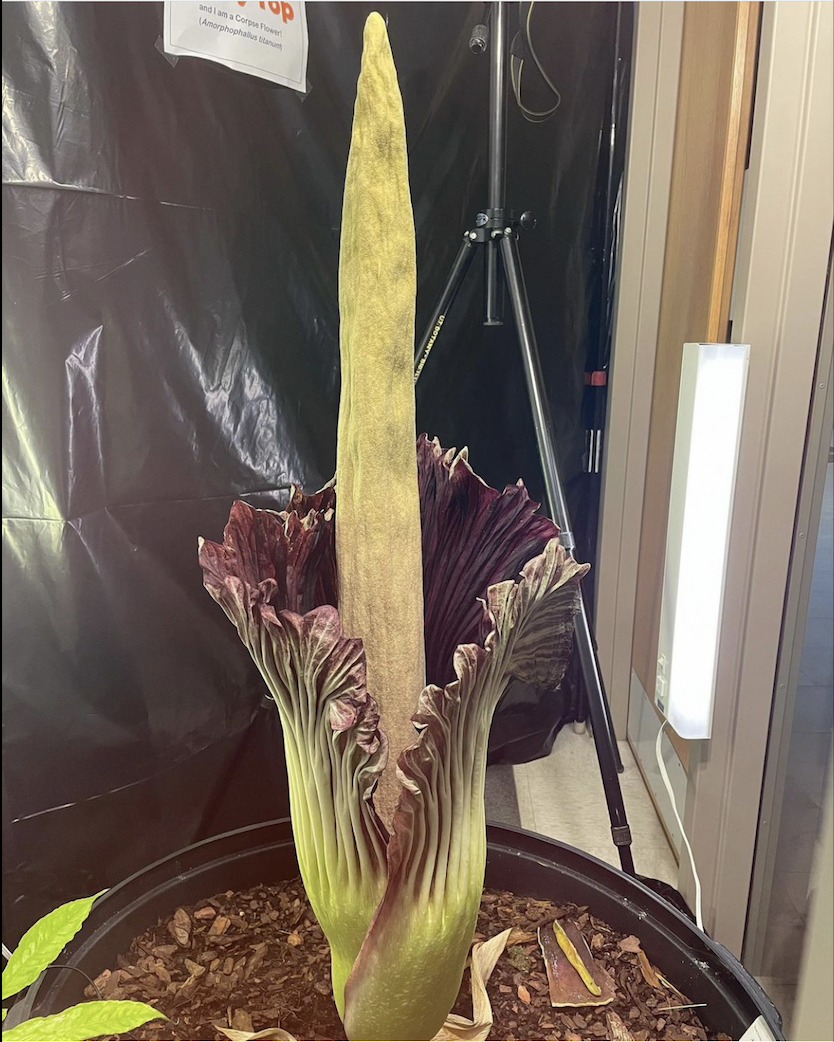
A corpse flower finally bloomed on July 29 at the Ecology and Evolutionary Biology Greenhouses at the University of Tennessee.
Located in the Hesler Biology Building, the Ecology and Evolutionary Biology Greenhouse maintains hundreds of plants on campus. They are primarily used for research, course work and experiments.
The greenhouse obtained a corpse flower in 1999 from the University of Connecticut. They received the corm, which is the underground stem of the flower. The greenhouse manager Jeff Martin has cared for it since he took over the position in 2016.
The greenhouse called the flower “Rotty Top,” but there are several aspects to its scientific name. Assistant greenhouse manager Kaitlin Palla talked about the corpse flower and its name.
“They are often referred to as ‘Titan Arum’ due to their giant size, getting much larger than other plants in the arum family (Araceae),” Palla said. “The blooms actually get their descriptive name from Indonesians, who call it ‘Bunga Bangkai,’ which translates to ‘Corpse Flower.’ The scientific name of the plant is Amorphophallus titanum, which comes from the Greek words amorphous (meaning ‘without form’), phallos (meaning ‘penis’), and titan (meaning ‘giant’).”
The corpse flower naturally grows in Sumatra, Indonesia, which Martin described as a “high humidity and high temperature” environment. Normally, the flower can grow as tall as ten to twelve feet, but UT’s flower only grew three and a half feet tall. However, they are the “largest unbranched inflorescence” flower in the world, which means they are “made up of many smaller, individual” male and female flowers according to Palla. These flowers also don’t open at the same time, which Martin said might be to reduce the chance of self-pollination.
“They are listed as endangered by the International Union for Conservation of Nature, with fewer than 1,000 individuals estimated remaining in the wild,” Palla said. “This decline is largely due to habitat loss, climate change and poaching.”
The greenhouse employed several methods to replicate the flower’s habitat, including blackout sheets, heating pads and humidifiers. Every 18 months, they repotted the flower to accommodate for its growth based on the measurements at the time.
The flower has two main cycles that it goes through. The leaf cycle happens first and occurs several times over many years. The flower grows a large leaf to photosynthesize and store up energy for 8 to 10 months. It repeats this until it is ready to bloom, switching to its flower cycle. Usually, this cycle starts when the plant is 7 to 10 years old, with an opportunity to re-bloom after seven years. Palla breaks down what occurs during the flower cycle.
“In the first phase of bloom, the female flowers mature and are receptive to pollen,” Palla said. “During this stage, the skirt-like spathe opens up, revealing its dark maroon color. This meaty hue is favored by beetles and flies, which are also being attracted by the smell of carrion. This odor is given off by the central spadix column, which heats up to 98 degrees Fahrenheit to blast the scent molecules into the air – pollinators can smell a corpse flower’s bloom up to an acre away! They will be drawn into the open vase-like structure of the inflorescence and bop around the ring of female flowers located at the base, depositing pollen on them. If fertilized successfully, these female flowers will develop into bright red fruit.”
“In the second phase, the spadix column cools back down and the odor begins to dissipate. The female flowers stop blooming and the male flowers become mature, shedding long strands of pollen that cover any unsuspecting insects present.”
The greenhouse’s corpse flower was unique in that it stayed dormant for over 20 years, not blooming until recently. Once it started that cycle, the flower took around 17 days to fully bloom. Martin said that their flower was uncharacteristically small, which might be why it took so long to bloom.
But the smell that the flower released stayed consistent with its descriptions. Corpse flowers are infamous for the way they smell, as Palla detailed. It is what makes the flower unique, as well as where it gets its name. Based on a poll, visitors to the greenhouse mostly described the smell as a “’dead animal,’ ‘rotten fish’ and ‘hot garbage,’” which Palla stated was “consistent with the compounds involved with the odor.” This odor attracts pollinators, which Palla said includes “flesh flies, carrion beetles, and sweat bees.”
Martin also provided his own interpretation of the smell that emanated from the corpse flower.
“It reminded me of if you walk into a room and there’s a dead mouse, but it’s been there for like two or three days, so you can smell the decomposition already,” Martin said. “But it’s not so bad that you feel sick. It’s enough to make you want to find it so you can get rid of it, so you get rid of that smell.”
Martin said that the flower began to bloom early in the morning, around 5:30 a.m. He said that you could smell the flower throughout the building, with the smell lasting for around two days. The smell began to go away by the second day.
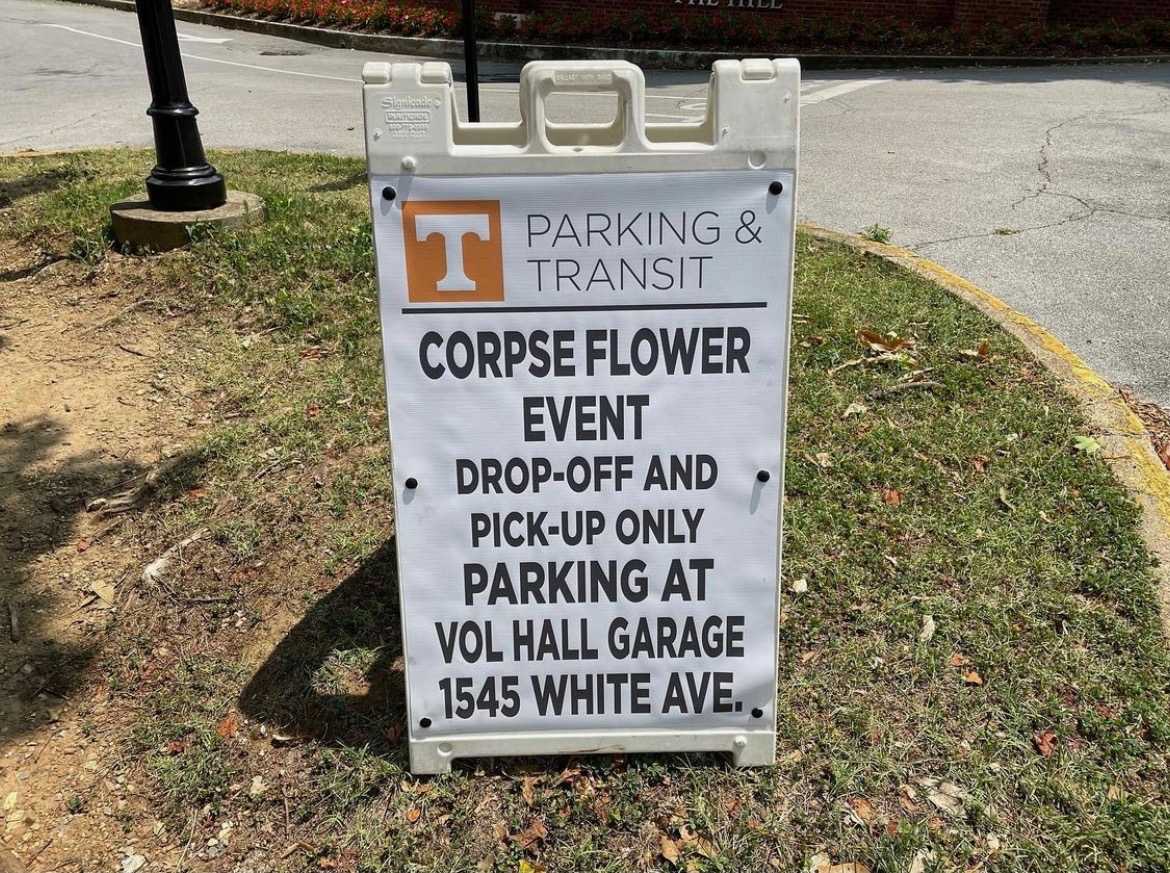
This blooming brought a lot of attention to the greenhouse. They even had to move the flower so that people could see it without the space getting overcrowded. Martin talked about why this blooming was so significant alongside it taking 20 years to bloom.
“I think mainly because it’s the largest type of bloom like that,” Martin said. “And then also just the look of it, the smell of it, and the fact that it’s not consistent and that it only occurs potentially once a decade. I think all of that piques interest. Even though people know it will smell bad, they want to see if it smells bad, because they don’t think that it could smell that bad.”
The greenhouse began preservation of the flower once it started to move out of its flower cycle. They salvaged the corm and repotted it, which significantly reduced in size after heating up. They harvested parts of the flower and sent them to UT’s Herbarium, where they will add the pressed and dried pieces to their collection for future studies. Finally, they sampled some of the pollen to examine further, as well as preserved the male and female flowers.
“One way we did it, we just used ethanol,” Martin said. “It prevents degradation. We put several in a jar and we’ll see how it works. … Mainly, it was just the female flowers that we were trying to preserve. We have the pollen, so that’s in our freezer, so we’ll be able to look at that under the microscope.”
They hope that the replanted corm will bloom again sooner than expected. Along with “Rotty Top,” they have received three more corpse flowers that they believe will bloom in a shorter time span. Their only struggle has been in finding a name for them.
“This was ‘Rotty Top 1,’” Martin said. “We can’t decide how we’re going to name everyone. We may take a page from UT, like they did with Smokey the Dog, and they’re all going to be ‘Rotty Top.’ Because it’s a pretty solid name and I don’t know if we can really out do that name.”
The Ecology and Evolutionary Biology Greenhouse appreciates the excitement that the corpse flower’s bloom created. They encourage people to come and visit them to see the other flowers that they cultivate, including one that acts like a Chameleon. Their Instagram @utk_greenhouse has more pictures and information about the corpse flower as well as the other flowers in their collection.
This article has been updated to add new information.