Have you ever had a vodka Red Bull? You sent your brain so many mixed signals.
Alcohol is a dualistic drug to begin with — it produces effects that are both stimulating and sleep-inducing. Caffeine, on the other hand, is strictly a psychostimulant. Combined, the alcohol-caffeine combo is a risky business.
Caffeine does not sober you up. That old wives’ tale is generally understood to be a myth in 2025. Instead, the caffeine in your espresso martini only weakens you further.
“What it does is it makes people feel more awake. So in reality, they’re just as impaired,” Sarah Colby said.
Colby, who has been at UT since 2011, researches how communities interact with nutrition, food security and food justice. She focuses her work on the behavior of adolescent and young adult groups.
“(The caffeine) is just making you feel awake, so now you’re an awake, intoxicated person. It actually makes you — research shows — more at risk for risky behavior. You’re more likely, for instance, to drive afterwards because you feel fine. But you’re still impaired and you don’t know it. You’re not able to tell.”
Caffeine’s not all bad — it has tremendous potential to impact students’ lives for the better. It can enhance the performance of your memory and increase the alertness of an individual. That’s why you might see so many people walking into exams with a coffee or Celsius. According to Colby, it’s all about getting the magic numbers.
“I would rather use 200 as my favorite magic number to aim for in terms of the benefits without the risks of caffeine.”
Here, Colby refers to 200 milligrams, the amount of caffeine in an Alani Nu or Celsius energy drink. Certain types of caffeine carry different weights. For instance, the average cup of drip coffee contains around 94.8 milligrams, while a venti iced latte from Starbucks, containing three shots of espresso, holds approximately 225.
The consistency of your caffeine intake can also have a remarkable effect on your body.
“I think most people know that if you are on caffeine and you automatically stop it, you can have side effects. … You’re much more likely to have, like, headaches and fatigue and irritability and have trouble concentrating,” Colby said.
The alertness and mood boosts that are associated with caffeine make it popular with active students. According to Colby, caffeine is a tool that must be used correctly when exercising. Her advice is to keep your intake at that “magic number,” 200 milligrams, and leave enough space between it and your workout — 30 minutes to an hour before hitting the gym is her advice.
Alani Nu Ambassador Grace Buxton is one of those students who enjoys a quick caffeine boost around the gym. Although she was initially a coffee fan, Buxton says that college centered her caffeine experience around energy drinks instead.

“Once I got to college and energy drinks were more the norm, I definitely hopped on the train and now I need one to workout,” Buxton said. “(Getting into the gym) is when I really relied on energy drinks and started loving their flavors. And now I drink them every single day.”
As an Alani ambassador, Buxton places importance on sharing her genuine love of Alani products with her community. Her Instagram posts, TikTok videos and cheery conversation encourage others to try the fun flavors and latest products.
“My goal is to authentically share how Alani makes my busy college schedule easier and more enjoyable,” Buxton said.
While Alani adds an extra splash of flavor to her day-to-day activities, something else draws Buxton even more.
“The fun marketing has really changed the game.”
As a marketing major herself, Buxton loves the tone of Alani Nu’s energy drink brand. Alani is a brand popularity star, bringing a notoriety to the table that could be the result of an eye-catching color scheme and mouth-watering titles. With flavors like Dream Float, Juicy Peach and Cherry Twist and fabulous can designs to match, Alani certainly pops off the shelves.
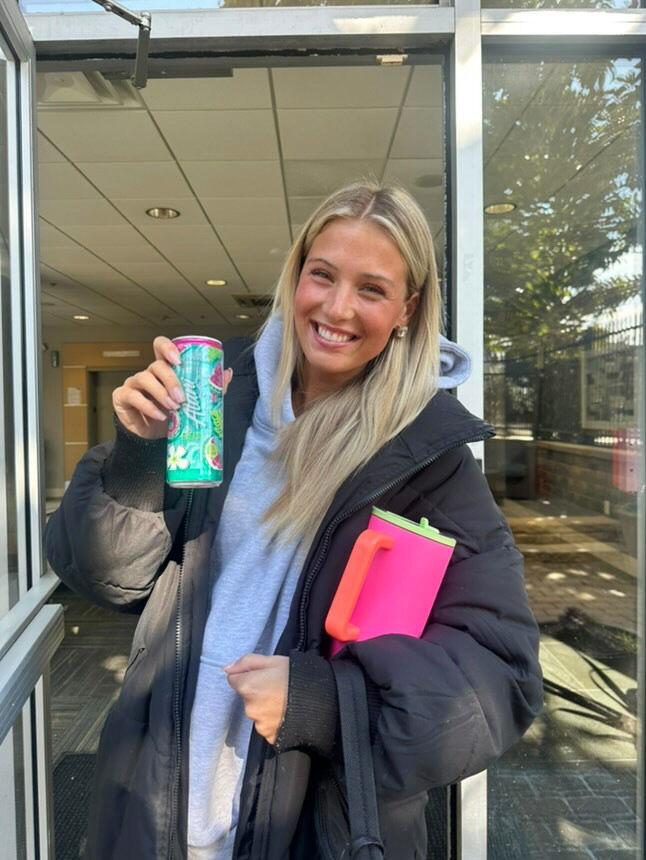
A big draw for college students can be a celebrity collaboration, and Alani has had several. Kim Kardashian, Paris Hilton and Megan Moroney have all taken their turn promoting a new, vibrant showstopper. These collabs have drawn Alani to a unique place in the energy drink realm, according to Buxton.
“Celebrity collaborations … I think it’s super cool,” Buxton said. “I’m the biggest Megan Moroney fan ever, so immediately, I’m like, ‘Oh my gosh, Megan Moroney’s energy drink? I need it.’ It wasn’t even a want at that point. It was a need. … And I know they’re actively trying to figure out another collab. I don’t think they ever stop with their marketing and brainstorming. They’re always trying to get the next best thing, and it’s obviously working.”
But just like alcohol, caffeine has its limits. Going above 400 milligrams of caffeine per day is when things can take a turn for the worse.
“It really can affect sleep,” Colby said. “People don’t realize that it’s hours later that it can affect sleep. … It takes about 5-6 hours (for) caffeine to stay in the body, but it depends because some people are fast metabolizers and some people are slow metabolizers. … So if somebody is a slow metabolizer, it might even be more like 12 hours or longer.”
Your metabolism affects how quickly your body processes caffeine, leading to increased or decreased side effects. This is incredibly specific to an individual, according to Colby.
“They can know (their metabolic rate) from paying attention to how they feel afterwards,” Colby said. “When you drink the same amount of coffee as somebody else, do you tend to feel shaky or jittery from it? Do you have more trouble going to sleep if you drink it at night? … If you notice those things when you drink coffee, then you’re probably a slow metabolizer.”
The effects of caffeine depend on your ethnicity, age, weight and gender. People with ADHD might see results that differ based on the individual. Those on medications should take extra care to understand the potential side effects of caffeine. According to a study published in the National Library of Medicine, harmful interactions between energy drinks and your medication make coffee and tea a better option for you.
Being knowledgeable about caffeine is a great way to make sure your caffeine intake is at the best possible level for you, giving you as many positive and as little negative effects as possible.
Knowing these things, Colby said, is crucial so that students “can actually make educated choices so they can get the best outcome. That’s what I would want to see.”