Hodges Library began showcasing the artistic collaboration between the Seed Library and the University of Tennessee’s Art 214 class on Nov. 15 and will continue to be on display until Dec. 2.
This event served as a celebration of the students in the Art 214 class to present their finished project. Each canvas was put on display along the walls.
The assignment consisted of selecting a seed from the Seed Library to ignite their inspiration and vision for their work. Participants nurtured their own seeds while exploring their origins and background.
This project allowed students to cultivate their own groundwork and exploration of the combination of nature and arts. Rather than following a typical straightforward art process with several instructions, each student used their original approaches.
Mary Laube, an associate professor in the School of Art, talked about what she wants students to take away from their work.
“I want them to leave the project and the class feeling empowered to be an artist and to really start to think about the things that make their work unique and how they construct and develop a real practice away from assignments,” Laube said.
Laube spoke on how her students used their own creative powers backed by research.
“Sometimes there’s this assumption that painters just go in the studio and they invent things out of their own minds and imagination,” Laube said. “That’s part of it sometimes, but since we’re at UT in an academic situation, we have these resources to really think about what research looks like.”
Juliet Barton, a sophomore at UT studying art history, chose thyme seeds out of inspiration from her father. Their dad always used spices and maintained an herb garden of his own.
Barton explained their initial thought process in choosing thyme as she gained knowledge about its ancient medicinal properties.
Healthline states that thyme is a type of mint herb and is a core element of cuisine. Thyme has a plethora of benefits as it can combat infections, pests and acne.
“It made me think about the vulnerability of the human body which ultimately brought me to thinking about my own body and the ways in which I perceive it,” Barton said.
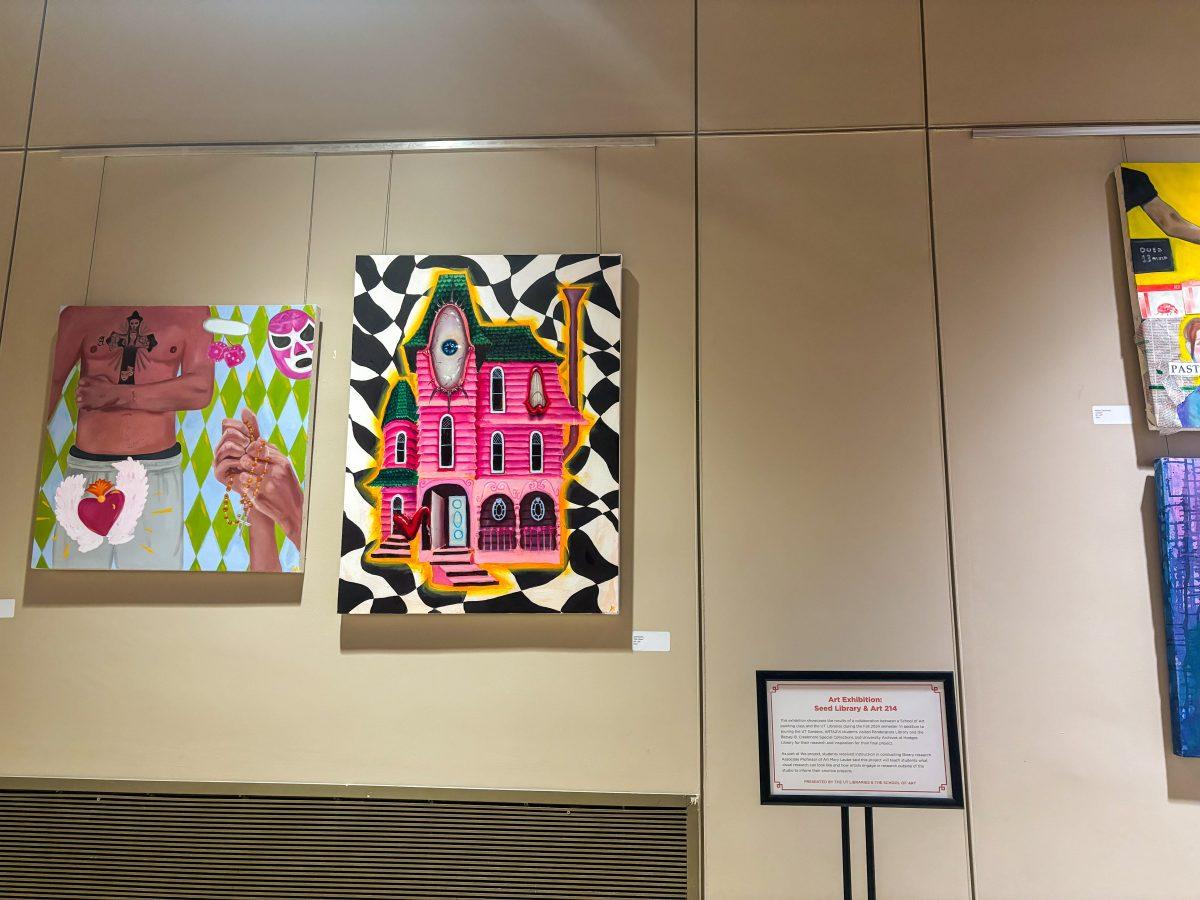
Barton’s canvas consisted of a funky pink mansion with unrealistic features for windows and doors with a white and black checkered background. The background contrasts sharply with the pink house, grounding the composition in a graphic way.
Compared to the other pieces of art on the wall, Barton’s canvas was significantly larger. Barton stated she had never painted on a canvas this spacious before, which created an additional challenge. They spoke on another obstacle she ran into.
“I used oil paint — it takes a long time to dry, so I’m working with a deadline on a canvas that’s very large with a lot of detail,” Barton said.
The project encouraged students to explore uncharted territory of the classroom’s boundaries, all while giving back to the earth by planting their seeds.
“It was really about learning about the human connection to nature, how we have exploited nature’s resources and how it connects to our daily lives,” Barton said.
“I am in general really proud of them — this is a semester-long painting that really required them to make their own decisions,” Laube said. “They really had to take some risks and make a painting that was truly theirs.”