As a Knoxville post-punk band takes its final bow, it leaves a hole in an ever-changing local music scene.
A chalkboard sign sits outside a tiny building in Knoxville’s Old City. The building starkly contrasts with the illuminations and bright signage of the restaurants and bars surrounding it. A baseball game is played in a brand-new stadium just two blocks from the building. Passersby on their way to and from the game pass by tens of college-aged kids smoking cigarettes on the sidewalk. Red drapes cover the interior of the building. A cardboard cutout of the words’ PILOT LIGHT” in the window is the only indication that the building itself isn’t vacant.
The chalk sign outside reads:
TONIGHT:
SERIAL BABY
CUMSHOTWOUND (NASH)
GLAD I DIDN’T GET MY STUPID WISH
OMFU + THE SCRAPERS
CASH ONLY
The Pilot Light is tiny. If more than ten people are inside, you’ve got to squeeze and excuse yourself to get to where you need to be. On April 19, it’s jam-packed with college students who wear work pants and Doc Martens instead of dry weave polo shirts and Lululemon leggings.
They chant for one more song as the three men on stage emerge from a group hug. The chants keep coming. Yet they’re standing there, somewhat bewildered, hardly saying a word. They are red in the face, with sweat pouring off them, visibly exhausted. Finally, with a slight reluctance, the band hops back on their instruments. It performs a blistering, fast, deafening rendition of Bill Monroe’s “Blue Moon of Kentucky.” The performance is blatantly haphazard, no more than a minute long. It sounds nothing like Bill Monroe, or Elvis, for that matter.
The bass tones rattle the Pilot Light’s walls. The guitar distorts and crackles, managing to slip between the chord changes. The drummer hangs on by a thread as the song breezes at the speed of a wild horse. It’s Bill Monroe’s pace. It’s The Jesus Lizard’s tone and attitude. It’s a perfect farewell from a band that bent the preconceived notions of both post-punk and the University of Tennessee music scene, even if ever so slightly.
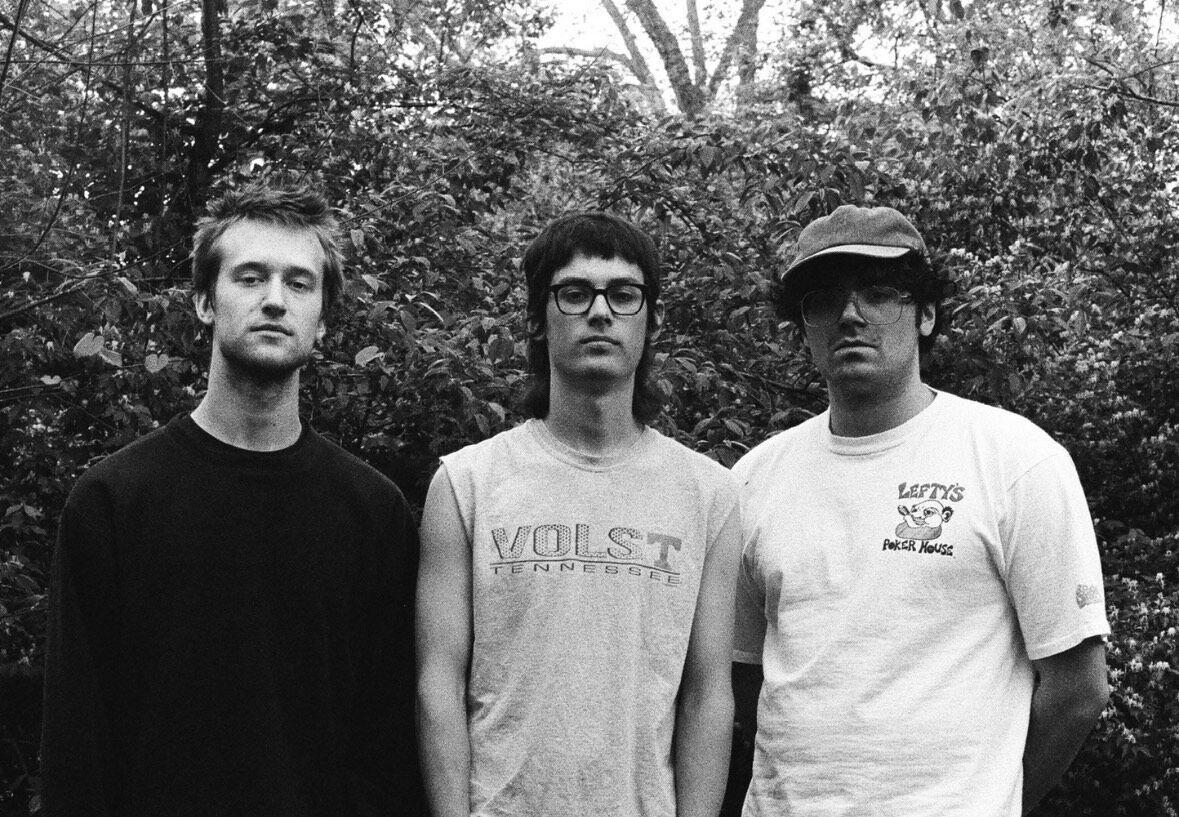
This is Serial Baby. A guitarist, bassist and drummer who met at the University of Tennessee. Ryan Cliff is originally from Dallas, Texas. Blake Drier, hailing from Nashville. Max Tsetsakis, from ten minutes up the road. They have two EPs that bear their name, all recorded with what sounds like RCA Victor recording equipment from the days of Jimmie Rodgers and The Carter Family.
At any given Serial Baby performance, you can hear fuzzy, distorted bass tones from a gigantic Peavey Speaker complemented with loud, thundering toms and a wave of crashing cymbals. Their sets consist mainly of originals, many of which include violent angst-driven vocals from Cliff and unorthodox time signatures.
They’ll occasionally throw in punk renditions of classic country and bluegrass songs. Their sets usually last roughly twenty minutes, and by the end of each one, you’re left panting, gasping for breath, with your voice gone from the shouting, the moshing, and the sweat that envelops you.
Ryan and Blake, the bassist and guitarist, respectively, live in a small, white house roughly five minutes north of UT’s campus. About a week before the show, I met up with Ryan, Blake, and Max in their backyard to talk to them about the upcoming show, the band’s story, and what comes next. When writing about it in hindsight, I feel like a British interviewer for VH1. When asking the questions, I can say it was somewhat reminiscent of that sort of thing. But it didn’t feel like a VH1 interview. These guys are my age, at the same school as me, and hold no pretensions about who they are or what they do. Ryan is wearing work pants and a VOLS crop top. Blake is in plaid pajamas.
Max is in shorts and a t-shirt I gifted him for Christmas roughly a year prior. Max was my roommate. He was in a band with me while Ryan was out of the country. We went to high school together, and went to the same shows in DIY venues throughout North Knoxville. One day, they may conquer the world in their own separate ways, but for now, they’re just three guys who happen to make phenomenal art in 20-minute-or-less segments throughout the Southeast.
“Why are you breaking up now?” I asked the three.
“It’s the in-between stuff,” Ryan said. “Me and Blake are graduating. I’m getting married in June. I’ll be in Boston.”
“I’m looking around,” Blake said. “Maybe here, maybe Asheville. We’ll see.”
“I’m trying to save up for EMS school,” Max said. “I got to get my ES1, then I go to ES2, and then I got to go see a few dead bodies, and then I can sign up for the fire academy.”
“We did all we wanted,” Ryan said. “Did two tours of the Southeast. Just wrapped up the last one. We’ve got three EPS out, gonna do a live recording of the last show, and then call it a day. Before the in-between stuff.”
Ryan Cliff needed a drummer quickly in the Fall of 2023. It was his third year of Architecture school, and he was dying to get a band together after the anticlimactic dispersing of his former Indie-Country band, Clementine. He’d hit up Frank Cloar, who lived in a grey house on Clinch Avenue, and said he wanted to get a festival together. He’d been playing around with Blake at each other’s apartments, and Ryan wanted to get back out there and perform in front of people. Impulsively, he told Cloar that he had a band ready to go for a gig and needed a place and a venue. With Cloar, Ryan enlisted other bands and made the first of many Serial Baby posters.
Ryan and Blake practiced with one drummer who had a prior commitment the day of the gig, so he turned to Craigslist for help. A guy he talked to from the website showed up at his apartment about four days before the gig.
“He’s like twelve or something,” Ryan said of the guy. “I don’t actually know how old he was. He does drive up on his own, so he’s at least old enough to drive, but he’s got everything in a suitcase. Like one of those Amazon suitcases they have for kids. We’re rehearsing at the BYX house in the Fort, and we got told to stop playing an hour in because he was, like, really bad.”
They were three days away from the gig and still didn’t have a drummer. Ryan finally had to tell Frank the truth. Frank told him of a guy about 18 or 19 years old who randomly showed up at their place about a week prior. Some musicians were out in the back, and this kid asked to jam and play with them for a while. The kid not only had drumming, but charisma in spades: enough to get Frank’s number, who passed it onto Ryan in this time of need. The kid rehearsed with Ryan and Blake for three days, and on the third day, Max Tsetsakis played drums at the first Serial Baby Show.
They mostly played covers that day, and by the end, they got a few half-hearted compliments. Still, the comment that stuck out to them was, “I don’t know what happened with that Pixies cover, but it just didn’t sound right.”
“That’s how we’ve kind of been running it ever since,” Max laughed. “Just show up and play.”
As soon as the audience outside hears Cliff’s bass tuning from outside, they immediately put their cigarettes out and hurry back inside. The dimly lit, red barroom already reeked of sweat from performances by CUMSHOTWOUND and OMFU+The Scrapers before.
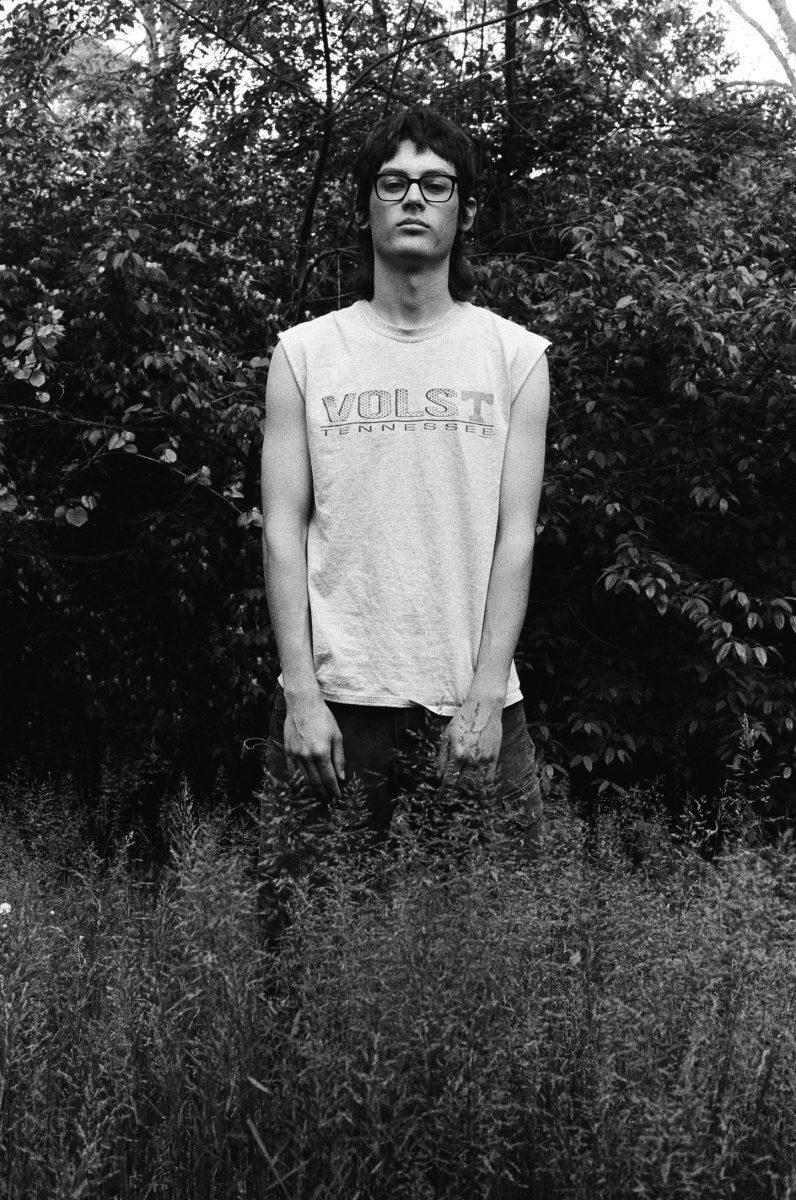
Ryan Cliff, 22, on bass guitar.
“‘Sup nerds.” Ryan says to the audience before launching into ‘Field of Bricks.” The song sounds indeed like a field of bricks. Like many Serial Baby originals, the song consists of Ryan’s signature daunting and loud vocal deliveries that counter how Ryan sounds in conversation. The bassline and Blake’s guitar move in sync, as Max’s drum fills segue into unorthodox time signatures, one by one, through the two-minute song.
The song seamlessly transitioned to a crowd favorite: “Laura D.” A song reminiscent of one by The Jesus Lizard, the lyrics consist of nothing but “Laura Dern.”
While the lyrics are simplistic, the grooves and chord progressions are anything but. The crowd really gets into it at this point. Doc Martens and loafers collide, Push comes to shove, and bodies fly around the dark, sweaty jungle amid urban gentrification. “Laura D” is followed seamlessly by a song paired with it from the jump: “Weeop”. Early on in their set, the band leans into their hardcore roots. The crowd responds accordingly.
“I think that third show in Nashville is where we got our swag,” Max told me in Ryan’s backyard. “And then we realized that we can really do this.”
There was a stage in a field punctuated by a few trees, with lights loosely dangling among their branches. The grass in the field was tall and crushed by the blankets of the people in the audience. It was in the middle of June. The field was hot and muggy, especially during the day. Mosquitoes flew in abundance. A ballooned screen stood behind the stage, where Ryan’s friend Edwin and five others showed homemade films throughout the day.
After Serial Baby soundchecked, before anyone got there, Edwin got a call.
“What do you mean you can’t come and cook for us?!” Ryan heard Edwin yell through the phone.
Apparently, the cook’s reasoning was pretty sound. He was involved in a horrific construction accident that resulted in a nail going through his eye.
Thus, Serial Baby manned the grill.
Ryan took orders while Max, donning a white tank top and chain-smoking American Spirits, cranked out hotdog after hotdog, sometimes spilling cigarette ash into the meat served. Ryan formed a line and called back orders like a line cook. Under immense stress, the band operated as if the owners and cooks in a local delicatessen before going on. When Serial Baby had to stop working the food stand and go on stage, people were agitated because their food wasn’t being served. Yet the hunger and agitation gave way when they got on stage.
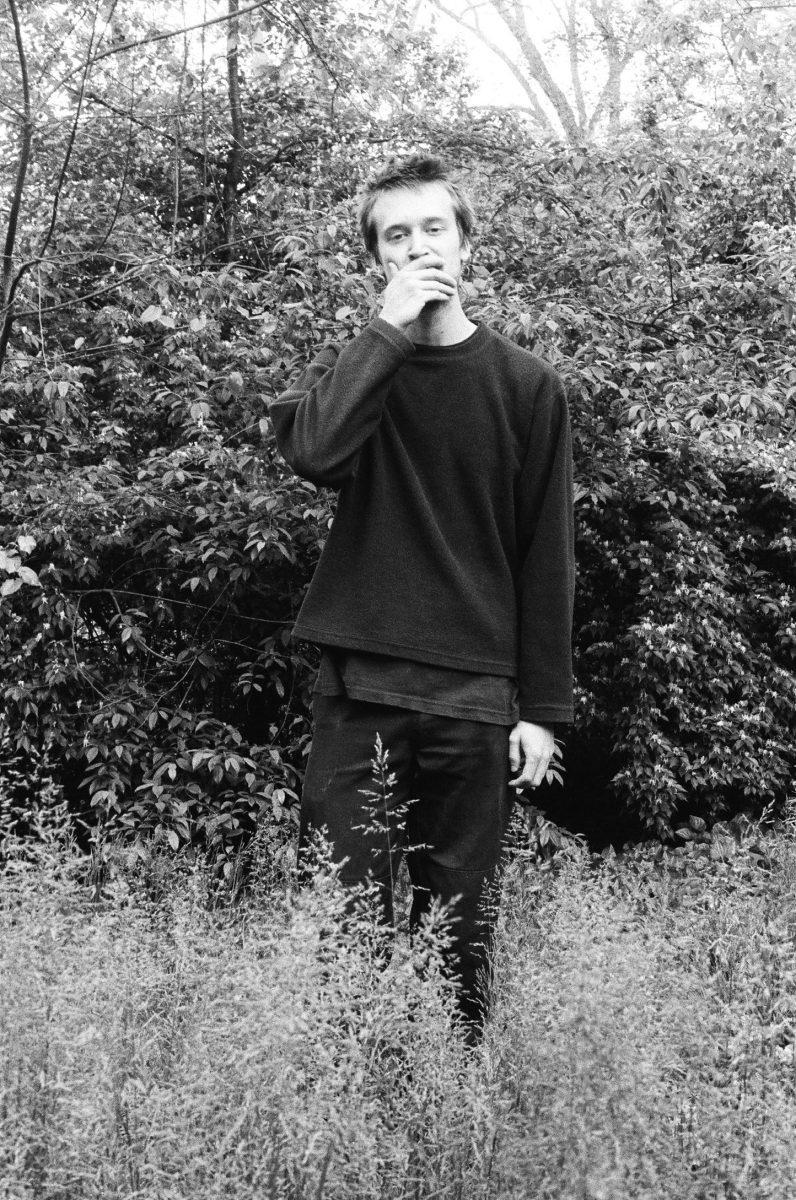
Blake Drier, 23, on guitar.
“That was the first time I saw people mosh to our music,” Max said. “I was like yeaaaahh man! It just felt really good.”
By the time they got off stage and went back to the food stand, they were greeted with words like “You guys f***king killed it,” alongside orders for yet another hotdog.
The show in Nashville was the last Serial Baby performance before Blake left to study abroad in Japan. Ryan and Blake are architecture students who had to study abroad for a semester per UT Architecture requirements. They both had to go halfway around the world during Serial Baby’s tenure.
When Blake was gone, Ryan and Max would perform as a drum-and-bass duo. They would also record songs as a duo when they weren’t on stage. Ryan would send the results to Blake, who would record his parts halfway around the world. The band had to go on hiatus when Ryan went to Poland in the Fall of 2023. While in Europe, he’d mix and release their second EP. And when Blake and Ryan returned, they’d play as if no oceans had ever separated them, as if no time was lost. They’d be just as noisy, ferocious, and proficient as before.
Yet despite the hiatuses not slowing them down, one thing sometimes did: finding places to play on UT’s campus.
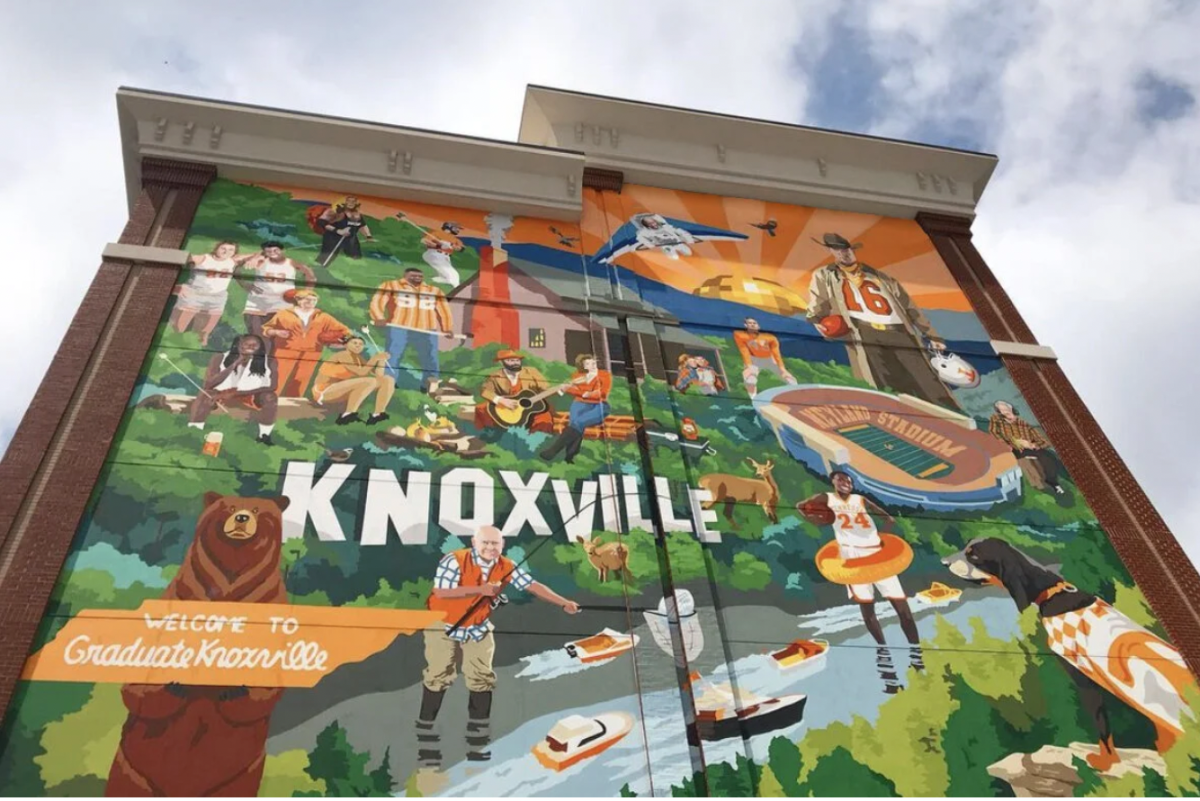
Cumberland Avenue, affectionately called “The Strip,” resides just south of UT’s campus, acting as a bridge between the academic haven of campus and the madness of the student-housing neighborhood of Fort Sanders, or “The Fort.”
The Fort is where I live currently. It’s where Ryan and Blake lived when Serial Baby first formed. Max lived in The Fort with me for months until moving back home recently. I was where Earth Day Fest 2023 was held, where Serial Baby held their debut. And just north of that neighborhood lies a street that used to hold bar after bar, where live music of all types lived for decades. My father spoke of passing up on paying cover to see a band called Alabama still in its infancy. That bar is now gone. So are many other bars, restaurants, and local businesses were on that street for decades.
In their place are sleek, stale high-rise student apartments. The character of The Strip was replaced with flats with the uniformity and the soullessness of a suburban neighborhood.
The few bars still standing on The Strip typically don’t pay bands to play as they used to.
“I wish more of the bars of the Strip did stuff, too,” Max said. “I remember one of the first times I went into Half Barrell, they had one of the bouncers play with his band ‘King Ghoul,’ and it was actually pretty f***king sick. I just wish they had more stuff like that going on now.”
“I mean, Literboard has a couple bands that play every now and then, but they’re all like Grateful Dead cover bands and stuff like that,” Ryan said. “You can’t play your own kind of stuff at those places.”
Ryan would even insist on asking some of his friends who play in bands at campus bars, but to no avail. There isn’t much of a market for bands with twenty-minute sets of mostly originals sung with Ryan’s angst and ferocity at the top of his lungs.
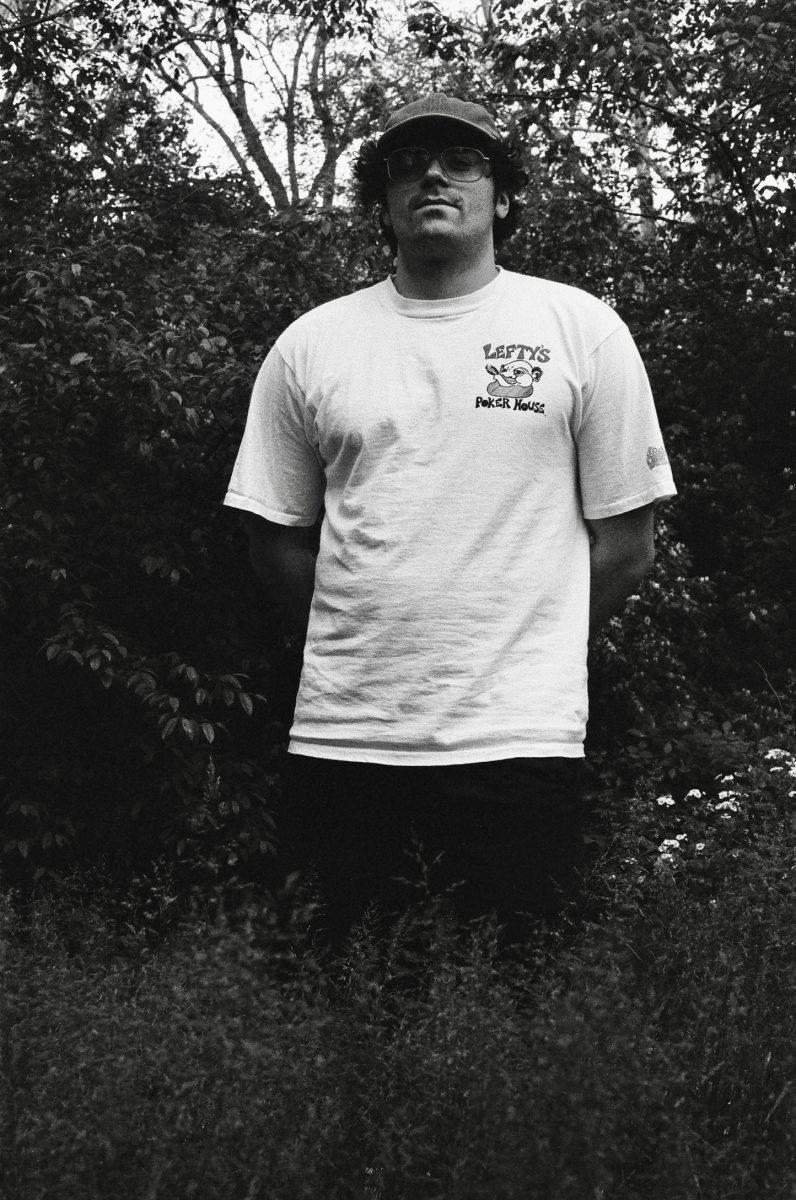
Max Tsetsakis, 21, on drums.
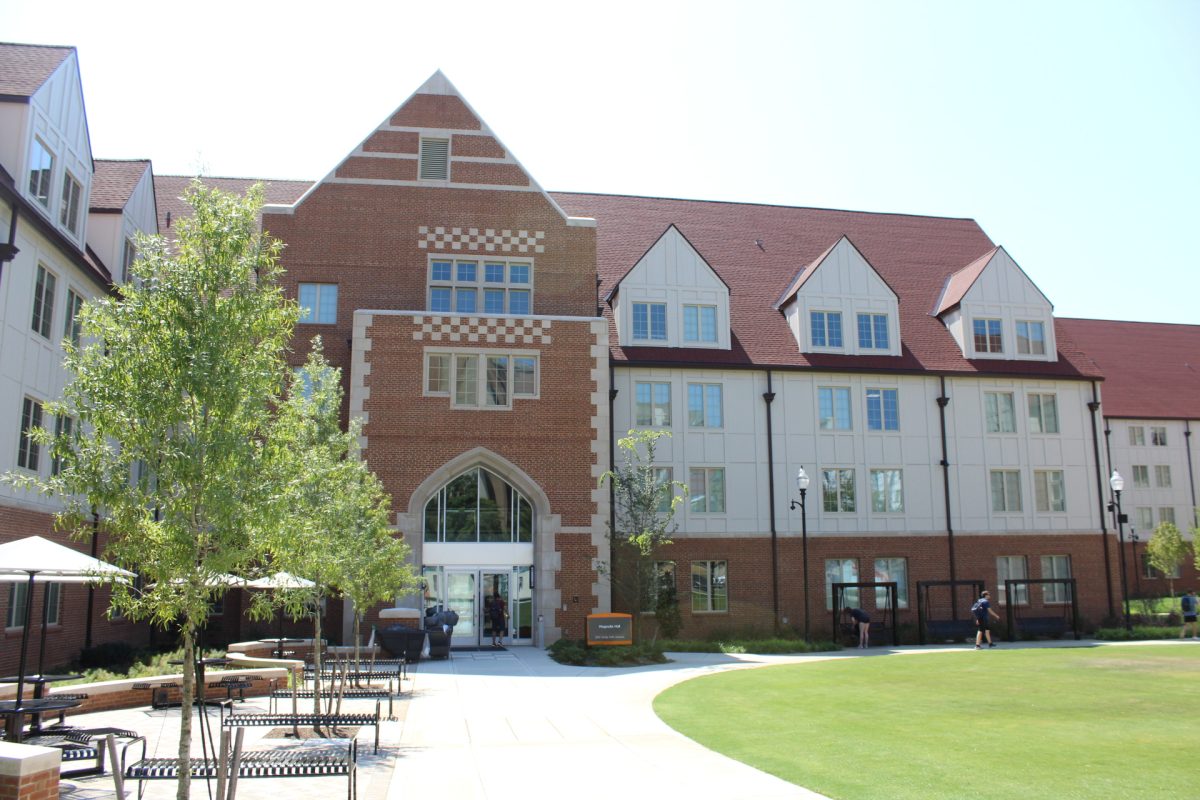
Even within the Fort, venues for bands like Serial Baby aren’t as abundant as in years past. When the Earth Day Fest was held, the living room of Frank’s house was sinking like a torpedoed battleship. It was clear to anyone who set foot in that house that the foundation was giving way. The property’s landlord told the tenants living in the home as much, and that they were ultimately evicted. The landlord said the house would be unavailable for a few years.
The students living in that house, mostly Juniors in school, would be unable to return. Yet, the following semester, new tenants were living within its walls. Most of them belonged to a fraternity. Within the new year, there wouldn’t be much music echoing from that backyard as before. The times when I did walk by and hear music coming from there, it would often be Morgan Wallen covers instead of the original, experimental music made by the musicians and artists that go here.
The night of their final show, Serial Baby announced the debut of a new song.: “Not An Nolan.” This song would only ultimately get one live performance. Most of the music contained the typical ebb and flow of any other Serial Baby song. Punchy, loud, distorted, with odd time signatures and Cliff’s trademark yelling. Yet, Max sat silently behind his drum set at the song’s end, almost in meditation. Blake repeated a guitar line -brief and simple, like a haiku. Hovering over the line was a form of respite as Ryan sang of watching a Texas Rangers game when he was younger. Yet, the story of the ballgame deviates in the last two lines.
“That’s the truth, that’s what you believe /
In this town that’s dying”
If you go to the Serial Baby Instagram page, you’ll find an abundance of posters for shows. Ryan designs them. It’s part of his passion project within the band. Every single poster is eerie, dissonant. Some have a Gen-Z slant of humor to them. Others are rather disturbing. Some have the band names pasted in white over human hearts. One has band names surrounding a fuzzy picture that Steve Jobs took while testing out face filters on the iPad in 2010. One has a 2010s aesthetic picture of a baby deer in the passenger side floorboard. One is of two separate shots of a bloody mouth with teeth missing.
Yet, one thing that many of these posters have in common is how all these venues take place in different locations, from two separate tours.
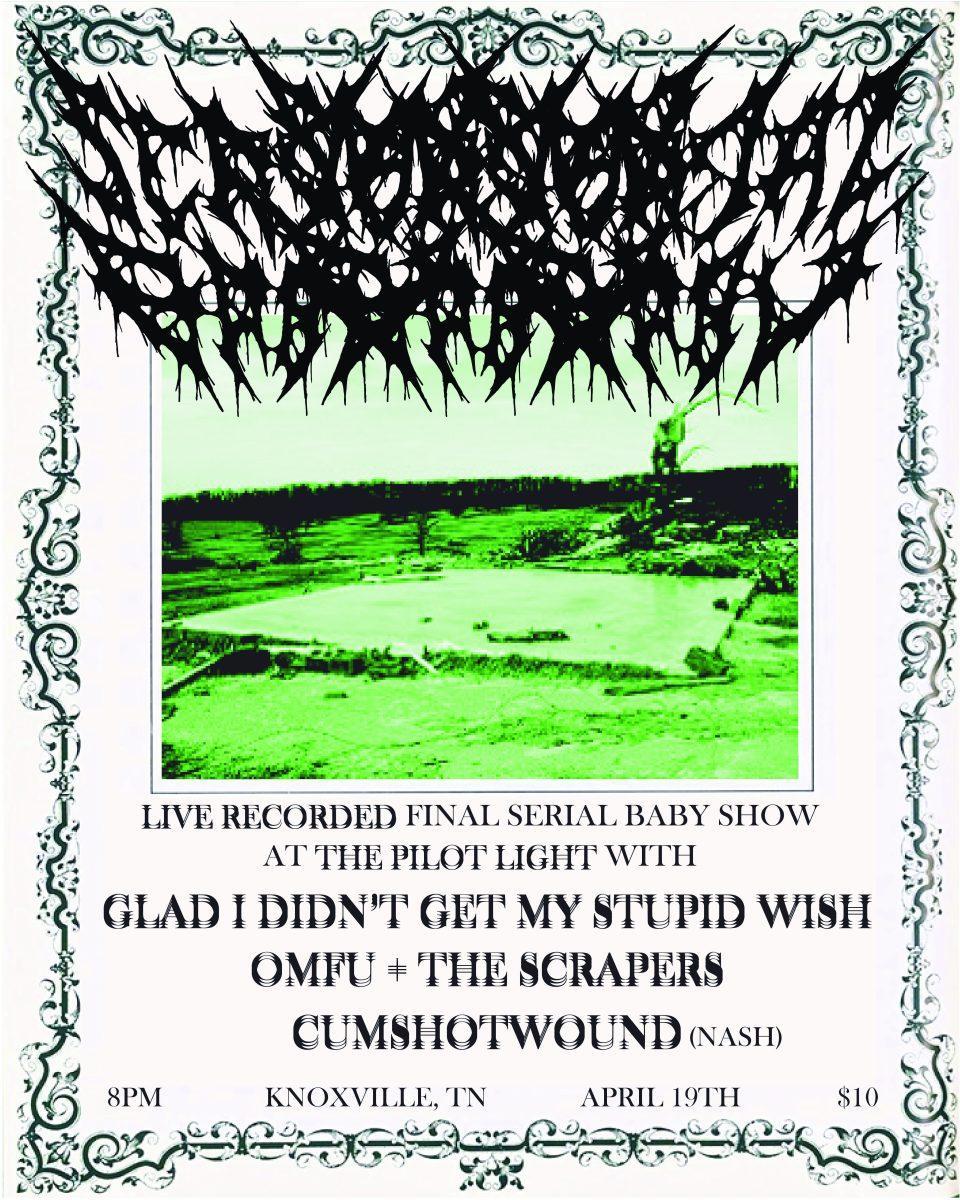
One was in New Orleans, where after the show, they went to a bar and witnessed a guy sitting in the back of the bar watching South Park at full volume on the TV, saying that it was “his show.”
One was from a storage unit in Milton, Florida, which Max called “the most brutally hot place I’ve ever played in.” The AirBNB that they stayed in for the night was an elderly Russian lady’s side room, which she offered for $40.
One was from a house in Chattanooga, Tennessee, where my band was opening for them. Ryan forgot to tell me to snag a microphone stand while getting Max’s drum equipment back in Knoxville. When I arrived without the microphone stand, all the bands shared a singular microphone taped to a Swiffer Wet Jet handle that was subsequently taped to the ceiling.
Some posters were of shows they didn’t know they would get to. Max bought a car in Nashville, which broke down in Crossville, Tennessee, less than two hours away. They arrived at gigs using cars they’d never bought from people they hardly knew.
Blake, too busy wrapping up school to make the last tour, would show up two states away to drive Ryan and Max to their next gig all the same. Ryan and Max only made a gig in Savannah, Georgia, because of one of Ryan’s friends whose house they crashed at in Atlanta the night before. He slept through his alarm and missed a flight to Florida.
Yet of the many posters on the Instagram page, multiple posters have two words on them more than many other posters: PILOT LIGHT. Serial Baby played there more than any other venue. It was their equivalent of The Winterland Arena for the Grateful Dead. I would be home for their final performance.
“It’s everything to me,” Max said.
“When I first started playing music, the Pilot Light was the goal,” Cliff said of the venue. “I was like, I want to go there. I wanted to so bad.”
As soon as they got there, they got comfortable. They would continuously play by themselves or backing local songwriter, 20cats, for shows. They got to know the bouncers, the bartenders, the sound engineers and anyone that would become regulars at their show there. Familiar faces would stand out in the small building whenever they played. A small, tightknit community wove within the walls whenever Serial Baby played there. A community that would wait anxiously for their return whenever they hit the road.
After performing arguably their most popular song, “Shmeeb,” Max broke a drumstick. He holds the shard remnants of wood high in the air as Ryan asks for a new one.
“Is there a single drum stick lying around?”
Someone from CUMSHOTWOUND hands Max yet another broken drum stick.
“What the f**k am I supposed to do with this?” He asks in frustration. “You know what? It’s fine.”
Just then, the bouncer of the Pilot Light hurries through the audience with a brand new pair of drumsticks.
“This is why this is the greatest venue in the world.” Ryan said to the crowd.
The lights shut off on stage, the bass overpowers the venue, and the band locks into their final performance of “I-40 and making plans.” The mosh pit caves, and the music sucks the venue in, like a dying star.
Halfway through the set lay the song “50 Greatest College Football Players,” a song from their second EP, surrounded by other songs such as “I listened to Family Tradition 7 times on my way home today,” and “They put up a gate at the Port Royal parking garage since I’ve moved away.” Within that song, Ryan started singing “The Tennessee Waltz.” “50 greatest plays” only contained the first verse and the chorus of the Waltz. Ryan hardly stayed within the confines of the melody, but with the lyrics shouted so loud, it was unmistakable. He’d included the Waltz many times throughout their recent tour. Still, this performance especially felt like a homage to a town he was rapidly leaving behind.
“The funny thing is that I’ve only lived in one place for five years at the most,” Ryan told me one night at a bar. “I’ve only lived at any given place, be it Lubbock, or Clarksville, or Knoxville, only five years at a time. And I feel like I’ve just now gotten to know this place, now I’m just about gone.”
Ryan ensured that Serial Baby always paid homage to the country music surrounding the regions he’s lived in. Yet before his ultimate migration to Boston, this last rendition of The Tennessee Waltz, a song played at every UT sporting event and so ubiquitous to the region, felt especially necessary.
Ryan said goodbye to Knoxville in more ways than just singing the Tennessee Waltz at his last show. A few weeks before the show, Ryan put up posters on electric poles around the Fort. He took note to put one up on the pole outside the grey house that held his first show two years ago. The posters were stark black and white with vague, fuzzy impressions of three musicians. Above the indentations read:
KNOXVILLE NEEDS YOU TO MAKE A PUNK BAND.
LEARN 2 SONGS.
WRITE 3 SONGS.
PLAY IT FAST.
PLAN A SHOW.
HAVE SOMETHING TO SAY.
Below the call to arms were recommendations of local musicians, past and present. At the bottom of the page were Instagram accounts dedicated to getting local hardcore acts in venues across East Tennessee and throughout the Southeast. The first set of recommendations on the poster was places to play. The first venue on the list was The Pilot Light.
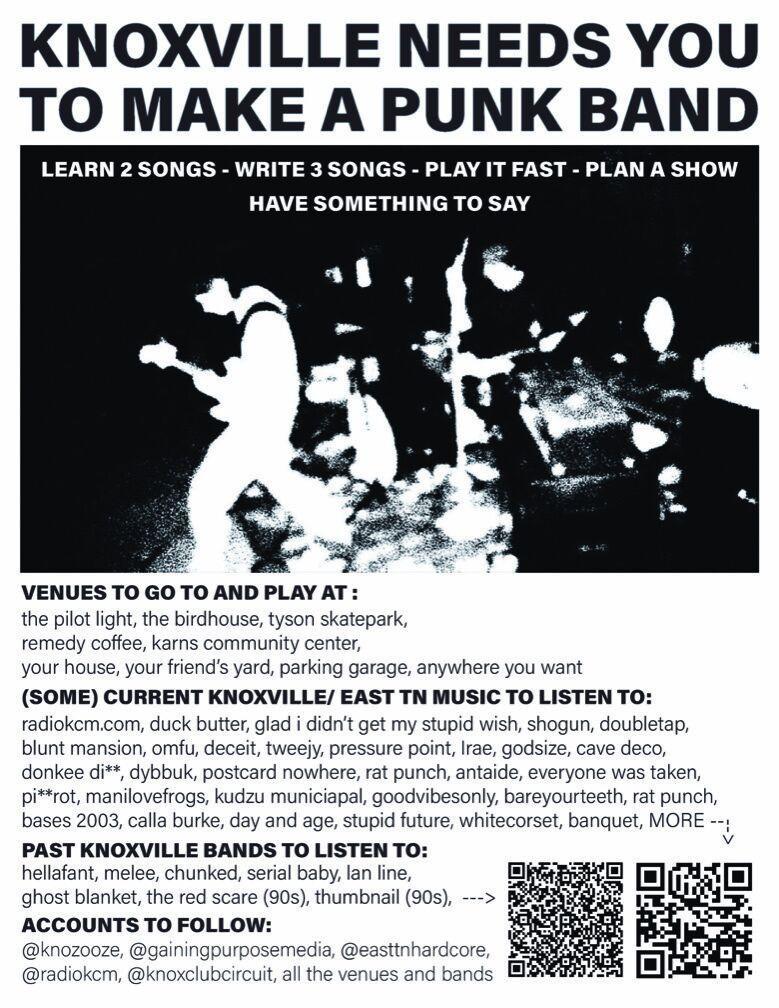
The last four were:
Your house
Your friend’s yard
Parking garage
Anywhere you want.
“Dude, all you need is one,” Ryan told me.” All you need is one frat dude whose dad made him be in a frat. He doesn’t want to be. And we need him to start playing his freaking stupid shit. You need one angsty frat dude to book a bad band. It takes three guys to have one show at their apartment. That was one of our first shows. We just told our neighbors, ‘I’ll give you beer if you come [see us play],’ It just takes one unafraid person.”
The last of the fourteen songs scribbled haphazardly on a small sheet of paper was “I Am A Pilgrim,” a traditional gospel and bluegrass song dating back to the 19th century. Ryan strips the song of its melody, screaming with what sounds like half-realization, half-fear:
“I am a pilgrim/
And a stranger/
Traveling through/
This wearisome land”
Ryan’s bass and Blake’s guitar play off each other in punctuating quarter notes, while a soul-grunge fusion in Max’s drums gives this rendition of a centuries-old song a newfound sense of angst. The song finally gives way to a deafening crash of symbols and ringing of feedback from Ryan and Blake’s amps. The stage lights slowly fade to black. Ryan stands before his amp, with his sole tool, relieved and proud at the work all three men have put in.
That was Serial Baby. A guitarist, a bassist and a drummer who met at UT. They will have three EPS and a live recording of their final performance to bear their name. If they weren’t at the Pilot Light, or their own house, they were blowing through the Southeast, oftentimes not knowing where they would sleep that night or how they’d get there.
They wound up in a blazingly hot shed in Milton, Florida, or in a living room in Chattanooga with a Swiffer Wet Jet for a microphone stand, or in Nashville out cooking hotdogs for their audience before a set because the cook hired for the venue wound up with a nail in his eye. They would play on all the same.
The tones were deafening, but the volume was perfect. This was a band that wanted to make a lasting impact on the UT music scene, and left seeds on the neighborhood electric poles to sprout the inspiration of just two more friends to pick up the bass and drums and play anywhere they wanted.
By the end of May, Ryan and Blake will have graduated. Soon, the three men will be spread out among the East Coast, figuring out what adulthood means. In this moment, here they stand, drenched in sweat, arm in arm, standing in fatigue and bewilderment. The audience chants for one last song.
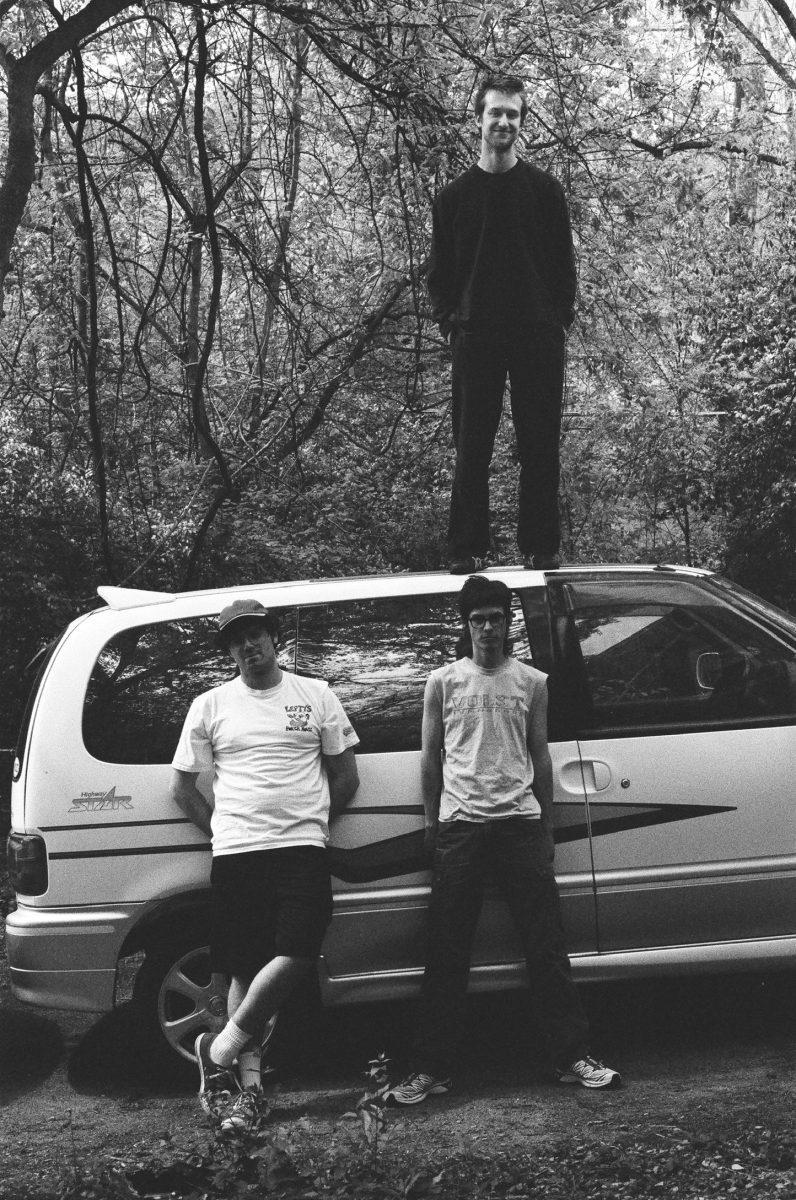
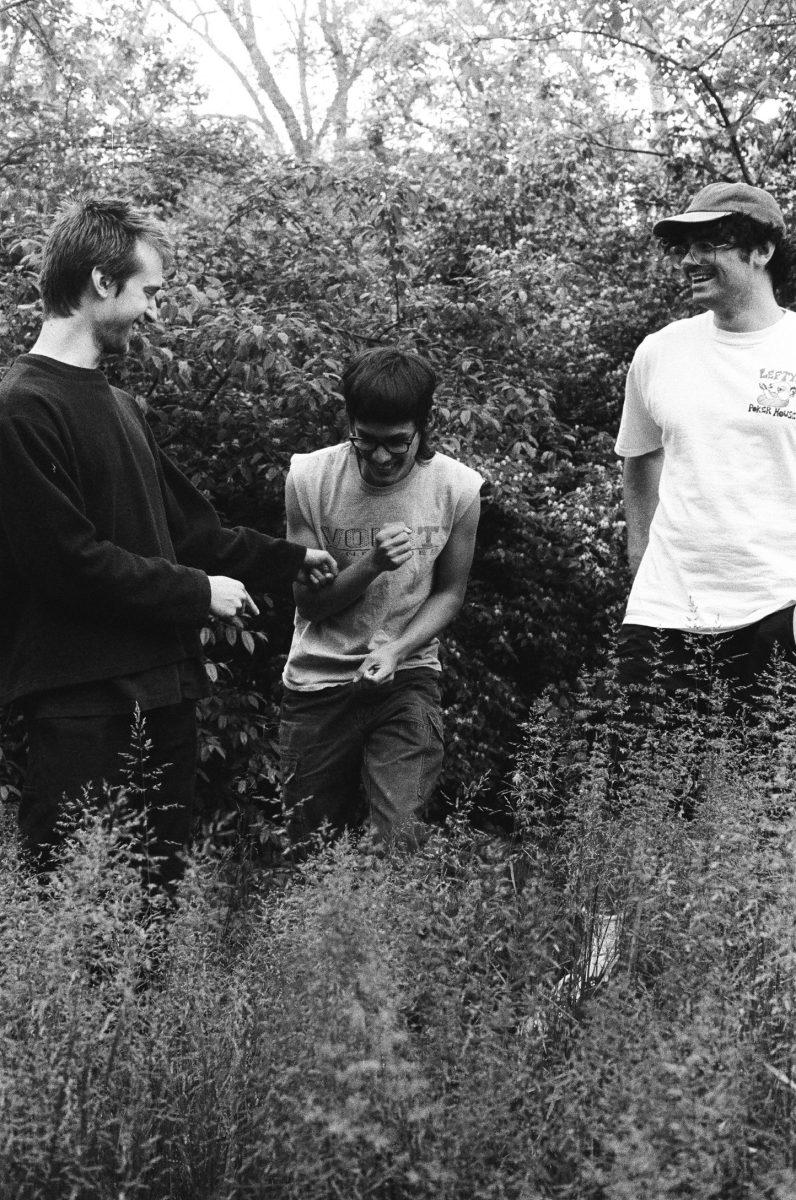
The band poses before playing their final show.