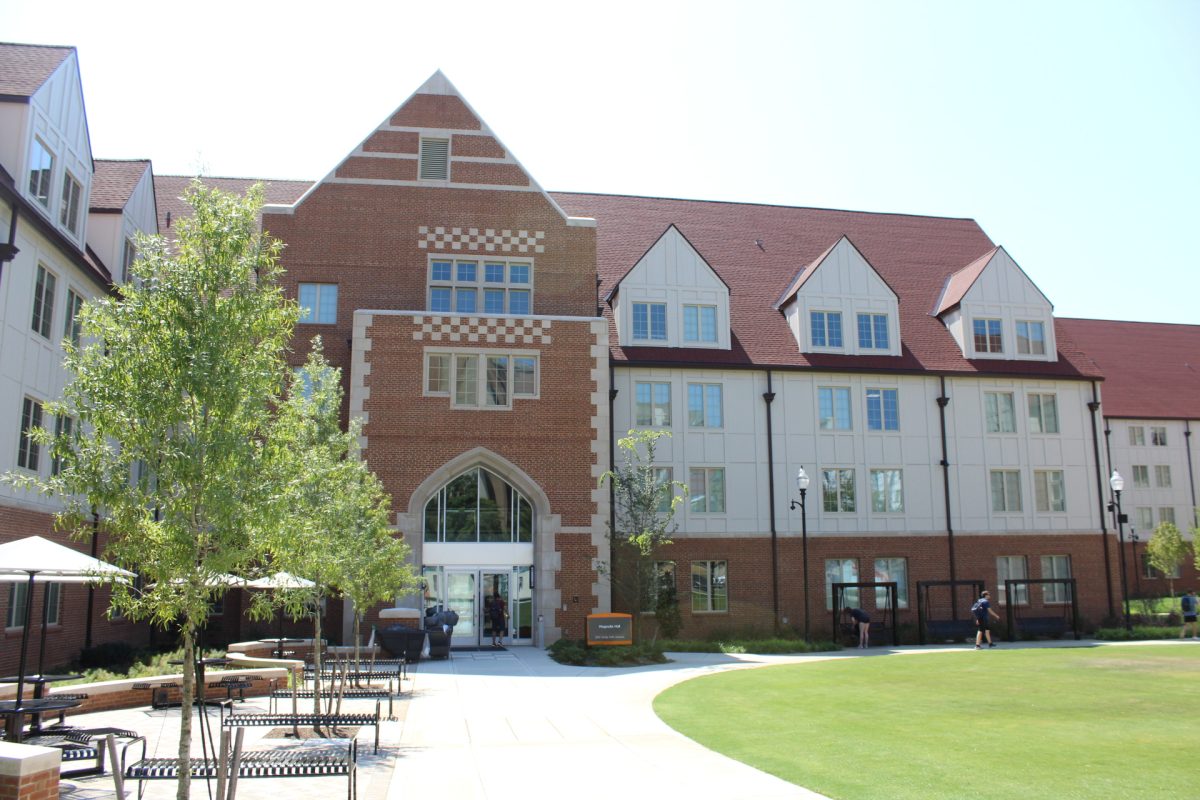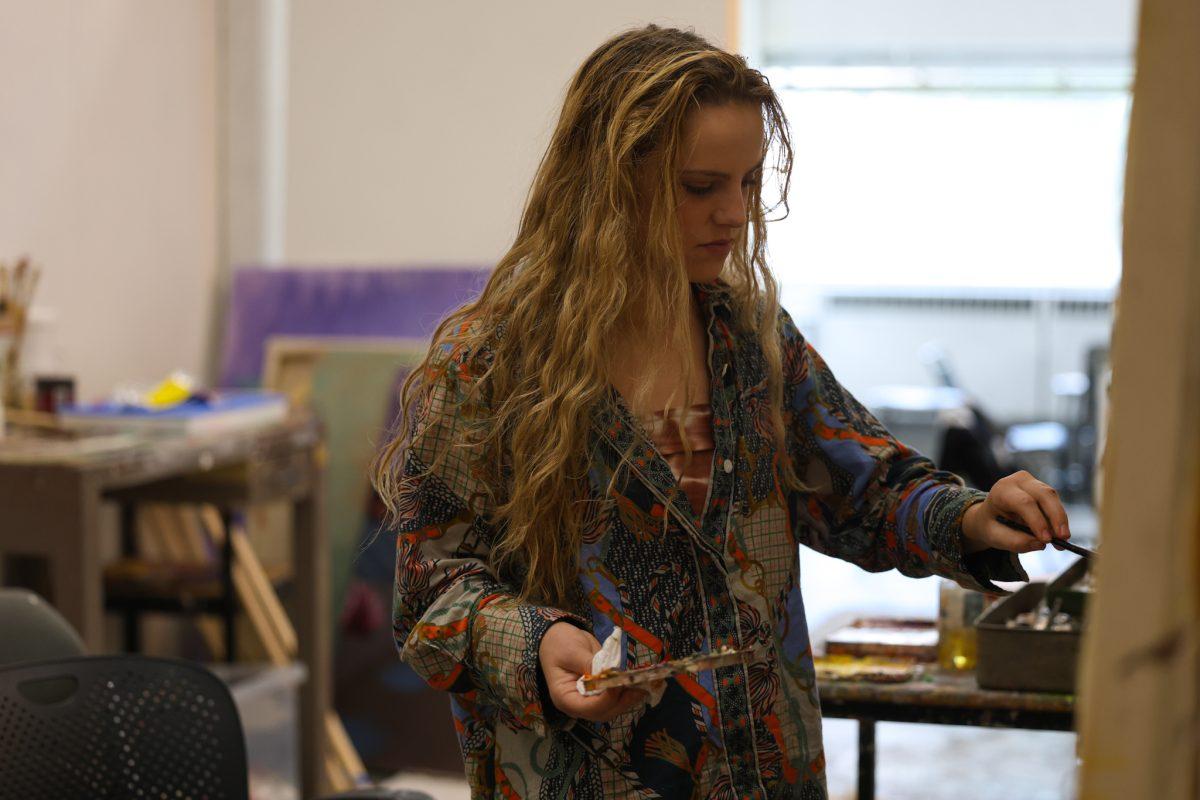
Behind the Art and Architecture building, a set of stairs leads down to the advanced and intermediate pottery rooms. Lit up by skylights, the underground workspace is given an earthy, cool feeling.
It’s here that Anna Babcock, an art and psychology senior at UT, has been spending her evenings working on finalizing sculptures for her upcoming gallery show at Gallery 1010 on Oct. 10 and Oct. 11.
In May 2024, Babcock hot grease splashed across the front of both her legs, sending her to the local emergency room. After her transfer to the Vanderbilt’s burn ward, it took a week for the full extent of the burns to surface.
“They had developed to second- and third-degree burns, and on that Wednesday, I wasn’t able to walk, so I ended up getting admitted to the burn ward,” Babcock said.
Babcock stayed in the burn ward in the ICU for just under a month. She went through multiple debridements, a process where they removed dead, damaged or infected tissues from a wound.
During the last two weeks of her stay, a skin graft helped with the pain and the healing process. A skin graft is when “they take skin from your thigh and put it through a machine and kind of stretch it over the sites that need it,” Babcock said.
The skin graft proved to be just the start of her post-hospital healing process. She had routine checkups to complete debridements and make sure the skin graft stayed clean for the six months it took for the wounds to heal. Then she started the process of laser treatment for hypertrophic scarring to help with nerve pain.
She went through multiple laser surgeries, and after each one, she saw a bit of positive change. The little steps, as explained by her father, kept Babcock motivated throughout the process.
“Each of the laser treatments that she went through, a few days after the procedure it would just be amazing to see the change that happened,” Charlie Babcock said. “She would find that every procedure made a difference and it was incremental steps.”
Healing — both physically and mentally — is a slow, nonlinear process that has a lot of layers to it that build upon one another.
“I haven’t had any difficulties talking about it with people. And processing it for myself, trying to process that pain, is definitely difficult,” Babcock said.
Babcock has been an artist her entire life. Through art, she now has an outlet to process her pains, her emotions and her story.
“Being an artist means I can explore the world through the lens of art,” she said.
Even as a child, she saw the world in color, as a place without limits on imagination or possibility.
“She was very kind, but she’s always been creative and she didn’t like having boundaries,” Charlie Babcock said. “You could just kind of see her come alive when she had wide open spaces to play.”
Being a child evokes a sense of wonder, curiosity and kindness. In the wake of the fire, she channeled these inner-child values as she reflected on events throughout her life.
“I think as I’ve been reflecting on it, specifically through art, it’s helped me again to see beauty in myself, in my scars, in my skin graft scars and being able to see beauty in that,” Babcock said.
The burns left irreversible nerve damage and scars on her legs.
“She’s been so mature but not numb,” Charlie Babcock said. “She’s emotionally engaged with how hard it is and there’s damage to her body for the rest of her life. But she’s been incredibly positive while she’s also grieved.”
Throughout all these complex emotions, she lets each of them take up space on the surface of both her mind and her body. She’s not tucking them away or bottling them up — each one runs its course in its rawest form.
“She’s not shying away from who she is or changing or hiding what happened. That takes a lot of character and self-confidence to just continue living without and not bowing to whatever it might be,” Charlie Babcock said. “She’s got that confidence and that strength and personality to do and to live uninhibited.”
It’s a bittersweet feeling. She’s both mourning the fact she will never be who she once was, while also accepting that this is who she is now.
“(I have) let myself have more grace on myself for things before the fire and after the fire,” Babcock said. “I can get very in my head about things and (being a) perfectionist and stuff, so I think grace is the biggest impact and it opened up me to a lot of different emotions and stuff. And instead of just moving past emotions, just letting myself sit in them.”
A lot of sitting time with her emotions is spent working on artwork.
“I’m making sculptures that replicate skin grafts and using my body as a mold basically cause I already see my skin grafts as beautiful, cause watching your skin grow back is one of the most amazing things ever,” Babcock said. “I’ve done some research on it so it’s helped me to understand the medical perspective and helped me learn more about skin grafts in general.”
Down in the pottery room, a pair of mannequin legs jut out from the shelf next to her workspace. The table is covered in clay, all in different forms and stages. One end has longer parts of her skin grafts, temporarily molded onto crumpled newspapers as they wait to be fired. The main area has all of the smaller pieces she’s currently working on, tucked into plastic bags to keep the clay moldable when she’s not there.
“Working with the medium of ceramics, using my fingers and tools to create the like-mesh shape, it’s slow and it’s allowed me to process,” Babcock said. “Not the whole time, but unconsciously process some of the burns and my feelings of the burns and engaging with the feelings of fragility and vulnerability in both a physical and emotional sense.”
Countless hours have been spent getting ready for this show, both in the pottery room and also in a small studio space on the top floor of the building.
“It’s called ‘My Ecdysis,’ that’s the process (that) insects, crustaceans, all of those where they’re shedding their skin,” Babcock said. “It was the closest word I could think of that felt similar to debridement and kind of loss of skin and it’s kind of like their new body emerges.”
Over the years, she’s worked with every media type, and is currently focusing on painting and sculpture. ‘My Ecdysis’ will feature a mixed-media combination of the two, working together to tell her story as a burn patient.
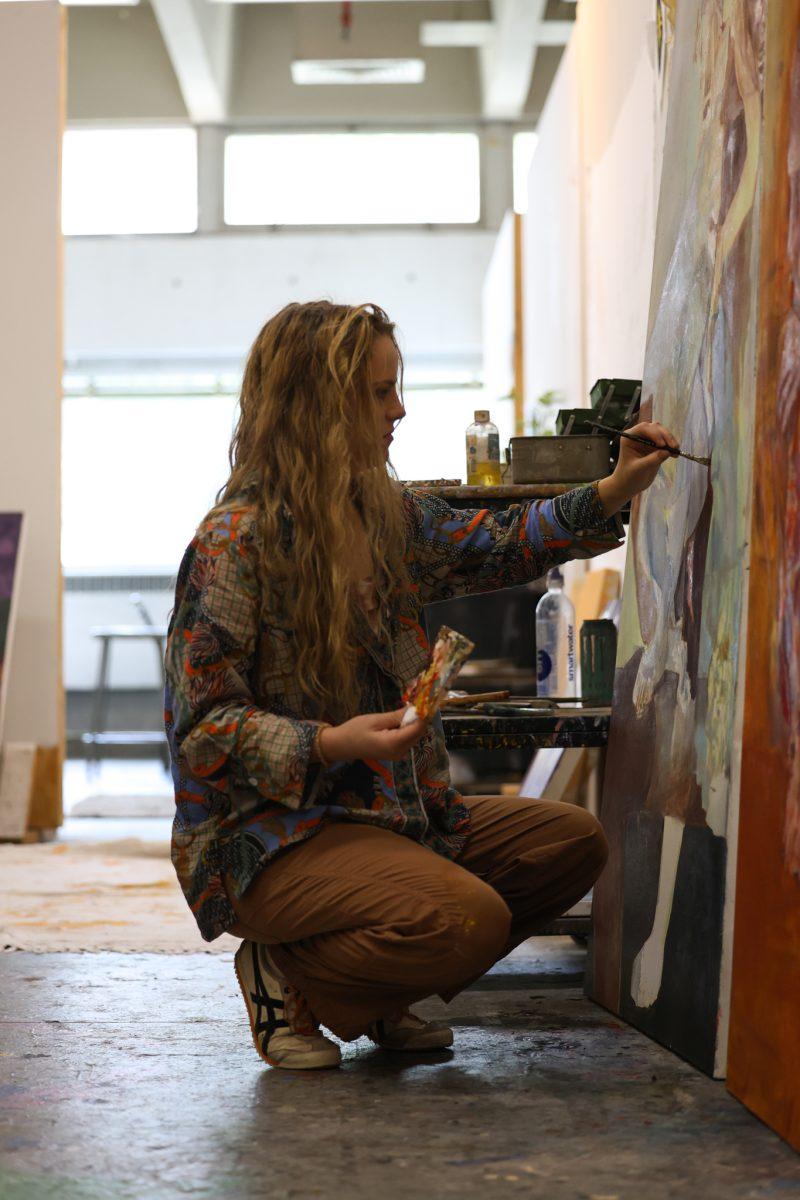
UT student, Anna Babcock, working in a studio in the Arts and Architecture building. Tuesday, Sept. 30, 2025.
Her father acknowledged how much time and effort has gone into preparing for her gallery, and how it’s given her a quiet space to reflect on everything she went through.
“Just getting ready for this show … a lot of that time she’s sitting alone, quiet, just thinking about what happened so she can convey it, so I think it’s been really good for her,” he said.
All of the reflection time has fine-tuned the details on the story that she wants to share. A truthful story, that is emotional, that is honest. It was the willingness to share her story that motivated her to apply for a gallery space.
“I think being able to be in galleries and being able to tell that story in one place,” Babcock said. “As well as my community who’s walked so close with me and been such incredible support, to be able to be with them and art influenced by the last year or so.”
The people who helped and stuck with Anna Babcock — her family, the nurses and her friends — all played a key role in her recovery process. They served as a source of inspiration and motivation for her not just in the moment, but long-term.”
“(She was) really affected by the impact the nurses had on her mental health and comfort, ’cause they were checking on her and talking to her as a person and not just a patient,” Charlie Babcock said. “She saw a career she could thrive in and have empathy in and it opened her eyes that it could be a really good fit for her.”
Alongside art and psychology, she is working on her prerequisites for an accelerated nursing program. Her experience with her own nurses inspired her to want to be that person for someone else. She’s used her background and relationship with art as a foundation for this interest.
“As I learn the language (of art), it makes me more curious about other people and being able to interact with people in a different way as opposed to observation and curiosity,” Babcock said. “I think it’s made me more compassionate with people and the way I interact with the world — it also brings me a lot of joy.”
Art has allowed her to express herself to other people and interact with them on a deeper level. She can bare all of her emotions in their truest state through paint strokes on a canvas or a carefully created sculpture. Every individual piece comes together to form a greater picture — a picture of grief, hope and life all blended into the story of Anna Babcock’s burn patient journey.
“I think in terms of burns specifically and telling my story through that, people would just be encouraged to just share with others and let your burden be taken on by those who are offering, even though that’s not always easy for me to be taken care of by others,” she said.
The past 16 months have been a series of complex emotions and continuous treatments. Throughout it all, she maintained a positive outlook and faced every challenge head-on.
“Her mom and I are just incredibly proud of her, the way she faced it, the way that she’s taken this on,” Charlie Babcock said.