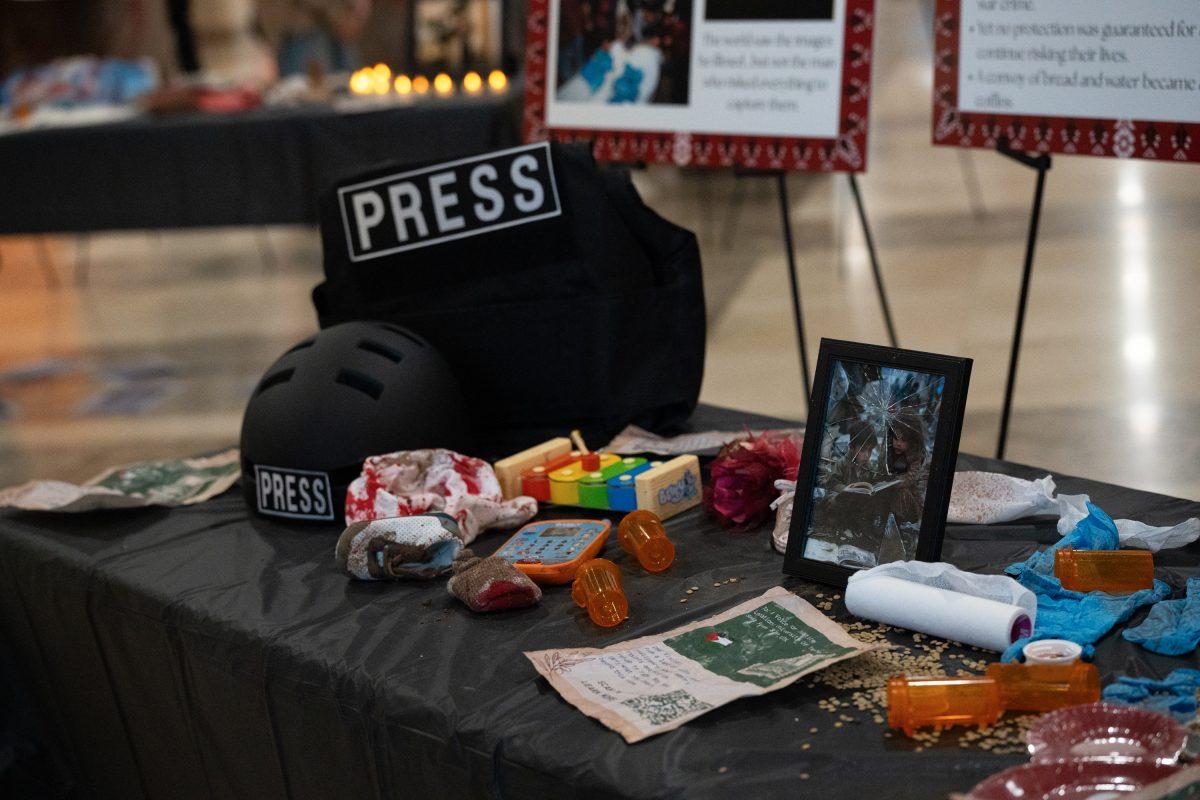
Blood-stained garments and children’s toys, spilled food and tampered with aid covered the tables of the Students for Justice in Palestine exhibit, “Echoes of the Land.”
Photos of killed Palestinians are surrounded by candles, creating vigils for the individuals. Showcased in Hodges Library on Wednesday, Oct. 22, the exhibit’s location allowed easy access to educate and spread awareness of the occupation in Gaza.
Set up by location, the exhibit allowed viewers to be visually taken through the Gaza Strip. Starting from the top of the strip, Rafah, then Khan Younis, Gaza City and onto the Occupied Territories, Jerusalem and the West Bank.
“When you see headlines about Palestine or Gaza, you’re thinking of it as just one word,” Raiyan Abumayaleh, UT student studying biological sciences and a member of SPJ, said. “We really wanted to emphasize that there are so many different cities, and every city has its own stories, history, families and massacres.”
The exhibit’s name symbolizes the geographical distance between Gaza and the U.S.
“We’re the voices for the people who can’t … speak up for themselves,” Abumayaleh said.
“Echoes of the Land” begins by taking the viewer through the history of occupation in Gaza, starting in 1917 during the Battle of Jerusalem, to the present day. Abumayaleh explains that she wants viewers to recognize that the occupation started long before Oct. 7, 2023.
“This has been a long, long going over generations and decades,” Abumayaleh said. “Yes, Oct. 7 has brought more awareness, but we want to make sure people know that it’s not something that started in 2023.”
An important aspect included in the exhibit is visuals of the journalists who were killed in Gaza during their reporting. In Khan Younis, Al Jazeera cameraman Samer Abu Daqqa, “was murdered in a targeted drone strike covering the aftermath of an earlier bombing,” one of the displays reads. Abu Daqqa is one of over 270 journalists who have been killed in Gaza since Oct. 7, 2023.
“Killing a journalist is a war crime,” Abumayaleh said.
Abumayaleh explains that the targeting of journalists is a way for the Israeli occupation to block coverage of the Gaza Strip.
“The easiest point for us to get information and see updates from our own families is through these journalists,” Abumayaleh said.
The majority of Abumayaleh’s family still lives in Palestine. She explains that communication with them is sometimes unavailable. This leaves headlines as the only information accessible to her, creating a huge importance of having journalists on the ground.
Hamzah Saleh, a UT student studying computer science and a member of SJP, explains what he hopes can be taken away from the exhibit
“It’s not an isolated issue,” Saleh said. “There are students here who are personally from that area and are affected by the conflict going on over there.”
By educating others on the occupation, SJP aims to bring more awareness to the Palestinian community.
“I just hope that a lot of people who maybe are indifferent to the cause, or maybe even against it, can learn something from it and really see the narrative that’s different from what we’re told,” Saleh said.