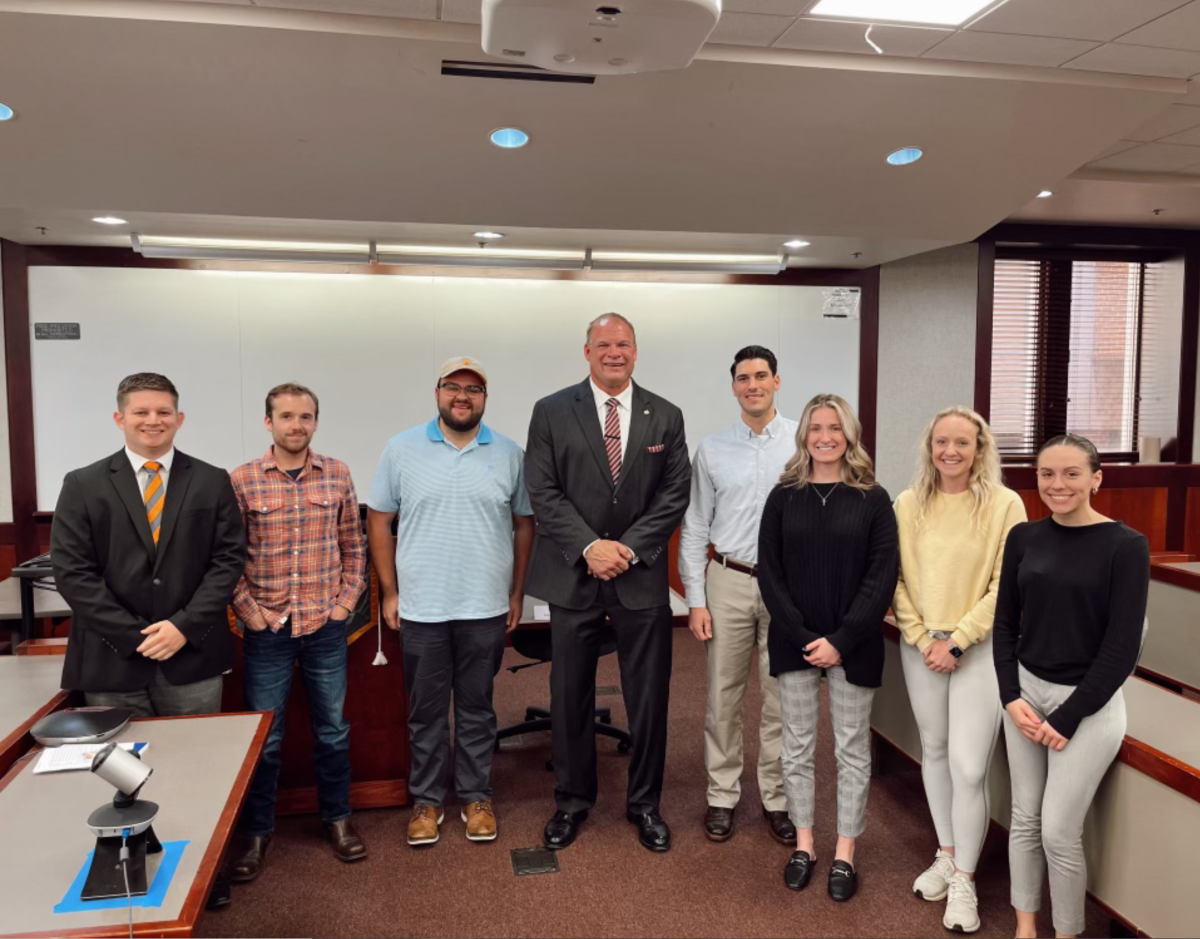
We are definitely not a “secret society,” but we are a well-kept secret at the University of Tennessee. We are a relatively small student organization at a small college and a large state university, but our small size does not reflect our passion and influence.
The Federalist Society was founded in 1982 on the campuses of Yale, Harvard and the University of Chicago to provide a forum for debate and discussion. Today, there are over 60,000 members of the Federalist Society. These members range from law students in over two hundred law schools to lawyers in every practice area to United States Supreme Court Justices. “Law schools and the legal profession are currently strongly dominated by a form of orthodox liberal ideology which advocates a centralized and uniform society,” and the Federalist Society was created to bring together conservatives and libertarians interested in the current state of the legal order to promote awareness on topics related to individual liberty, traditional values and the rule of law.
Over the past several years, the Federalist Society at the College of Law has fallen dormant. Most undergraduate students have never heard of us, and before the start of this academic year, many law students likely had no idea who we were or what we did. However, over the last six months, the student chapter has worked tirelessly to bring in guest speakers, host events related to recent Supreme Court decisions and promote collaboration with other student organizations. A primary goal of these events is to introduce law students to conservative thought in an inviting, respectful way that makes it approachable to all. We want to promote respectful discourse, spirited debate and bring together like-minded individuals in the face of opposition.
We as an organization have been striving to open the eyes of our peers to issues that affect all of us and highlight key principles related to originalism and textualism. However, our efforts are not met without opposition. Due to the general mindset of the legal profession, especially law school professors and law students, opposition comes in many forms ranging from sideways comments in the halls, reluctance to host joint events and an underlying, but often unspoken, reluctance to offer funding and meeting spaces for our student organization. We have struggled to gain support from the College of Law administration. Because most law school professors and administrators are of a single ideological mindset, their willingness to engage with other student organizations is apparent and may, although inadvertently, dissuade students from engaging with our student organization due to a lack of support, fear of retribution and a notion that our thoughts are somehow radical or unsupported. Furthermore, nearly all other student organizations are integrally involved in the running and direction of the College of Law and its sponsorship and activities, but the Federalist Society is perpetually left out of these conversations.
We do not set out to change people’s minds. Instead, we seek to introduce ideas to people that they may never have encountered. In some instances, our meetings and subsequent messages may be the first time these ideas have been heard by our peers. This places us in a unique situation. We must maintain a respectful and inviting environment while introducing concepts that are inevitably controversial. We are nonpartisan and do not advocate in any political sense, which means that we do not lobby for legislation, take policy positions or sponsor or endorse nominees and candidates for public office. However, we do seek to promote traditional, conservative values and an interpretation of the United States Constitution, and as such, the laws of our state and federal governments in accord with the beliefs of our Founding Fathers – beliefs that were once majority opinions, but are now suppressed by the ever-controlling, dominant and pervasive agenda.
It is sometimes disheartening to encounter people at the College of Law and the university who are unwilling to engage with our organization. The university consistently makes decisions that run afoul of our state constitution and enact policies that are troubling. The university constantly boasts “diversity” in everything it does and says. However, the type of diversity our organization promotes — diversity of thought — is perpetually disregarded. Our organization is made up of individuals from all walks of life and lived experiences, so we promote a different form of diversity. This is a concept that is seldom endorsed. However, it can be argued that this is the true diversity that must be lauded. Diversity of thought does not depend on how you look, how you talk or where you are from. It depends on your moral framework and the beliefs that you deem important.
Moving forward, we hope that the university recognizes the importance of intellectual diversity on campus. We need to promote open and free discourse regarding hard and controversial topics. The university must adopt policies that are symmetrical and unbiased for all groups of students and student organizations.
Just because a thought or idea is mainstream does not mean it is right. We challenge the readers of this article to think hard about the beliefs they hold and accept challenges to those beliefs. Open discourse and debate are primary vehicles to introduce people to foreign concepts and can serve the purpose of highlighting ways of thought previously hidden by the mainstream agenda as well as strengthening your ability to defend your beliefs. Lastly, even if you are not a law student or a member of the University of Tennessee system, the concepts we promote influence how you vote, how much power you, as an individual, play in your state and federal governance and the knowledge you possess regarding important topics.
Columns and letters of The Daily Beacon are the views of the individual and do not necessarily reflect the views of the Beacon or the Beacon’s editorial staff.