“Heated Rivalry” just wouldn’t be as popular if it were two women — but why?
Oftentimes, people plead for LGBTQ+ representation in the media, yet they have a narrow view of what they truly want to see. The gap between popularity in series with gay men compared to gay women is apparent. For instance, throughout the various social media platforms, many women start accounts and channels on “BookTok” or “BookTube.” Some make recommendations for LGBTQ+ books, but most of these books only truly represent one group of people — gay men.
Beyond just literature, the difference is still present in visual media. Many viewers tuned into the final season of “Stranger Things” with hopes of the popular ship “Byler” — the hypothetical relationship between two main characters, Will Byers and Mike Wheeler — happening. Byers did officially come out as gay in one of the final episodes, and there were many hints throughout the season that pointed toward his sexuality. Wheeler was in a relationship with a female main character, Eleven, for the majority of the series — however, this did not stop the persistence of Byler fans.
In the end, Byler did not happen, and many fans felt disappointed. But why did fans feel like they were left without representation?
Robin Buckley, another highly involved character in the series, came out as lesbian in the third season and was eventually romantically involved with another woman, Vickie. People begged for “representation,” but they already had representation right in front of them — so why were Buckley and Vickie not sufficient?
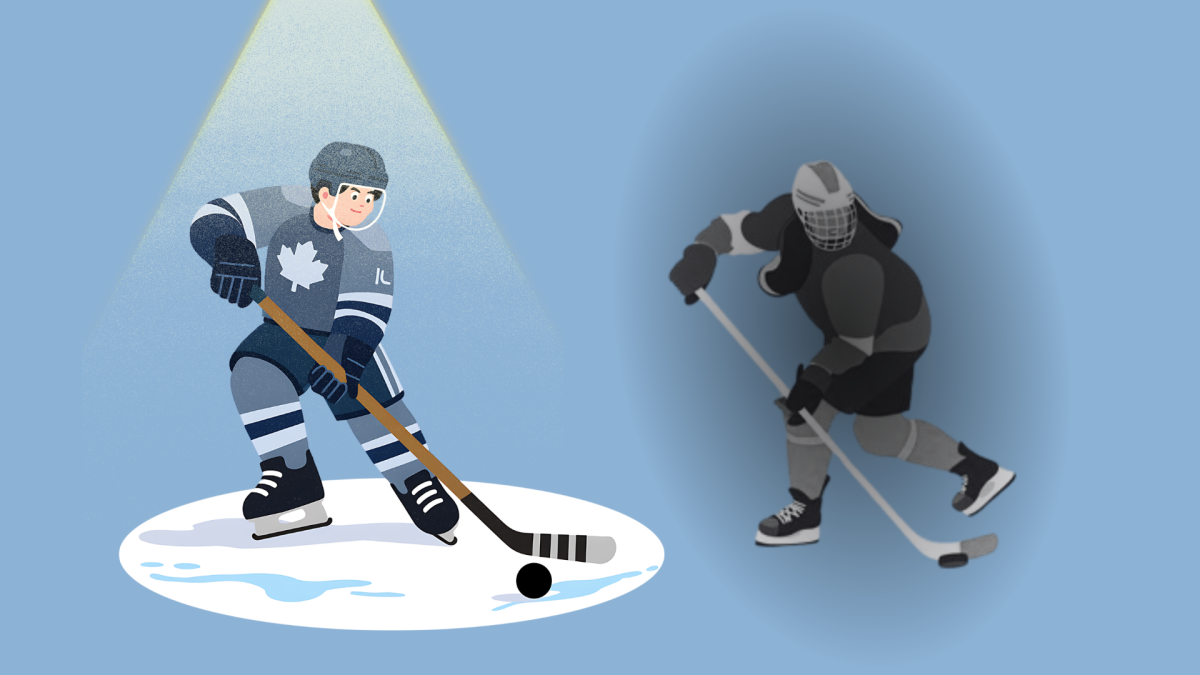
To get to the point, the recent internet phenomenon “Heated Rivalry” has broken records for the amount of views for a scripted series on HBO Max. Based on a book by Rachel Reid, the show follows Ilya Rozanov and Shane Hollander, two male hockey players who connect through a sexual relationship and later become romantically involved. Now, I am not trying to downplay the emotional vulnerability that the series displays between the characters, especially within a sport that can have a more homophobic demographic.
However, many fans are doing more than just appreciating the adaptation. The audience has grown to be mostly straight women, and it’s clear some of them are fetishizing gay men. For instance, comments throughout the internet from women have referred to them as their “boyfriends,” and I have also seen people talk about how they “love when two men kiss.”
But does their interest in MLM (men loving men) relationships stem from a deeper societal root than just physical attraction and their sexual identity?
Yes, and it’s misogyny.
It is evident that the attitudes toward the sexualization of men and women are treated differently. Initially, I thought this was unfair — however, the “why” and “how” of such sexualization are objectively different as well.
Women tend to be perceived as more physically sexual than men for various reasons, such as clothing or gender stereotypes (men paying for a date). On the other hand, women gravitate more toward an emotional “sexualization.” To provide an example, many straight women fell in love with “Heated Rivalry.” However, most of them, rather than commenting on just the physical appearance of the main characters, were drawn to the lack of power imbalance due to both characters being male.
But why is a relationship involving two men the only relationship without a power imbalance?
The reason a power imbalance is still prevalent in relationships involving two women is because of the way women are displayed in different forms of media. Typically, women are “victimized,” and when other women see this, they can subconsciously ensure they have control over the other woman.
Women being shown as a dependent, weaker being has been a trend throughout history due to the majority of nations following a patriarchal system, which only reinforces traditional gender roles. Obviously, because of this, disparity is present in heterosexual relationships too.
So, women long for the display of an emotional relationship where individuals are treated as equals. Unfortunately, the media typically only displays this with MLM relationships. Men sexualize women, especially in depictions of lesbian relationships, but it is evident that women do the same to men. However, rather than the physical attraction that causes men to do so, women desire the equal power balance displayed in the relationship.
As students in college, you have the power to change the helpless, victimized character that prior generations have pushed onto women. Instead, you have the ability to redefine the stereotypes, push boundaries and create a new narrative. Then, one day, the difference in success between MLM and heterosexual or WLW (women loving women) relationships will not be so great.
Women will feel represented as who they are, rather than having to turn toward purely MLM relationships to find a sense of desire for that emotional connection. After that, maybe we can get a “Heated Rivalry,” but with two women instead — and hopefully, it will break records too.
Katherine Hill is a freshman at UT this year studying public affairs. She can be reached at [email protected].
Columns and letters of The Daily Beacon are the views of the individual and do not necessarily reflect the views of the Beacon or the Beacon’s editorial staff.