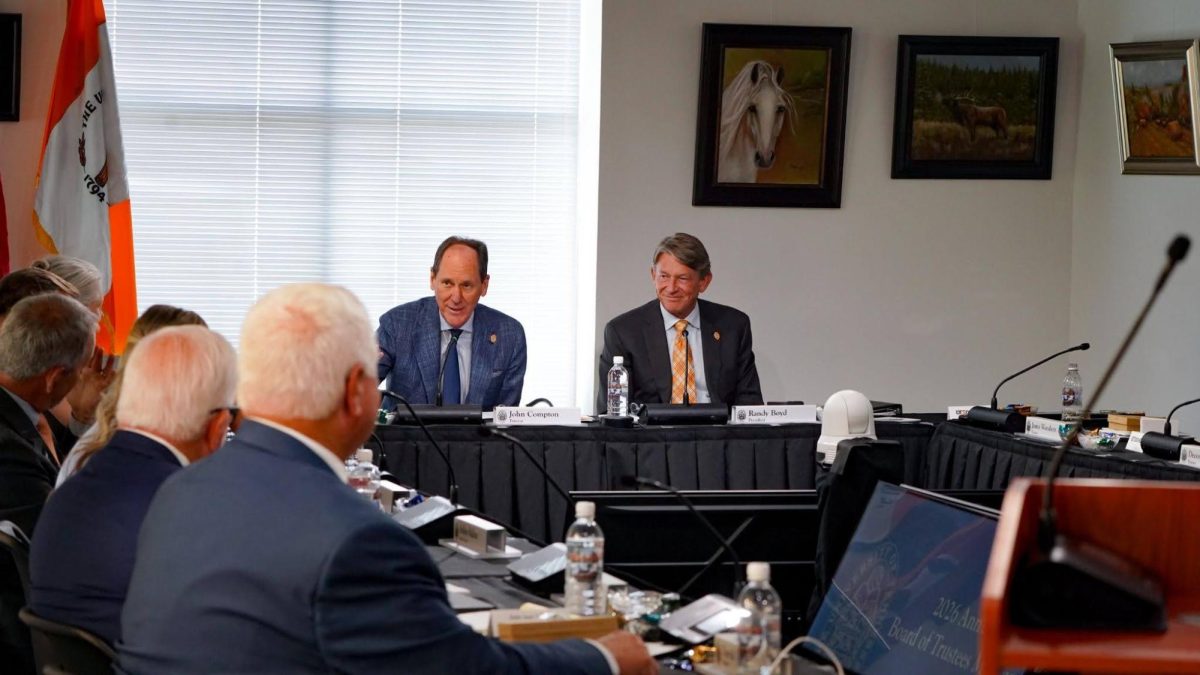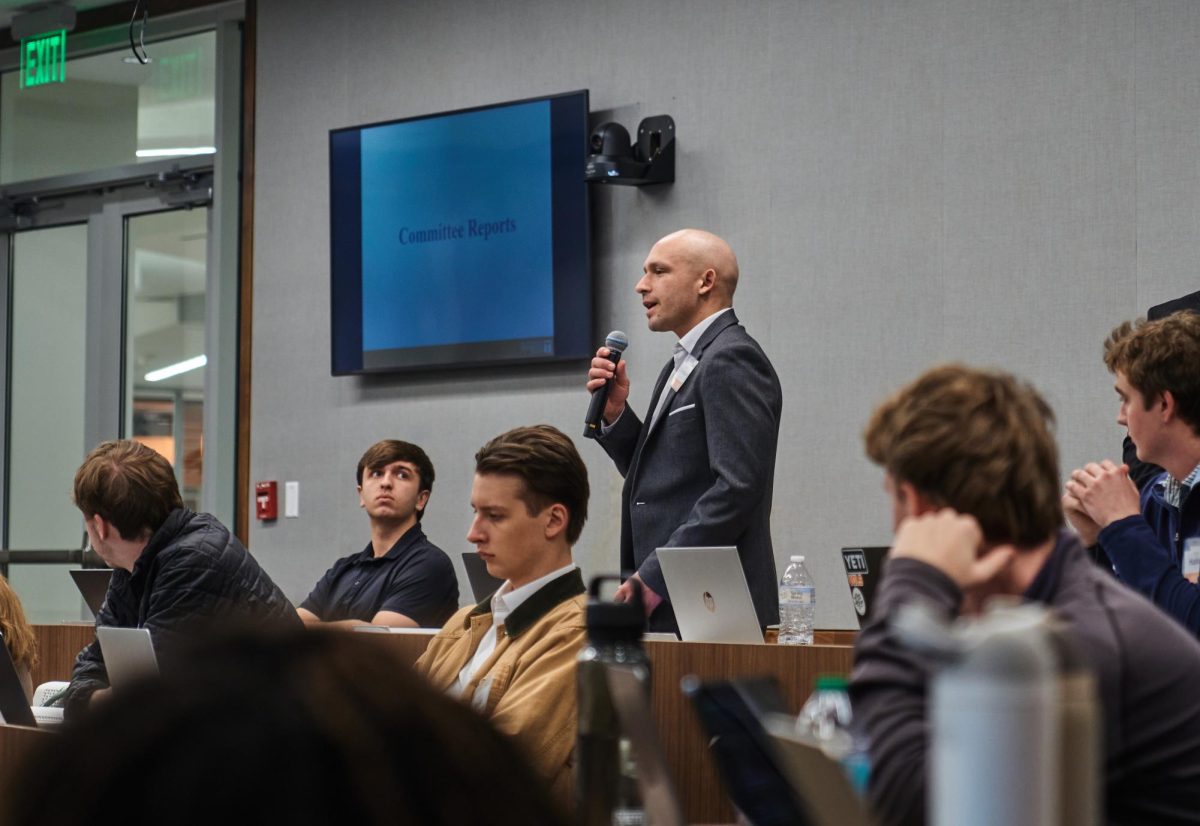
The Chicks late ’90s hit “Wide Open Spaces” sounded through the senate chambers as members of the Student Government Association senate made their way into the second meeting of the month. The 12th session, held on Feb. 17, featured various appointments, as well as the reading of two resolutions and a bill.
Appointments
The Student Government Association welcomed a new member to its executive cabinet. Samuel Strong, a junior at the University of Tennessee, was appointed as the director of communications. Strong, who has a background in communication and media relations, will lean on his skills to showcase the work of SGA to the UT community.
Alongside an appointment to the executive cabinet, the senate voted on three committee chair appointments for Sens. Piper Behan, Annika Amaral and Avery Griffith. Behan will serve as the academic committee chair, Amaral will serve on the environment and sustainability committee, and Griffith in student advancement. Going forward, these senators will be the head of their respective committees.
First readings: Grades, bus stops and canopies
First readings opened up with the presentation of Bill 26-1. This bill, sponsored by the student advancement committee, was presented by Sen. Don D’Arcangelo. In light of continued student success and achievement within the Haslam College of Business, Bill 26-1 asks that the university consider revising its grading system in regards to core business courses. If passed, Bill 26-1, aptly named the “A-plus Bill,” raises the possibility for students in said core courses to be awarded an A-plus on their transcript.
“This is a plus into helping care for the students that truly put in the academic work,” D’Arcangelo said.
Additionally during this time, Resolution 26-1 was introduced. Sponsored by Sens. Jed Baso, Madeline Malone and Luke Hatler, this resolution aims to address inconsistencies seen regarding campus bus stops such as a lack of benches and clear signage.
To allow for students to have a more convenient, comfortable and accessible experience utilizing UT’s bus system, Resolution 26-1 calls upon the university to standardize bus stops, signage and directories. Within the resolution, the senators provided a preview of what these standardized stops could look like.
This resolution will be worked on in collaboration with UT Parking and Transportation, as well as Facilities Services.
Resolution 26-2 was also presented to the senate. This resolution proposes the idea of redeveloping the area behind Alumni Memorial Building and Gate 21 of Neyland Stadium. This is a high traffic area utilized by many for gathering during game days, waiting for buses and talking with friends.
Those who spend time in this space, however, are sometimes subject to weather and intense temperatures. Due to this, Sens. Malone and Baso thought to make the space more comfortable for users. In doing so, the resolution asks that a canopy and additional seating be added to the space.
Bill 26-1 passed with a vote of 86 to 14 to 0. The “A-plus Bill” will undergo review by the academics committee before it proceeds to second readings.
Both Resolution 26-1 and 26-2 were passed with votes of 97 to 3 to 0 and 100 to 0 to 0, respectively. Unlike bills, resolutions must only go through first readings.