As college students, we are on a path to finding our identities and figuring out where we want to go in life. As an important time in our lives, the formation of our identities plays a huge part in the college experience.
The arts are arguably the most common way in which people explore their identities. Since the beginning of time, people have found ways to express themselves through various forms of art such as music, visual art, design, writing and theater.
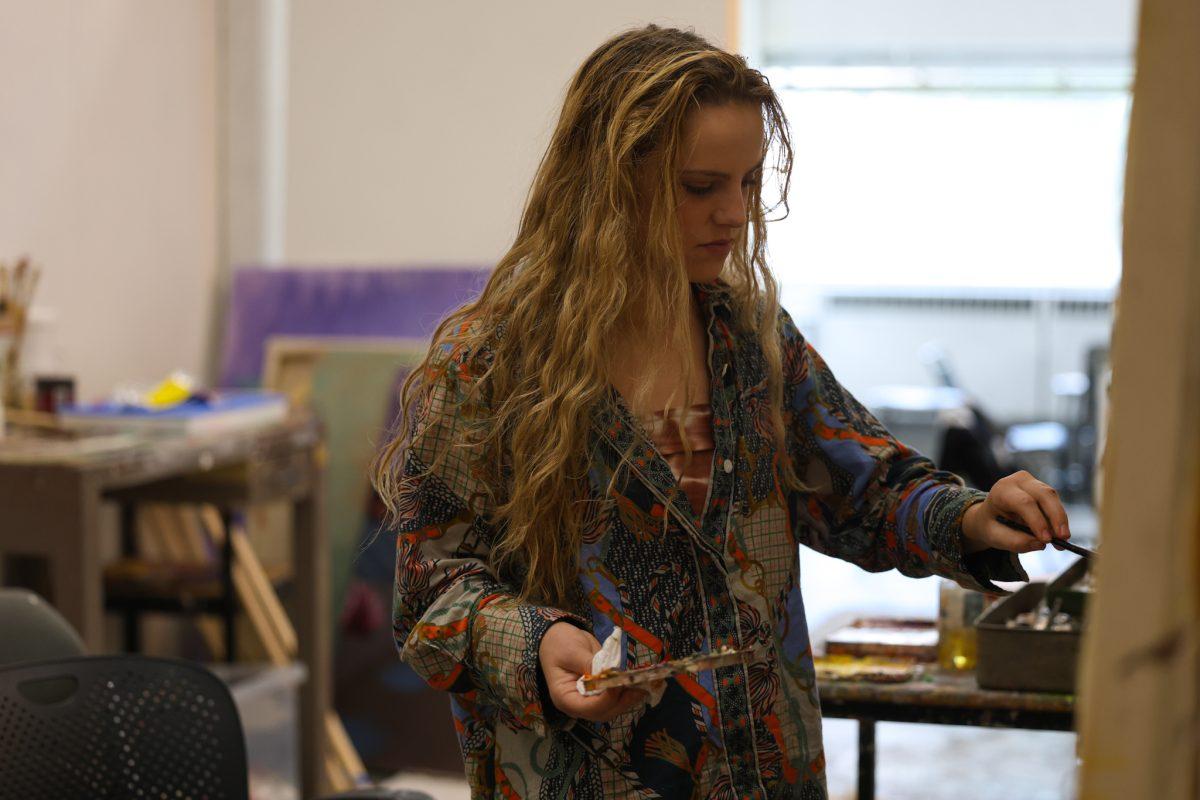
Sophomore Mariam Ceesay expresses herself through visual art and has been interested in art since a young age.
“I would say my interest in art started around second grade,” Ceesay said. “A lot of my interests focused around children’s media, and I watched a lot of creators on YouTube who made content based off it.”
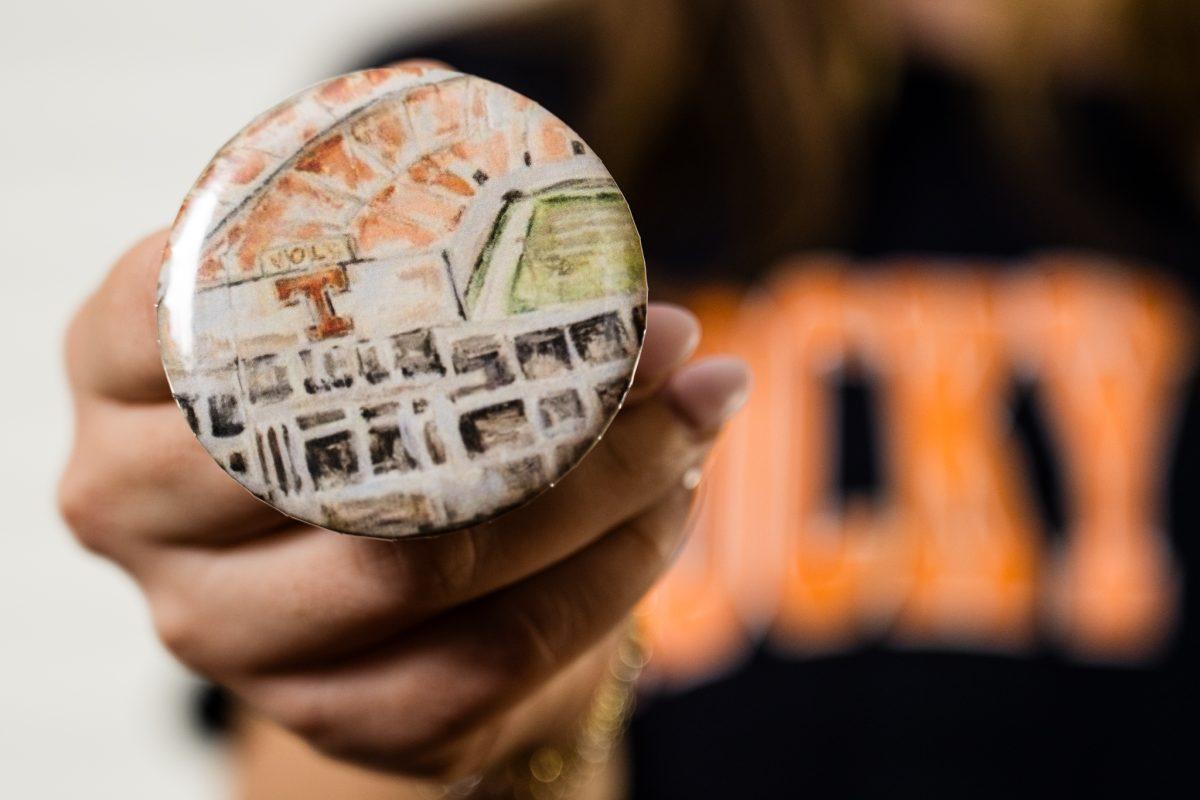
Later in life, she became enamored with the video game Five Nights at Freddy’s and saw that people were drawing art of the characters. In order to reach that level as well, there was a steep learning curve she would have to navigate. In middle school, Ceesay began to dabble with digital art as well as begin improving at traditional art. Her preferred mediums are pencil and watercolor.
“I stopped drawing in lined paper notebooks and started snatching copy paper from my dad’s printer,” Ceesay said. “If I wasn’t sticking my head in a book or playing with my sister, I was definitely drawing.”
She eventually began to create her own original characters and having art skills allowed her to illustrate them. She would often spend days in her own little world just thinking about her original characters.
While her main interest is in drawing, she has recently become interested in the art of doll-making. She also tried animation, but due to the difficulty of the medium, especially when it comes to coloring, she drifted away from it.
She started getting involved with the online digital art community through spaces known as “Closed Species” communities. These were communities online that usually consisted of artists who would create fictional, fantastical species. However, in order to be able to draw these species yourself, you would need to pay the artist for the right to draw them. These communities became a point of contention in the online art community because many felt it was unfair that you basically had to pay to create fanart of a fictional species. Ceesay spent a lot of time in that community before eventually drifting away due to the controversies surrounding it.
“I don’t think I’ll ever be able to hit that speed of art production ever again because I was making multiple polished pieces a day,” Ceesay said. “If I had that kind of energy right now, I’d be an astronaut.”
Later, she started taking commissions on social media such as Instagram. One of the biggest commissions she got was $150. She would also often draw characters from video games that she liked.
While she had originally planned on pursuing a career in art, she instead decided to pursue a degree in biochemistry and molecular biology.
“That’s not to say art hasn’t helped me though,” Ceesay said. “For my first research study job, they let me in because I could illustrate well and so I got to do a little graphic for them.”
Other than having a work study in a research lab, Ceesay is also secretary of the Poetry Appreciation Club. In her spare time, she enjoys drawing, video games, reading, a little bit of creative writing and watching documentaries. At the moment, she is obsessed with documentaries on natural disasters and severe weather.
Her identity has played a definitive role in her art throughout the years. Her parents are from Gambia, but she was born in the U.S.
“Through art, I could find a community and make friends.” Ceesay said. “You will also meet a lot of people doing digital art because a lot of identities come into play. Online, you also meet a lot of people from around the world. I’ve met people from basically every continent.”
Her identity has helped her strengthen her art on her journey. Art provided her with an outlet through feelings of isolation and mental health struggles.
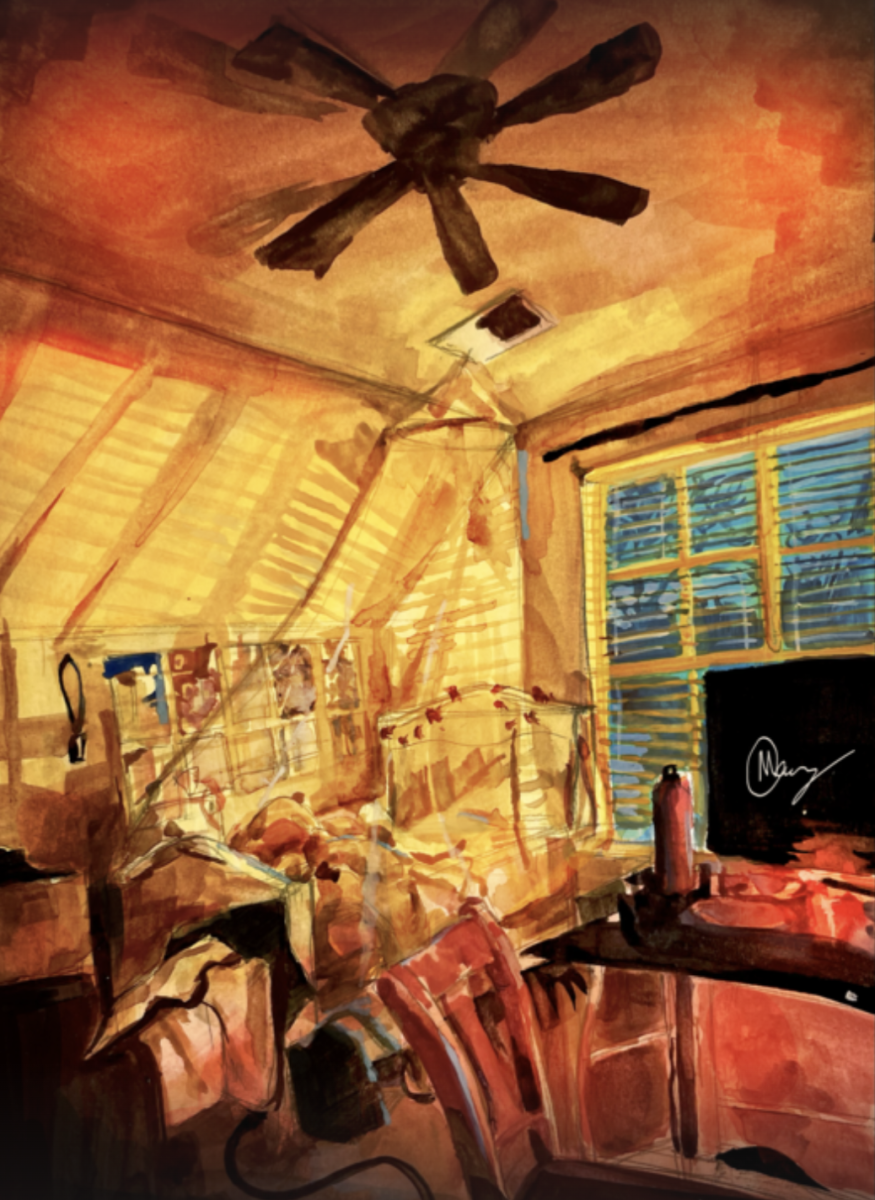
“When I was doing AP art in high school, one of my portfolios was related to isolation after Covid,” Ceesay said. “I had done paintings of parts of my childhood home and there were little bits of my identity that popped through. I used little white rabbits as a representative of myself in some of my art. I’d been going through a lot mentally, so that showcased itself in the themes I decided to focus on. I’m a very anxious person, and I decided to use that as a jumping off point of my art. There’s some art of monsters peeking out from under my bed. Shadowy figures in the backgrounds of looming social pressure and things like that. Childhood fears and anxieties also played into it, like a fear of abandonment. I would take pictures of isolated environments and add in shadowy figures.”
One of her goals she’s working toward is getting better at drawing humans. She’s drawn mainly to animals or fantastical species, and so the way she draws humans is inconsistent, but she’s determined to improve.
“I continue to make art because it’s not just a hobby, it’s a means of self-expression,” Ceesay said. “Even if I lost both of my hands and somehow my feet as well, I’d still find some way to draw because I have ideas and the easiest way to get these ideas down is to draw them.”
Charles Berlin, an art teacher at White Station High School in Memphis, taught Ceesay in AP art, and was very impressed with her artistic prowess.
“While she was my student, she demonstrated excellent technical skills in watercolor, selecting usually very challenging subject matter to render,” Berlin said. “Mariam also had a fantastic ability to let the watercolor medium go ‘loose’ to create more mood.”
Berlin says Ceesay was “way beyond her years” with the pieces she created during her time in AP art.
In the modern art community, there are a lot of conversations being held around generative AI and its place, or if it even has a place. Ceesay is vehemently against generative artificial intelligence, especially when it comes to visual art. One of her reasons for opposing AI is because of the lack of effort involved in generating an image.
“One of the big joys in making art is the actual making of it,” Ceesay said. “Putting art in AI is like mass producing art, and many AI images are stolen from artists without their consent. Artists already have a difficult time finding work, and mass producing stuff hurts artists a lot.”
Recently, there has been a rise in the popularity of generative AI. Programs like ChatGPT are often used to help with writing, and there’s a variety of programs that generate images. There are also programs that will generate music. Even college classes are beginning to integrate AI into their coursework, and many companies see it as the future. However, AI is also embroiled in many controversies. Many artists and workers are against it, seeing it as unoriginal and also blatant plagiarism to use AI-generated things. There are also concerns about generative AI’s impact on the environment.
“I think, eventually, people are going to have to back out of generative art,” Ceesay said. “One of the larger issues is that AI generation is a massive energy sink. We are already facing the repercussions of our human hubris and massive energy consumption.”
She says we may be getting closer and closer to the Dead Internet Theory, a theory that predicts that the internet will become nothing but bot activity and AI-generated content, wiping out any organic activity. It’s quite a dystopian idea.
“I think we’ve entered an age of humanity where we are in an age of disinformation,” Ceesay said. “With the ability to generate images and videos, we’re entering into a stage where there’s no guarantee that what you’re looking at on the internet is real or not.”
She also thinks of AI art as “soulless.”
“One of the benefits of the internet is interaction with actual people,” Ceesay said. “People want to see something real. Why should I look at art if you didn’t care to create it yourself? I’d rather watch an elementary schooler make a flip-a-clip animation than watch an AI generated animation.”
It’s not just artists who are in danger from AI. She says AI could also put college professors out of a job.
“If AI becomes a thing, art professors will lose their jobs,” Ceesay said. “If no one is learning to do art, who will teach people how to do art? I think we’ve approached technology in the wrong way. Make a dishwasher that’ll load itself, instead of AI that’ll copy all art.”
Ceesay hopes for a world where original art can be created by humans, with their identities flowing into their art like hers does. In the end, it’s our identities that create art, and our individuality gives that art meaning.