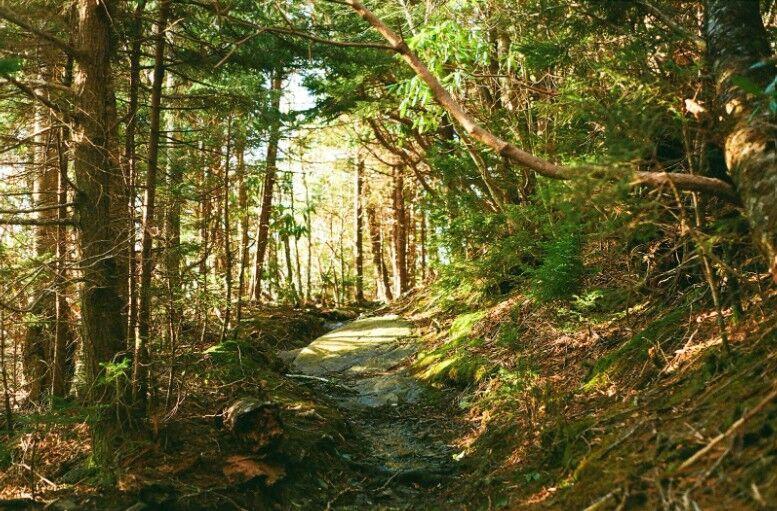
I had a chance encounter with the winter caretaker of a famous lodge in the Smoky Mountains.
I wanted to learn his story.
To find it, I had to race time and sleep amongst the snow on the tallest peak in the Smokies.
I first met a man who went by the name “Wildcat” back at the start of the new year. I was eating lunch at a desolate Le Conte Lodge with two friends when he appeared out of thin air, smoking his omnipresent pipe.
He’s the only presence in a place covered in snow and desolation. Grey hair enveloped the side of his head like a halo. He had a grey beard that hung loosely from his chin. His brown down jacket faded with age, covered his grey flannel shirt in the frigid January mountain air.
He spoke in a slow, quiet, Western American drawl. His introductory sentence was, “Did you know that mittens are actually warmer than gloves?”
The snow melts as he talks.
His answers are sparse when you ask him a question. His demeanor is stone cold, yet not unfriendly. Yet, I was immediately fascinated by the guy. From mid-November to mid-March, he spends most nights in isolation as the winter caretaker of the lodge, resting atop Mount Le Conte.
Most of the time, his only companions are hikers staying at a shelter three-tenths of a mile away. He occasionally invites guests to his cabin, but most of the time, he sits alone, with nothing but a radio and a journal to occupy his time.
His only source of heat is from kerosene heaters in the four walls of his cabin. His only food is leftovers that were dropped onto the peak from a helicopter roughly a year prior. His job was essentially that of Jack Kerouac’s when he was stationed alone on Desolation Peak in Washington State. He appears to have mastered the art of desolation, isolated on a peak in the East Tennessee wilderness. Not only that, but upon asking him — “Have you ever hiked the Appalachian Trail?”
I received the reply, “Name the trail. I’ve done it.”
Upon reading up on his trail journals, it’s pretty safe to say he’s earned the right to say that. He’s hiked the Appalachian Trail twice, as well as the Continental Divide Trail, the Pacific Crest Trail, the Colorado Trail, the Florida Trail and pretty much any distance trail with abbreviations.
Wildcat wasn’t always Bert Emmerson’s trail name. When Emmerson was relatively new to the area, he would drive through the mountains with friends in a Jeep. Communities were built around people driving around with CB radios back then. They weren’t just reserved for truckers. Trucker or not, you needed a CB name, and if Emmerson didn’t pick his own, his buddies would choose one, and he might not like it.
He went back to his roots for his new moniker. His life didn’t revolve around the beauty of the natural world as it does today. Back then, it was farming. He grew up on a farm in the flat plains of Osbourne, Kansas, with yellow grass, a never-ending wind and winters filled with snow, freezing air and dark days. Plus, a constant, non-stop wind.
Emmerson went from the farm to Kansas State University — the Wildcats. The only university in the world with a major in livestock food manufacturing. He got his degree and started working in agricultural food production.
After having only lived in Kansas, he got a job working for a food lot in California before he received a phone call about a potential job offer in Tennessee.
Immersed in the beauty of the hills and by the mere size and awe of Neyland Stadium, with the help of better pay, he found himself in the mountains of East Tennessee working in yet another food lot.
And then, in April of 1987, he had a profound experience. He hiked across the Smoky Mountain portion of the AT. From shelter to shelter, from Davenport Gap to Fontana Dam, he found characters from all over the world with different motivations and aspirations, all unified by the call of the woods.
“ I decided that when I wanna grow up, I wanna be a backpacker just like them.”
I’d told people all the time about this guy, this mythical figure who got paid to take care of a cabin in the middle of a national park. I had since gotten a position as a contributor for The Daily Beacon and told them I wanted to write a story about this guy. My buddy Harrison Ing, a fellow writer for the Beacon, said he wanted to come along. He’d never been backpacking before and was just as curious to meet this “Wildcat” and find out his story as I was.
The day before our ascent, we learned through the official Le Conte blog, “High on LeConte,” which Wildcat runs during the offseason, that the peak had received four inches of snow and that Highway 441 — the main road through the Tennessee region of the Smokies — was covered in snow.
With April rapidly approaching, I knew my window was limited.
Yet, before I could hear his announcement for that day, my girlfriend had told me that she hiked up to Grotto Falls via Trillium Gap, one of the five routes up to Le Conte — jackpot.
We didn’t get out of Knoxville until 11 a.m. on March 8 and didn’t get on the trail until 2 p.m. Harrison, inexperienced as he was, fastened his rented tent and sleeping bag onto his school backpack with his belt and a bungee cord that just so happened to be in the trunk of my car. In his backpack was a copy of Slaughterhouse-Five and The Alchemist by Paulo Coelho, along with a sketchbook.
He had a jacket he used on an expedition to Antarctica hanging loosely over his tent and sleeping bag, with his water bottles dangling in his jacket pocket, making the weight on his back anything but centralized. The disorganization, along with the abundance of luxury items, bode for extreme discomfort in his shoulders, with his backpack straps cutting into them.
“I don’t think I can make this man,” he admitted to me with less than a mile into the hike.
But we had no choice. I was going to be gone for two weeks afterward for spring break. The day after my return, the Le Conte Lodge would open for the season, and, presumably, Wildcat would be back home, wherever that may be. I couldn’t miss this.
We had less than four hours to hike one of the longest routes up to the Smokies’ tallest peak. By then, the sun would set and we may have been screwed.
Wildcat was restless in the summer of 2015. He was 67 years old and had been retired for 10 years, becoming what he calls a “full-time backpacker.” He’d hiked the AT once before, southbound, back in 2004. He’d since hiked the Pacific Crest Trail and the Continental Divide Trail twice.
But the thing about thru-hiking is that it gets addictive. It doesn’t matter if you’ve done one or all three. There’s something about it that grabs hold of you and won’t let go, no matter how many thru-hikes you’ve done.
He’d been contemplating which trail he’d hike when the Holston Conference, a Methodist Ministry comprising churches from Tennessee, Virginia and Georgia, contacted him to hike the AT again as a Trail Chaplain. This time, he’d be hiking during the backpacking offseason, when the weather would cool to an eventual frigid temperature, and the fallen leaves would eventually be covered with bitter snow.
“I don’t know why they asked me,” Wildcat told me. “I drink. I smoke. I cuss. I don’t know why they picked me of all people. They just told me all I had to do was walk 2,200 miles and follow the golden rule.”
From Maine to Pennsylvania, everything was fine. Then, he tripped on a rock and developed a hernia in his abdomen. He continued hiking anyway, for 450 miles. He got to Virginia, where it just became grueling. He decided to leave the trail and head back home for surgery.
“I’m certain that this is all part of God’s ‘Master Plan,’” Wildcat wrote in his trail journal. “He is constantly attempting to teach me important lessons in Patience, Humility, Tolerance, Acceptance, Love, and all of those other important virtues where I may be falling short of perfection.”
Halfway through our hike, we stopped at a tall spring sprinkled with white water that rolled down the hill beyond our eyesight. We were running low on water and decided that this would be the place to refill. I got out my filtration system and filled the bag with cold water. It looked crystal clear and refreshing until I squeezed it through the filter and saw the water transform into a white opaque liquid.
I investigated my filter only to find that the main filtering ring was gone. I had a small bottle of iodine tablets in my backpack. But those take thirty minutes to dissolve and purify the water when you buy a brand new bottle, and my bottle had been rattling away in the top compartment of my backpack since I was in Boy Scouts.
“Here’s what we’ll do,” I said urgently to Harrison. “We’ll forgo water until we get to the top of the mountain. We’ll ask Wildcat if he can take a look at my filter before we conduct the interview.”
Harrison and I raced through the pines of Trillium Gap. The sun sank quickly, and the sky turned from a bright orange to a cool, dark blue as we reached the peak. Snow had crept its way up toward the top, increasing in volume with every step as we climbed on.
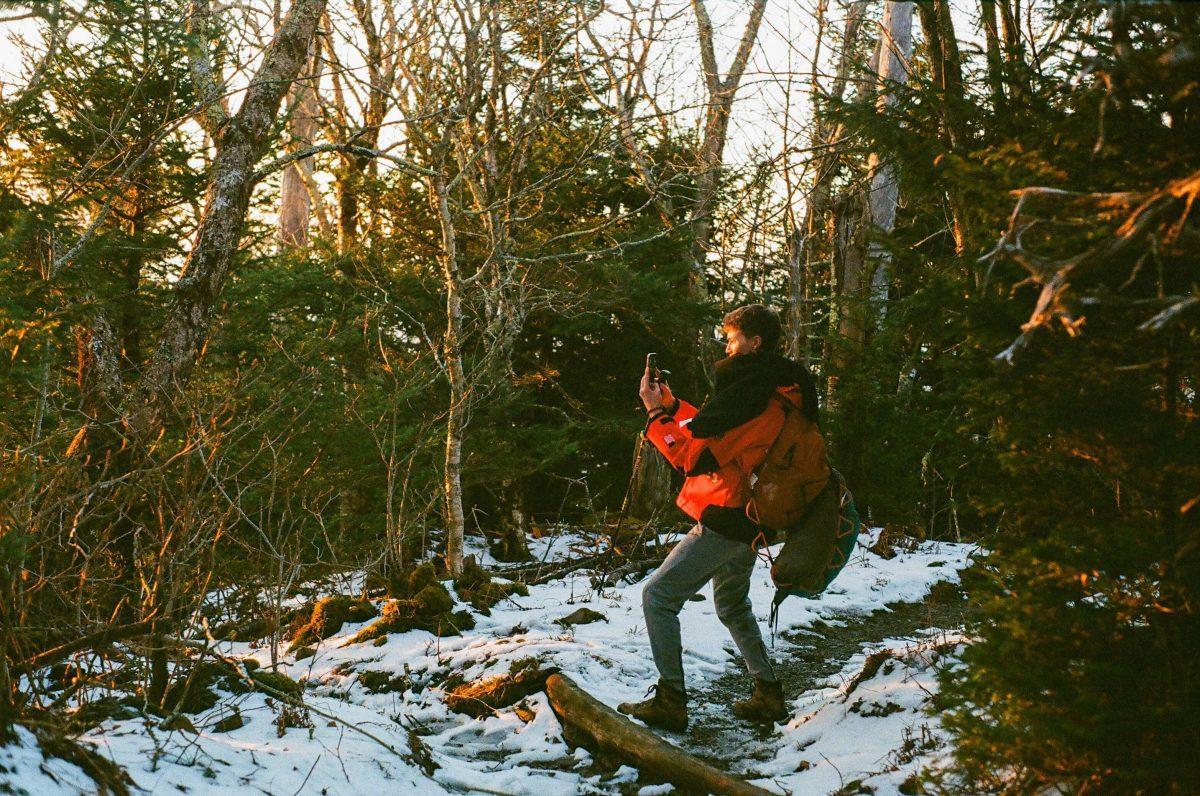
Staff Writer Harrison Ing quickly stopped for a photo on the ascent.
We passed a spring trickling with water as we reached the village at the top of the mountain. There were old cabins propped up all around, both big and small — all made of wood.
The birdcalls had silenced. There was no sound but a slight breeze and the sway of the trees overhead. As the sun finally descends completely from sight, a slight chill emerges. We had to get our headlamps out. A small kerosine lamp shone in the window at a cabin at the bottom of the hill. A radio faintly played bluegrass in a cabin overlooking the ash and poplar trees. A few jovial voices crept over the sound of the radio.
Harrison walked up to the cabin with the music and knocked on the door, hoping that we’d be let in for the interview over some stew and tea. Wildcat was more apprehensive about such a thing.
“Do you guys have a card?” he asked upon hearing that we write for a school newspaper.
“I’m just a contributor,” I reply. “My buddy here’s the staff writer. I don’t think he has a card on him.”
“You realize it’s kind of late, and I have people over.”
My heart sank.
“I know it’s a little late and I’m sorry. We’ll be staying at the shelter overnight. If you want to talk in the morning, we’re fine with that too.”
Wildcat pauses for a moment. “How bout I meet you out at the shelter tomorrow morning after I get breakfast, and we’ll talk then.”
He gave me his card. On the back of it was the purple Kansas State logo.
Before I went back to the shelter, I turned back to him to ask him about my water filter dilemma.
“If you go down about a tenth of a mile down that way,” Wildcat told me, pointing to the trail that we’d just ascended, “There’s a spring down there that has the purest water in the entire Smoky Mountains. I’ve been drinking straight from that spring for 40 years and have been fine.”
This was a little hard to believe. It had been beaten into my skull for years in scouts that no matter what, no matter where, you have to boil or filter your water in order to purify it. Plus, beside the spring itself was a sign that read “BOIL ALL WATER.” And here’s a guy who probably has an immune system that operates as efficiently as an oil tanker, giving me advice that ran counter to anything I’d been taught for years.
“Do I still need to filter it?” I asked apprehensively.
Wildcat looked at me as if I was stupid.
“If it’s the purest water in the entire Smoky Mountains, would you filter it?”
“Fair enough,” I said.
Harrison and I went back down to the spring. We stuck our water bottles right beneath that spring and drank straight from the source. It was as crystal clear and smooth as any water I’d ever drank. We had no complications. It was then that I felt completely in touch with my natural surroundings. Relieved, I hiked to the shelter and tried to stay warm on a 19-degree night.
It was a cold winter equinox when Wildcat woke up at the cabin at the Woods Hostel. He’d just received a resupply of provisions at the Fontana Lodge and was ready to hike to Cades Cove, where his wife Becky would pick him up and drive him to Maryville for Christmas.
A few days prior, his friend Nightingale — with whom he’d parted ways at Stecoah Gap — had told him about a couple named Bonnie and Clyde from New York, who were staying at the Fontana Dam shelter. When he arrived that day, Bonnie and Clyde were still there. They were completely out of food, kerosene and money. They carried no cash due to a distrust of backpackers and didn’t have any credit cards. They were stranded, with ill-fitting backpacks, waiting desperately for their resupply to get there.
There was also a Southbound hiker named RipTide who was also running low on food. As a Trail Chaplain, Wildcat opted to perform a “feeding for the masses” and fed all three hikers with the food he had just received in his resupply. He also gave Clyde a $20 bill for beer and cigarettes, which Clyde utilized for that purpose precisely.
The next day, Bonnie and Clyde, through the forces of nature, were forced to wait and see if their provisions would arrive. The mail wouldn’t usually arrive until about 2 p.m., which would ultimately delay their 12-mile hike to the next shelter. They had no choice but to stay yet another night at Fontana Dam.
Wildcat’s second thru-hike of the Appalachian Trail was filled with tough choices. With Christmas with his family coming up so soon, he had to make another one. Yet, he was indeed a Trail Chaplain, so he decided that he’d spend the night once again with these strangers.
Their resupply box didn’t come in the next day either. His wife was going to pick him up at Cades Cove for the holidays, which, at this point, was an impossibility. Ultimately, he decided that his wife would pick up all three of them at Fontana Dam and take them back to Maryville for Christmas with his family.
The day after Christmas, he took them to Little River Trading Company, an outdoor store in Maryville where he worked at the time. He got them properly fitting backpacks and a new supply of food before his wife drove them to Clingman’s Dome, where they set off with a new batch of thru-hiking strangers with funny trail names once again.
In shelters throughout the Smokies, there are two wooden bunks, each holding roughly six hikers. There are strips of wood approximately six feet long on the bunks, designating where each hiker sleeps. Every single one was taken the night before. We had breakfast with various hikers from throughout the southeast and said goodbye to each one of them as we waited patiently for Wildcat’s arrival.
10 o’clock came and went. Then eleven, then 11:30 — No sign of the guy.
“I’ve got a soccer game to go to tonight,” Harrison told me.
“I’ve got to be at work at seven tonight, but we’ve come all this way. We gotta talk to the guy.”
“Let’s just go back to the lodge and see if he’s still there. If he’s not, we’ll just chalk it up as a loss and head back down.”
We hiked back through the snow. When we returned to the lodge, the trees ceased to surround us, hanging above the cabins. The sun was at the apex of the sky, making the snow on the ground exceptionally bright. Standing on the steps descending to the lodge was Wildcat, perfectly centered with the building behind him, like a concierge of a hotel.
He apologized for not being as hospitable the night before, and we sat on a picnic table and ate lunch. He poured tobacco into his pipe and took slow, thoughtful puffs as he told us stories about driving through the Smokies in his Jeep, his first time seeing Neyland Stadium, hiking through the Smokies for the first time and taking Bonnie and Clyde home for Christmas.
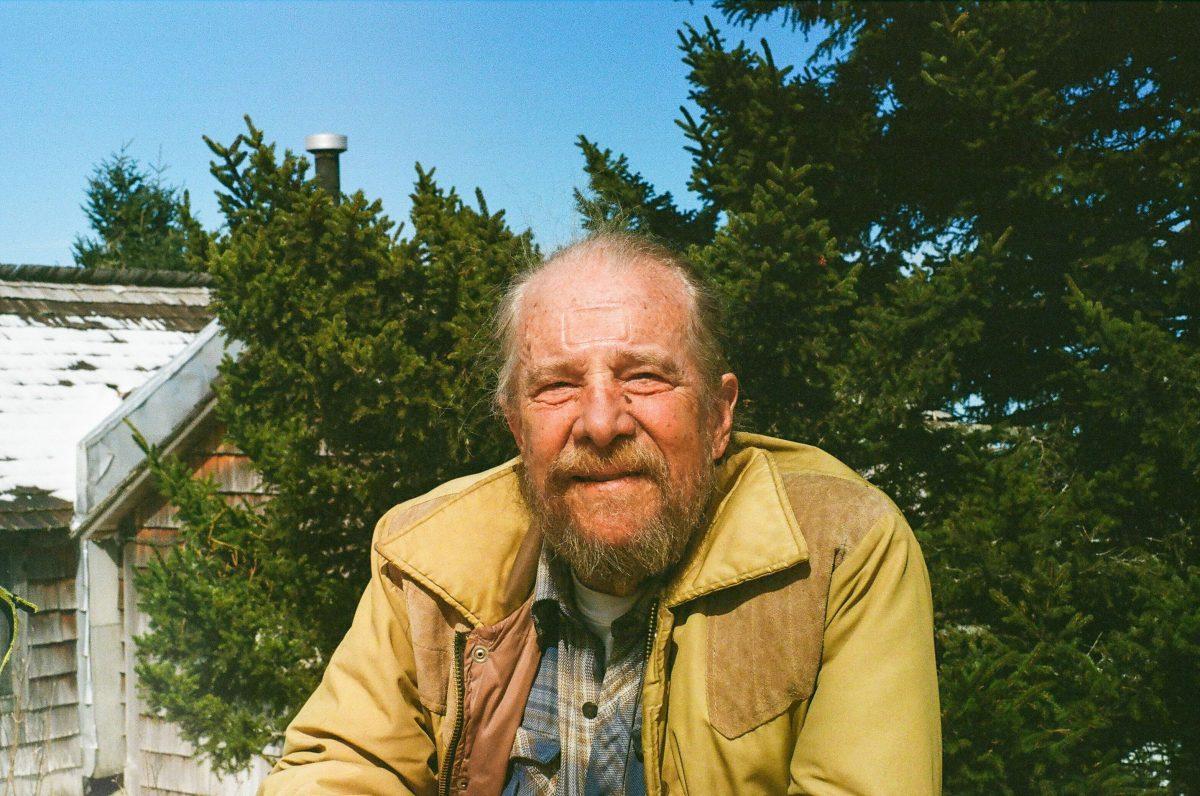
Bert Emmerson, also known as "Wildcat" poses for a photo after the interview.
“Are you religious at this point?” Harrison asked him.
“More spiritual than religious,” Wildcat said.
“Is it based on anything, or is it just your personal ideal?”
“My personal ideal,” Wildcat told us,“It’s difficult to describe. Say you were alone here, on top of a mountain, and all the roads were closed around here. No backpackers coming up here for a couple of days. My footprints were the only ones on top of the mountain. You’re sitting up at Cliff Tops, and you’re close to God.”
As we concluded our interview, some friends who’d visited him before gave him some bread. We asked if we could take a picture of him, and as he posed, he took off his headlamp, leaving an indention on his forehead. God knows why he was wearing a headlamp at noon on a snow-covered mountaintop. We said our thanks, shook his hand, and headed down the Bullhead Trail to our cars and back to the city once again.
A couple of weeks have gone by since I spoke to Wildcat. It’s now 4 a.m. on a weekday, and in exactly one hour, I’m scheduled to get up, immediately put on my clothes without a shower, scrounge around for a travel mug, and get on out the door within twenty minutes to go to work. I’ll go in by 5:30, manually put the lane lines in, and watch old professors take lap after lap in a dingy basement swimming pool that feels like Jell-O.
Yet just a few towns over lives a man who has made my lifetime’s worth of years living amongst the pines and snow, walking mile after mile throughout the United States. In the winter, he gathers water from the purest spring in all of the Smoky Mountains, lives off leftovers and finds himself close to God when the footprints surrounding him are none but his own.
This story was written for Professor Brian Canever’s JMED 414: Magazine and Feature Writing class.
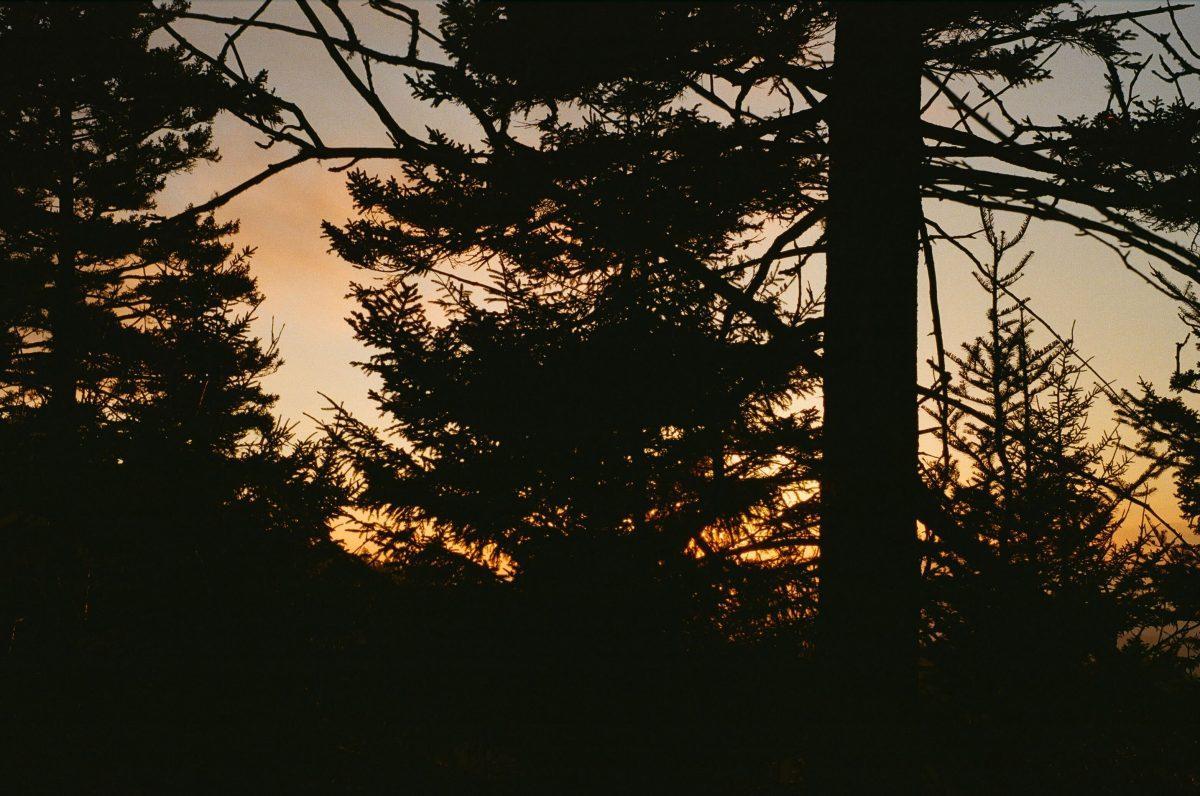
A sunset of the Smoky Mountains as seen on Mount Leconte.