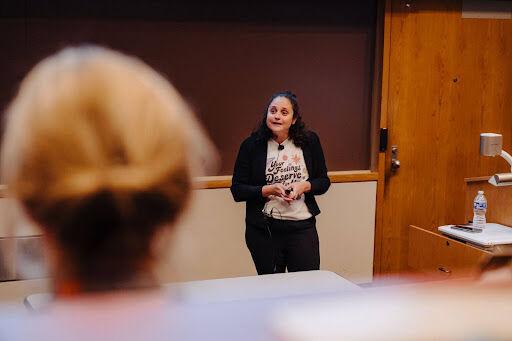
Quick to laugh and even quicker to smile, Chief Wellness Officer Jessica Gold put me at ease right away. Though we were only meeting virtually, the uneasy feeling when you’re about to meet someone new in a professional setting was already settling into my stomach. Jessi, as she prefers to be called, calmed my butterflies and invited me into her life in the sweetest way possible.
Over the next two weeks, I would listen back to numerous interviews with Jessi, her colleagues, students on her wellness council and many others. My intention was to unpack this woman, uncover her passions and introduce her to the University of Tennessee in fuller form. Little did I know that in only two hours of conversation, I’d feel so comfortable around her that I’d be asking for her advice on my personal life.
All I knew about Jessi was from a light feature article written by Macy Roberts for the Beacon in April of 2024. Jessi had just stepped into her position as inaugural chief wellness officer. She had a broad scope of the entire UT system — meaning all five Tennessee campuses — and she had said she was excited to begin assessing the UT campuses and their approaches to wellness.
I wanted to know more about this hefty title of “Chief Wellness Officer” and what exactly that meant for Jessi in her daily life. What I found is simple: for UT students, our wellness is in kind, warm and extremely capable hands.
Connection, connection, connection
Jessi is stationed in an office in Memphis, Tennessee, but you won’t find her there very often. Meetings, flights to other states, seeing patients, attending events (often speaking at them) and seeing her own therapist keeps her very busy. Her calendar is managed by an administrative coordinator (Simone, you’re awesome) and I considered it a privilege to get two hours of her time. It led me to wonder, though, how does one prioritize so many relationships with so many people across the UT system of five campuses, when you hardly see anyone in person?
Jessi told me that as a kid, she moved around a lot, and that was before you could just text or email people to keep up with them. As distance threatened to strain her relationships, she was determined to stay connected despite the distance. Since she’s been passionate about that from such a young age, she finds it less challenging to do the same in her career — maintaining personal relationships with people she doesn’t see in person is just a part of who she is.
“I just think it maybe is something I learned as a skill over time and that as technology has evolved, it’s actually just become easier for me,” Jessi said.
I didn’t speak with a single person who didn’t talk about Jessi as though she was their best friend. By her own admittance, she is a “friend collector,” and the reports were glowing.
“To me, she’s always a person first, she’s always Jessi first. … That humanity is always there.”
That’s Noah Hamlett speaking, senior at UT Knoxville studying psychology. He’s on an undergraduate student advisory council that Jessi works with, composed of students from all five UT campuses. They give Jessi a firsthand glimpse into the lives of students at UT and where she can grow wellness.
For Hamlett, Jessi is a true mentor in his life. With Jessi’s schedule being so busy, they often interact online only. Hamlett says that doesn’t keep Jessi from connecting with him on a personal level — they share a passion for making a difference in other’s lives and improving the way things are for students and healthcare professionals alike. Working with Jessi has been the most impactful part of his time on the council, Hamlett said.
“It’s made me kind of believe in myself more.”

Hamlett spoke of Jessi as a springboard he can bounce ideas off of, a feeling echoed by Lindsay DeVore, the graduate research assistant for UT system marketing. They both mentioned how Jessi supports and encourages their dreams for UT wellness.
As DeVore’s boss, Jessi provides the lens through which DeVore views her job of student communications, which includes running the Instagram page for UT wellness (@ut_wellness).
“We’ve only met a few times in person (because) my job is almost completely remote, and she’s just always been there and made sure that I had what I needed,” DeVore said. “One thing I really love and value is the open communication. I feel like I can have a random idea and be like, ‘What do you think about this?’ and she’ll be like, ‘Oh, well, I thought about this,’ and we’ll kind of riff ideas off of each other, which I love.”
Students are not the only ones to fall under the broad scope of the chief wellness officer. Jessi also focuses on an essential part of the UT population that isn’t students — the faculty and staff who are taking care of them.
Megan McKnight is the director of the Center for Well-Being at the University of Tennessee, Chattanooga. She works closely with Jessi on several topics, and pointed out that Jessi’s heart for the caregivers and staff who lead initiatives for students around campus is having a significant impact.
“That can be, you know, challenging at times, right? She tries to figure out how she can support the folks doing this work,” McKnight said. “… If they’re feeling supported … they’re ultimately gonna show up better for students.”
As much as she feels comfortable keeping contact with people from a distance and with technology, Jessi still places importance on seeing people face-to-face. As part of her first year as chief wellness officer, she visited every campus in person.
“I will try to keep doing that because I think face time matters.”
The past year
Jessi has spent the past year working to understand health and wellness on each individual campus so that she can lead initiatives that help where it’s needed the most. Keeping track of five campuses that are all uniquely different sounded very overwhelming to me, and I told Jessi so. She just laughed.
“No, I love it, to be honest. I mean, the scope to anyone would be overwhelming, (and) I had mentors be like, ‘Are you serious on that?’ But my brain works at a system level,” Jessi said. “In terms of things I’m good at, I like building networks (and) connections, and that’s always been a skillset. And so for me, that is also fun, like sort of how do we build big collaborative groups on these issues and how do we talk about this in a broader way that’s effective and how do we support each other?”
In February, UT Knoxville provided a free Narcan training event. The result of a system-wide initiative, this Narcan training is just one of many programs Jessi has begun to pilot, based on connecting campuses and understanding student needs. Every campus was different when it came to Narcan access and Narcan training. Some had been involved with the topic for years, others were just beginning to see it as a need.
“If you approach things like they are the expert and your job is to listen and figure out how you can add value, I think people are much more likely to listen or want to help,” Jessi said. “So I didn’t tell the campuses that they should think about Narcan or focus on Narcan. I asked some questions and we got there together.”
A born problem-solver with a knack for building connections, Jessi places emphasis on listening, understanding and then doing. A good working relationship, in her eyes, is one where both sides are unafraid of asking questions and learning from the other.
In the summer of 2024, Jessi pulled together the UT System’s Substance Use Prevention and Awareness Work Group, comprised of representatives from each campus. In March, they hosted a one-day, system-wide training session at the UT Chattanooga campus. According to McKnight, co-chair of the work group, events like these provide essential momentum as her team tries to increase awareness and support Narcan access at a system level.
Not just the absence of illness
What, exactly, is wellness? The question was something I asked nearly every interviewee, and one I came to realize has many different answers. Deeply personal to each soul, wellness looks completely different in you than it does in the person passing by you on the street.
The meaning of “wellness,” Jessi says, is actually crucial. It’s not something you can throw away as “interchangeable with well-being,” or unimportant because it’s simply a term. Instead, Jessi uses the SAMHSA definition, which is a holistic approach to eight different “dimensions” of wellness: emotional, environmental, financial, intellectual, occupational, physical, social and spiritual.
“I think it’s really important to look holistically at a person and say, how do all these different factors of their life intersect to make them well?” Jessi said. “Wellness doesn’t have to just be the opposite of illness.”
Eight different dimensions of wellness can sometimes seem overwhelming. Jessi pointed out that by siloing each into different offices — such as the Office for Financial Wellness or the Student Success Center, with their focus on occupational wellness — we can break the dimensions down into manageable portions.
Others might choose a more organic definition.
“For me,” Hamlett said, “Wellness is being able to be aware of when I need to ask for help or when I need to take a second and take care of myself.”
Hamlett said he thinks college students can believe that it’s normal to be stressed, anxious or depressed all the time, “And something’s gotta change about that, you know?”
For DeVore, filling her cup is often done through fitness, movement and healthy foods, but for others, it can take on a different angle, such as drawing or another form of creative expression. “Personally to me, wellness means prioritizing yourself first. I really believe you can’t pour from an empty cup,” DeVore said.
Wrapping it up
I could feel the interview drawing to a close, and it saddened me. I found myself asking sillier questions in an attempt to draw out both my time and Jessi’s, knowing that our busy schedules were cursing every word.
Jessi had made me feel seen. As the oldest daughter of six with a sharp drive for achievement and a keen awareness of social expectations, my leadership roles generally put me in a caretaker position. Hearing someone else acknowledge the hardships of being that caretaker and looking out for others had broken down a few of my walls. I was unwilling to end the Zoom call, and I suddenly knew that this was the reason Jessi was chief wellness officer — only two hours of my time, but she had already left a profound impact on my life.
Jessi said one of the privileges of her role is being able to ask someone what they would choose to do if they only had more time to do it. “They don’t have time because they’re putting out fires all the time. So I can do some of these slower things that they wish they could do.
“I think that I’ve spent the year really trying to build relationships so that people know what I’m doing and why I’m doing it.”