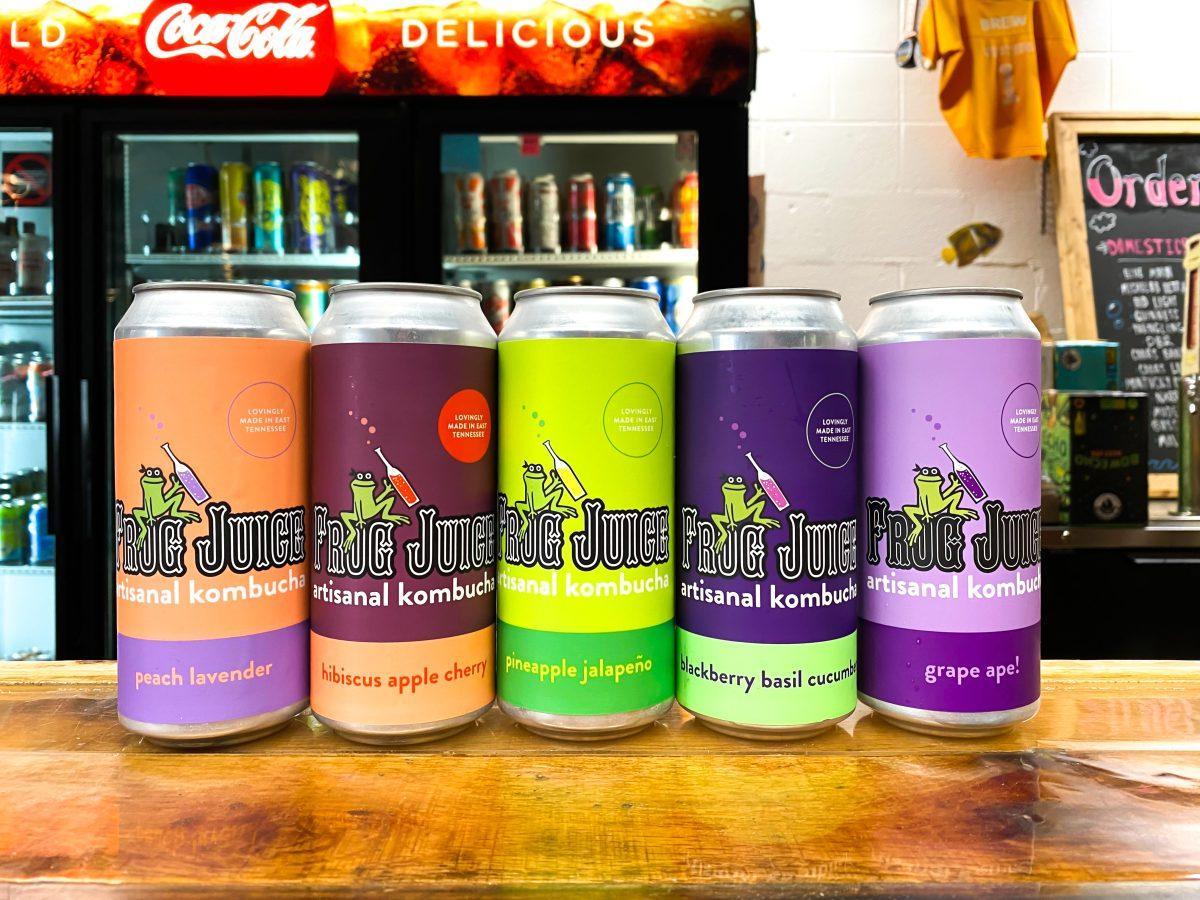
Starting from jars in Chicago and moving to breweries in Knoxville, Frog Juice Kombucha provides locally sourced kombucha to East Tennessee.
Frog Greishaw began brewing kombucha when she was a bartender in Chicago. She first brewed it as a hangover cure, but it began to grow popular with her friends and the chefs she knew. Even after she quit drinking altogether, she turned this hobby into a business.
Five years ago, she moved to Knoxville and began to brew on a larger scale. She used to deliver kombucha to sell in Chicago, but she reallocated her efforts in East Tennessee as that became less sustainable and the mental toll became too much.
“I started all over here essentially with no real contacts or anything,” Greishaw said. “I didn’t really know anybody here when I moved here. Kind of had to start from scratch.”
About three years ago, Greishaw met Benjamin Clingner, a former beer brewer for over 20 years. He became fascinated with Greishaw’s kombucha and they’ve been business partners since then, with Clingner taking over the brewing operations with his years of experience.
“Then I started trying other kombucha, and pretty quickly realized that she was knocking it out of the park,” Clingner said. “Just, significantly better than any other kombucha that I have ever had. Then she mentioned expanding her business and what that looked like, and I was like, ‘I’m in. I will do everything I can to help you grow this.’”
Clingner talked about watching Greishaw’s process and how consistently she made her kombucha regardless of the quantity being brewed. He said that this aspect is what brought him on board.
“Watching her work, watching her work with the farmers and source locally and organic and not skimp on ingredients, and just do it right, it all translates,” Clingner said.
Since then, the business has expanded, with Frog Juice Kombucha being sold all over Knoxville. Along with Knox County, their kombucha can be found throughout East Tennessee, including Sevierville, Maryville and soon Chattanooga.
“We’re working on Chattanooga now and Cleveland,” Greishaw said. “Both super cool. (Sales representative) Kaitlyn was down there doing her thing, and we went and did our deliveries the week after and it was so awesome to meet everybody and they were so excited to have it in their store. I couldn’t have asked for a better response.”
They previously bottled the kombucha using recycled glass, primarily when the business was still based in Chicago. They moved to cans during the COVID-19 pandemic, which increased their productivity as a result.
“We moved into cans during the pandemic, during 2020,” Greishaw said. “That really set it off. … It was taking us three months, or maybe six months to work on a pallet of glass, and then it was all of a sudden we were going through double the volume in cans at least.”
A large aspect of using glass was being able to see the kombucha inside. Since they moved to cans, that was no longer possible. To counteract this, they worked with local artists including Emily Hoffman to design the labels for the cans to go along with the logo that Greishaw’s dad created years ago.
“There was a little bit of a rebranding with the cans, because the nice thing about glass was that you could see the product, so trying to reflect the color of these flavors onto a label, onto a can, kind of prompted just a rebranding in general,” Clingner said.
Their designs reflect the drink inside, giving whoever buys one an idea of what the kombucha looks like. This goes for every drink that they make, especially the six flavors that they brew on rotation right now.
At times, the design of the label will influence the kind of flavor that they will make. For example, they created the limited edition Fruity Booty kombucha for the South Side Pride Festival and adjacent events last June. They plan on bringing it back later this year.
“Sometimes the packaging influences the flavor,” Greishaw said. “Like we did a gay pride can last year called Fruity Booty. My niece was always calling everybody jabooty when she was little … she just thought that was hilarious. So, I was like, ‘Let’s do something because she really likes the kombucha.’ And the can was super fun. But the flavor was more inspired by the packaging, and we were like, ‘What’s the fruitiest, bootiest flavor that we can do?’”
That specific drink featured a large set of ingredients blended to create the limited flavor. For every drink, they source all of their ingredients from local Tennessee farms. They’ve recently set up a deal with several farms to buy specific amounts of produce for their kombucha batches.
“This year, we finally got to a point where we had a little bit of time to figure out exactly how many pounds, kind of project those numbers for produce for farmers and do contract farming for the first time,” Greishaw said. “And that is a huge deal, because that really diverts a lot of food waste, and it also saves time for the farmers, and money and resources that they really need.”
This allows them to eliminate excess waste while keeping everything that they make fresh and organic.
“Getting to meet these people, go to check out their farms, see what their process is, has been so awesome and so educational,” Greishaw said. “I come from a long line of farmers on both sides of my family, and that has really been nice to drive that home and step into those footsteps of my ancestors and let them carry that.”
“It’s so important. We’ve gotten so far away from that. And we really believe that if you buy crappy ingredients, you’re going to have a crappy product. Getting the best stuff that we can from people that are right here, and creating that revenue here has been great. Plus, you get all of the benefits of eating food that’s grown where you live, which is actually really important to do,” Greishaw said.
This also goes for their brewing process. It takes about three weeks for them to brew, package and distribute each batch of kombucha. They try to be environmentally conscious as well.
For example, Clingner said that their ratio of water to kombucha per gallon is one to one, which is in contrast to the 10 to 20 gallons of water it takes some breweries to brew one gallon of beer. The process involves fermenting tea with SCOBY.
“It stands for Symbiotic Culture of Bacteria and Yeast, and it looks like if pancakes and jellyfish had a baby, and it kind of floats on top of your liquid and creates a film on the top of your liquid to keep bad bacteria out,” Greishaw said.
“We basically make a giant batch of sweet tea, and we feed the SCOBY, and then that sits as long as it needs to sit to get to the right Ph range and the right flavor profile,” Greishaw said.
They repeat this process using some starter SCOBY from the previous batch, allowing them to get a quicker start on the brewing process. They don’t use any syrups or artificial colors for their flavors.
Some of their current flavors include Blueberry Basil, Pineapple Jalapeño, Hibiscus Apple Cherry, Blackberry Basil Cucumber, Grape Ape and Peach Lavender. They also currently have Beet Apple Ginger and plan on making Mint Raspberry kombucha in the spring, along with bringing Fruity Booty back in the summer.
Greishaw developed most of these flavors in Chicago at the request of chefs and other people who tried her early batches. She attributed her drink mixing knowledge and skill to a mentor she had while opening The Violet Hour specialty cocktail bar in Chicago. This mentor taught her how to balance every ingredient within each drink, drawing certain flavors out without having one overpower everything else.
“It’s been really fortunate to have Frog’s palette with all of her years of bartending and mixing different cocktails,” Clingner said. “To sit down and develop a new recipe, we would do it in some small jars and do a shotgun pattern, and do maybe five or six different varieties of that same flavor. … She’s really on it when it comes to that flavor profile of what things will taste good together, and what ratios those need to be represented as well.”
Recently, Frog Juice Kombucha moved into a new brewery location last fall. It’s allowed them to expand their operations and production. As they supply more areas outside of Knoxville, they’ve been well received by the community despite their drink and kombucha itself not having fully broken into the mainstream yet.
“It’s been so well received,” Greishaw said. “I really couldn’t have asked for a better turnout.”
They hope that people will try their drink and enjoy it, even if they’ve had bad experiences with kombucha in the past.
“The reward is, when we reel it back in and they try it, they go, ‘Oh my gosh, this is different. This actually tastes good,’” Clingner said.
“And that’s what we try to do, we get something in your hands that is good for you that you drink not just because you have to … drink it because you want to, because it actually tastes good, and that’s kind of my goal with it,” Greishaw said.
They also hope to continue growing their business in a conscious way, while still producing full-time jobs, supporting local farmers and affecting the community in a positive way.
“[Grow] with grace and ease,” Clingner said. “But within a realm that is not destroying our planet in the process.”
They try to work within the community as much as possible, like volunteering for the Quarry Day at Fort Dickerson’s Quarry where they picked up trash. On the business side, Greishaw wants to practice conscientious capitalism by putting money back into the community to help those in need as well as initiatives and organizations that are actively helping the environment. They mentioned Keep Knoxville Beautiful as a group helping to promote local environmental activism.
“I feel like Knoxville has a really incredibly supportive community and people that are concerned and are trying to do things about it,” Greishaw said. “I like the conversations that are happening and I like even more the actions that are happening. I can’t wait to be contributing more.”
While still a startup, Frog Juice Kombucha has left a footprint within Knoxville as they continue to expand to other areas. Their kombucha can be found in most restaurants, coffee shops and gyms in town. As they continue to expand, they’ve maintained their local flare while they build themselves up, one batch at a time.