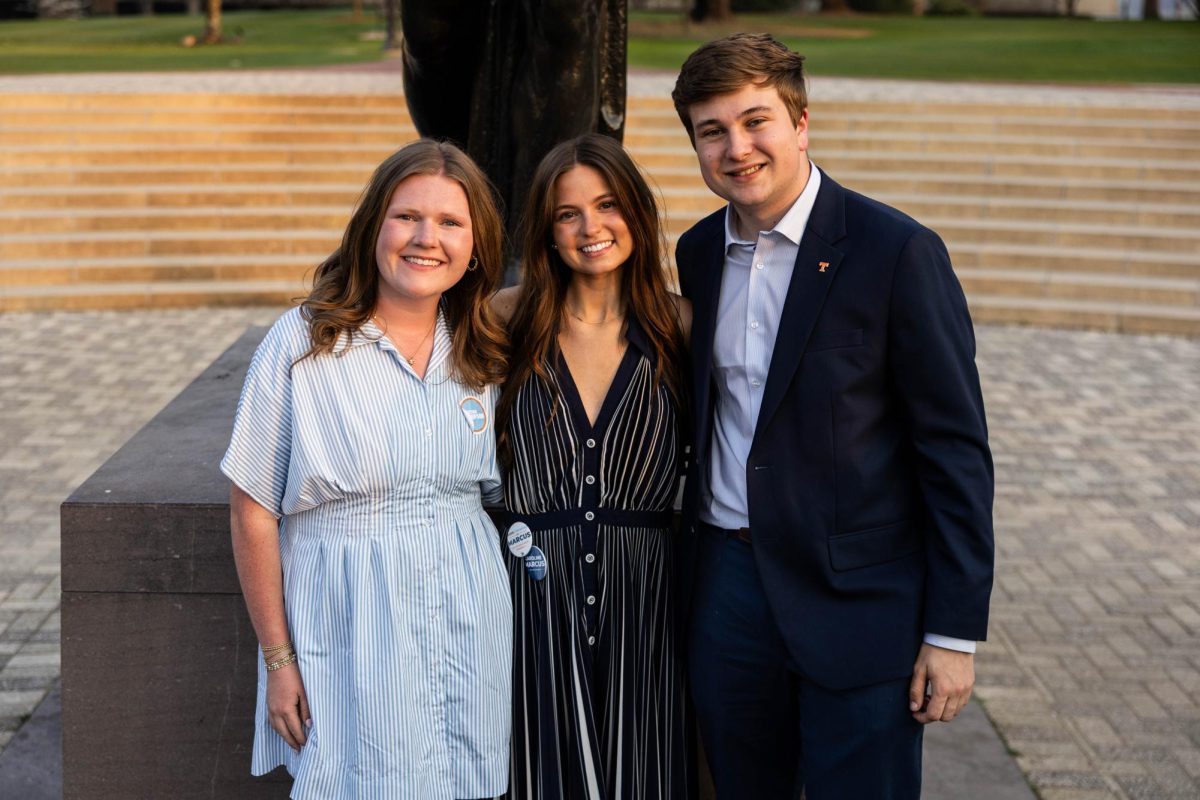
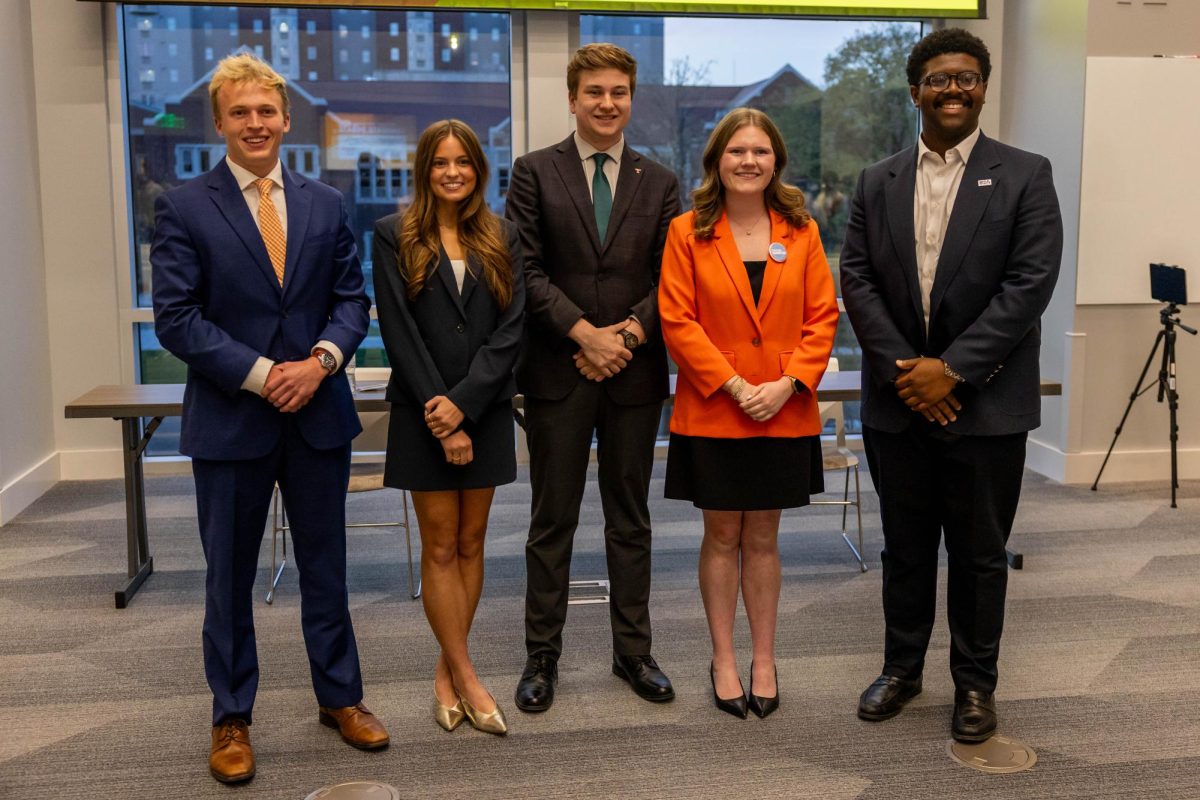
When Abbey Lawrence, a junior geography major, began her freshman year at UT, she and some of her friends decided to go to a student organization fair on Ped Walkway. It was there she decided to apply for the Student Government Association’s (SGA) first-year leadership council (FYLC), which she says gave her one of her favorite college experiences as well as some of her closest friends.
“I feel like it really set the foundation for basically my whole time at UT, not even just involvement in SGA, but all kinds of things,” Lawrence said.
Lawrence would not hesitate to tell you how much she has loved her time in SGA. Even after her freshman year was cut short due to the pandemic, she continued to pursue the organization.
After serving as a member of the FYLC, Lawrence moved on to become a senator, a senator secretary, the director of the environment and sustainability affairs committee and is now running for student services director with the SGA campaign “Evolve.”
The past two campaigns Lawrence has witnessed were completely digital campaigns, so this year will look entirely different to her. What is also glaringly different though, is that Evolve is running completely unopposed.
The campaigns in 2021 and 2020 saw the beginning of a dwindling in voter turnout for SGA elections, according to Ben Pham, a junior aerospace engineering student and this year’s election commissioner. Even though the student body was not turning out as much, though, SGA was coming in full swing with three large campaigns each year, competing online for the votes.
Although this year’s ballot makes every Evolve candidate a shoe-in to win, the team is not necessarily viewing it as a positive for SGA as whole. Lawrence sees the race less as something she has to work hard to win and more as a mission to advocate for the organization she loves and ultimately bridge the gap between it and students so her team can successfully pursue their goals of helping the university.
“It’s almost as if we’re not campaigning for ourselves as individual candidates but campaigning for student government as an organization,” Lawrence said. “But also just trying to restore that space for students to exist and matter and belong and have a place to express themselves and meet other students — all the things that SGA kinda felt like it was for me when I first became involved.”
As seen with campaigns in previous years, Lawrence said this turn of events was not what they initially expected and thinks it has pointed out some bigger issues.
“The fact that we are the only SGA campaign that is running is definitely something that is concerning to all of us because that just shows how difficult it is for people to get involved and run their own campaign. I think that really points to the barriers in the election process as well as just getting involved at UT in general,” Lawrence said.
Although she and the rest of the Evolve team see these barriers, Lawrence is confident in the current election commission teams’ efforts so far to recognize and fix the issues.
That is exactly what Pham is setting out to do in his new role as election commissioner. After serving as a legal adviser for last year’s Forward campaign, he saw firsthand how people ran into confusion with election packets and do’s and don’ts.
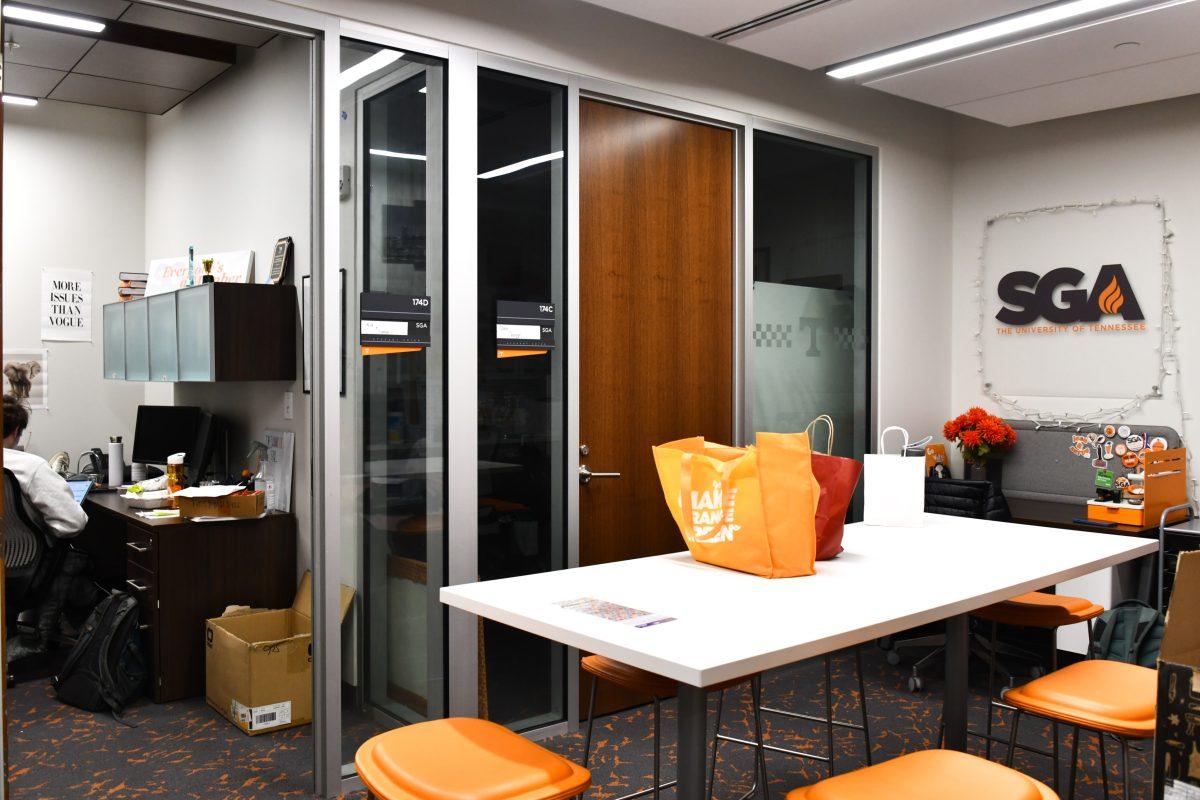
Inside of the SGA office inside the Student Union, open for walk-in's or hang-outs for students and faculty. Monday Mar. 28, 2022.
Accounting for the changes that may drive more campaign participation next year, Pham also sees the current situation as a sign of unification and collaboration within what the student body really wants for the future of UT. For that reason, he’s working with Evolve to, like Lawrence said, campaign for SGA.
“I feel like everyone’s just starting to come to the same conclusion on most issues,” Pham said. “Almost everyone’s having trouble with dining, with parking, they have trouble with inclusivity and instead of trying to compete against each other on that, I think from what I’ve seen … they’re all coming together instead and saying ‘let’s work together under this one party and push that effort forward.’”
Pham also cites the pandemic as a reason for less and less participation in student government, which Lawrence and Evan Sudduth, a senior marketing major and current SGA chief of staff, echoed.
“We’ve seen a lack of involvement in SGA and within any student organization, not only with our school but within all the SEC schools,” Sudduth said. “For me, I think that people, as they’re coming back to campus … we kind of come back to what we call normal; people are choosing very specifically and intentionally what they want to get involved in.”
Not only does the lack of motivation to get involved play into this, but Lawrence points to the aftermath of COVID-19 that may be imprinted on SGA longer than they had expected.
“I think this transition back to in-person has been just as challenging as it was to go online,” Lawrence said. “There’s just a disconnect between student government, admin, a large majority of student programs and then the student body, like there’s just a gap there. It’s going to take time and effort to fill. I don’t think it’s because students are disengaged or it’s a feeling of apathy, I think it’s purely that the knowledge to get involved is just not out there.”
UT’s back and forth in schooling modality has, according to Lawrence, perpetuated the difficulty of getting students involved. She said the confusion surrounding what point of the pandemic we’re in might be why this year is so much less involved than last year, when campaigning and school was almost entirely online.
“We’re not fully back in-person, we’re not fully online, we’re in this kind of gray zone that has been pretty challenging to navigate,” Lawrence said. “People were so plugged in online last year, everything we did was online, like we were living online, and I think people were also looking for those connections online which made people want to join those campaigns … it was almost easier in a sense because everyone was so plugged in.”
This “gray area” is not only responsible for a disconnect with the student body but also, Lawrence thinks, with the UT administration.
“I’m not saying there’s not necessarily collaboration because of anything negative. I just think the conditions we’ve been working in have just kind of broken that line of connection,” Lawrence said.
Evolve hopes that this disconnect will dissolve once the fall semester begins and once UT staff sees the issues that are coming up with student involvement in a club whose goal is to better the university.
“I definitely urge anyone, like any administrators, faculty members, anyone who’s not a student at UT to definitely pay attention to what’s going on right now … to the fact that there is only one SGA campaign because that’s definitely not a positive thing and that’s not something that we want to keep happening going forward,” Lawrence said.
For Sudduth, this connection with the administration could also assist in the connection with the student body and, in turn, spark more SGA involvement.
“I think having that personal relationship with administration and SGA could lead to the student body saying ‘OK, SGA’s working with administration, they’re making actionable changes,’” Sudduth said.
Despite all the reasons why this is happening and all the concerns for what it means about SGA, Lawrence sees a light at the end of the tunnel.
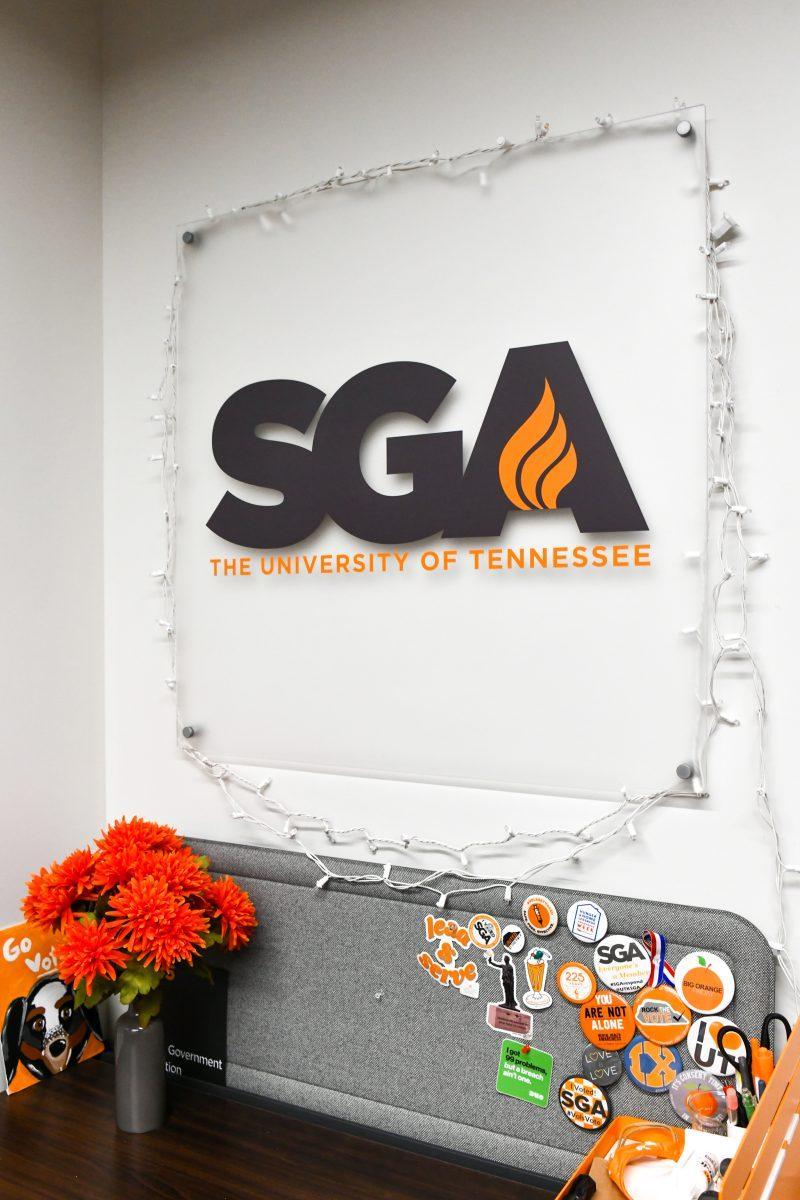
The SGA office located in the Student Union and available to all students and faculty. Monday Mar. 28, 2022.
In attempts to get signatures so they could run for office, Lawrence and the others running for executive positions on Evolve’s team set out to go to the library in search of signatures from students studying, many of whom were freshmen.
“I would approach somebody and talk to them about SGA, kind of getting their signature,” Lawrence said. “People would not know what SGA was, like at all, which is concerning.”
After feeling disheartened following the initial realization that so few people understood SGA’s mission, Lawrence still managed to find a silver lining.
“Then I had a lot of really awesome conservations, we all did, with people about SGA, and so I definitely don’t think students don’t care or they’re not interested,” Lawrence said. “I think it’s just a gap of getting the word out there.”
Evolve applies this method of optimism to this year’s campaign because at this point, there is not much else they can do to change the state of this year’s ballot. Instead, they can change how things are done.
“Of course in the future, I would love for SGA election season to be restored to this sense of friendly competition that it once was, but looking at the present, obviously that’s not what’s happening now,” Lawrence said. “There’s always positives within a negative, and I think if we focus on those, we focus on this opportunity to do things differently, do things in a way that may better serve students than we have through elections in the past.”
More than anything else, Lawrence and Evolve see this race as an opportunity for a fresh start – a fresh start with administration, with the student body, with other clubs and as a fresh start transitioning into a UT campus and SGA election without COVID-19 restrictions.
“I think this could be a really good opportunity for students to become more engaged with SGA, despite there being only one campaign, and that will set kind of a foundation for us to go forward with new ideas, new programming, new initiatives whenever school starts again in the fall,” Lawrence said.
While Lawrence flung herself into student government the moment she stepped on campus, Sudduth had quite a different experience.
He participated in SGA his freshman year, but then took some time off, saying it wasn’t for him. When he returned as campaign manager for Forward his junior year, SGA looked different.
Not only had SGA been impacted by the pandemic, but administration had also changed — presidents had come and gone. Despite the disconnect SGA has with administration and the student body, Sudduth was encouraged by how positively different the inner-workings of the club felt to him.
“I feel like there’s been more distance between SGA and administration as I’ve seen, as time has gone on, and that could be for a multitude of things,” Sudduth said. “Then I think I’ve also seen on the SGA level just less of a hierarchy and more acceptance.”
Even though he is graduating, Sudduth does not see the fact that a campaign is running unopposed as the beginning of a downward spiral.
“I definitely have hope and I see SGA growing back and becoming more powerful and better than ever and helping students again, but I think right now we’re just kind of in a transitional period,” Sudduth said.
In terms of the future, Lawrence said that what’s going on with this year’s election is not a sign of apathy on behalf of the student body, based on what she has experienced in so many of her conversations. Rather, it’s a sign of needing to start fresh with new ideas and help from the university after years spent in a gray area of isolation and confusion.
“I think we all fall into the whole … Volunteer spirit,” Lawrence said. “People really do want to connect and form a community on campus. We’re just kind of lacking the resources we need to restore that sense of community on campus.”
The SGA election will be taking place April 11-13. You can cast your vote at votesga.utk.edu.
This article was updated to reflect more accurate information.