Young Americans for Prosperity set out on Monday to answer one question: Who are students voting for in the upcoming Student Government Association elections?
As of Monday evening, the organization’s poll found 48% reporting in favor of Zack Duncan and 44% in favor of Caroline Marcus for the next student body president. Additionally, vice president candidate Adarius Parrish was polling at 50% and Anna Beth Thompson at 43%.
YAP is a new club started by sophomore public affairs student Parker Huskey as an extension of a national organization called Americans for Prosperity, a political advocacy group.
“Not a lot of people talk about what’s going on on UT campus. And I think we’re kind of filling that gap, and being a group that represents those problems and has discussions about those problems, and really just tries to find out what the students are feeling,” Huskey said.
The goal of the club is to look at campus and local issues and figure out what’s important to the student body, and use that information to create a nonpartisan communication channel between them and the SGA.
“(We) sort of put our finger on the pulse of what students really care about and petition them to our student government and to our administration here at UT,” Charlie Olita, a sophomore public affairs student and the club’s vice president, said.
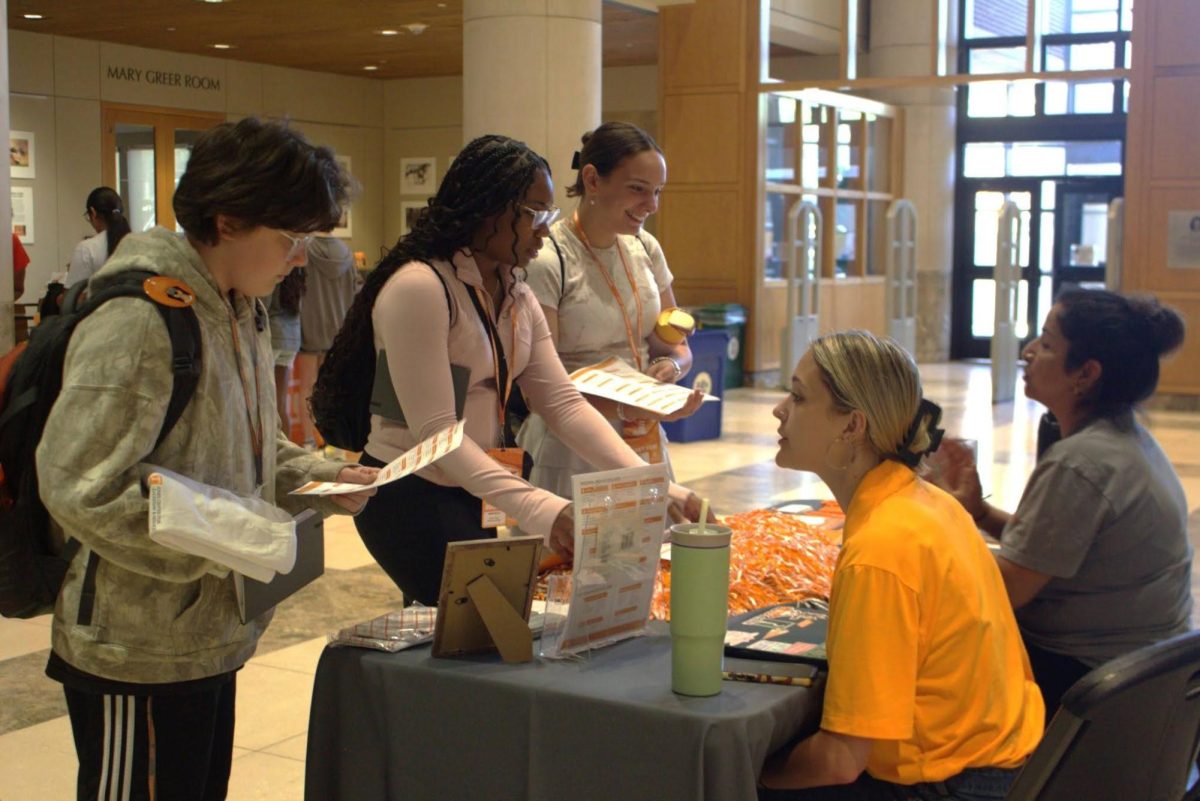
With the SGA elections coming up, they’ve been very interested in how the polls look before and after last night’s debate between candidates. They spent Monday taking a straw poll for the election, which starts Wednesday at 6 a.m. and closes on Thursday at 5 p.m..
“We just wanted to see the numbers and see what students were really feeling like. Obviously, the next couple of days is when the real election starts, and campaigning will ramp up and all that kind of stuff. So we just wanted to see how students are feeling right now about it,” Olita said.
Both Olita and Huskey are excited about the data they collected. When they first set up their table, they didn’t have a set goal on the number of responses they wanted, but ended up with enough that Huskey feels it’s “a good enough-sized sample that I think it’s going to be representative of what the election’s going out to be.”
“I think this is a really fun thing that UT does. It gets people excited about these elections, and, you know, everyone wants to know the answer before they come out. So we’re trying to figure out what those things are. And then, you know, kind of tell it to the greater student body beforehand,” Huskey said.
The data they’re collecting serves two purposes: the first is to give both the candidates and students an idea of what the outcome might be, and the second is to have benchmark numbers for how last night’s debate or campaigning will impact how each candidate performs in the polls.
“My intention is … to compare the two polls, you know, our poll, and then the official SGA poll and sort of see … how the results from today’s poll, which is before all of that, is different from the actual SGA poll that starts on Wednesday,” Olita said.
To compare, they will use traditional political polling methods to check shifts in percentage points between the two polls. YAP will share their results from Monday’s straw polls with the candidates, who Huskey theorizes “might shift their campaign strategy after our results come out.”
“I guess we’ll see the results when they come in and see how the debate tonight affects that, and how the increase in exposure over the next two days will impact them,” Olita said.