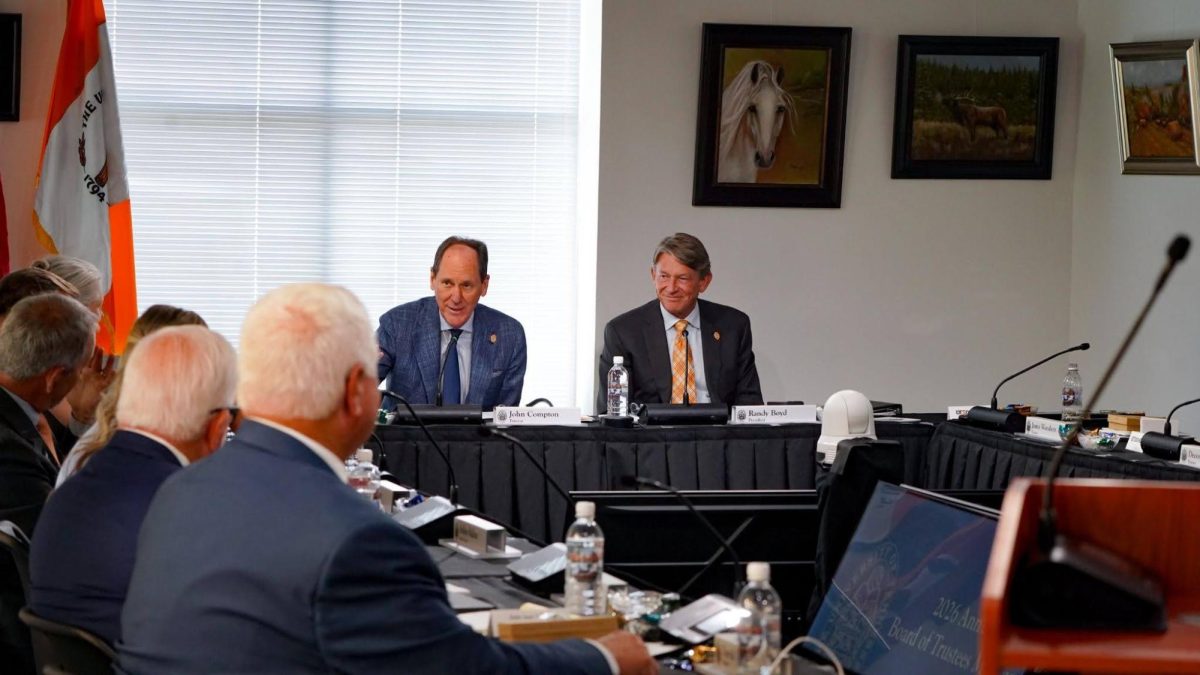
The faculty senate began to wrap up the year in its second-to-last session Monday afternoon, focusing on faculty pay and state legislation.
Resolution to increase faculty pay
Faculty senate President Charles Noble introduced a resolution to add an extra 1% to Tennessee’s mandated 1.5% annual pay increase for faculty to match the current 2.5% inflation rate.
UT Chancellor Donde Plowman shared her concerns over where the funds for the initiative would come from, suggesting that additional pay increases should instead be addressed on a departmental level.
“We all wish that percentage had been higher,” Plowman said. “The deans could make some decisions if they wanted to.”
Past faculty senate President Derek Alderman argued that faculty members must be treated as investments to keep UT competitive.
“We are the flagship, crown jewel of this state in terms of higher education,” Alderman said. “And we want to do what we can and keep that in place.”
A majority of senators voted to pass the resolution, with two opposed and one abstention.
State legislation
The senate discussed three bills currently in the works of the Tennessee General Assembly.
HB 2194, which awaits Gov. Bill Lee’s signature, would streamline university termination policy, removing certain opportunities for faculty.
The bill has raised faculty senate concerns over the protection of tenure, as it holds both tenure and non-tenure faculty members to the same termination process. Plowman said the bill instead “lifts up how important tenure is.”
“It’s really not about tenure,” Plowman said. “It’s more about workplace accountability, or the conduct of faculty.”
Senators asked Plowman what they can do to protect due process.
“Your role is to just be the best faculty member you can in your classes,” Plowman said. “Continue to be professional faculty like you are.”
The bill follows months of faculty terminations over comments made about political influencer Charlie Kirk. In February, Chancellor Plowman terminated assistant professor Tamar Shirinian after Shirinian commented online about Kirk’s assassination, saying “the world is better off without him in it.”
Shirinian has since filed a complaint against Chancellor Plowman and UT President Randy Boyd in both their personal and official capacities.
“What makes it hard for us is when things happen that just publicly don’t look good,” Plowman said.
Plowman directly stated her support for tenure after senators questioned her opinion on the bill.
“Tenure is something that I strongly believe in. So does the president,” Plowman said. “We worked hard to make sure to give our voice to those bills this year, and we will continue to do that.”
The senate addressed SB 1741, titled the “Charlie Kirk Act,” which would require universities to incorporate a freedom of expression statement similar to the University of Chicago’s into university bylaws. The bill passed in the senate and is waiting to be considered by the house.
The senate also looked at SB 1959, which has been deferred to summer study. The bill would require Tennessee universities to install a “Charlie Kirk Memorial Courtyard for Civil Debate” on campus. The bill is expected to cost universities over $18 million.
On the topic of free speech, Plowman shared recent student survey results, reporting 91% of students say they feel completely free to express themselves on campus.
UT AI Hub
The new UT AI Hub launched in late March as an initiative of the Office of the Provost. Provost John Zomchick spoke to faculty members about the AI Hub and how it is being monitored.
“There is visibility, but I believe that our Office of Information Technology has decided not to monitor usage of the new AI Hub for privacy reasons,” Zomchick said. “We choose not to do that unless we are forced to do it.”
Athletics update
Marshall Steward, deputy athletics director, visited the senate to provide an update as national attention on collegiate sports brews. Steward discussed current issues with the transfer portal, which President Donald Trump worked to address in a recent executive order.
“Everyone knows that this is untenable, that it’s unsustainable, that there needs to be a federal solution, and no one knows exactly what that is,” Steward said.
Steward also emphasized positive updates in UT athletics, boasting increasing academic success of UT athletes amid national challenges.
“One thing that has only gotten better is the academic performance of our student athletes,” Steward said.
The faculty senate will meet for its last meeting May 4.