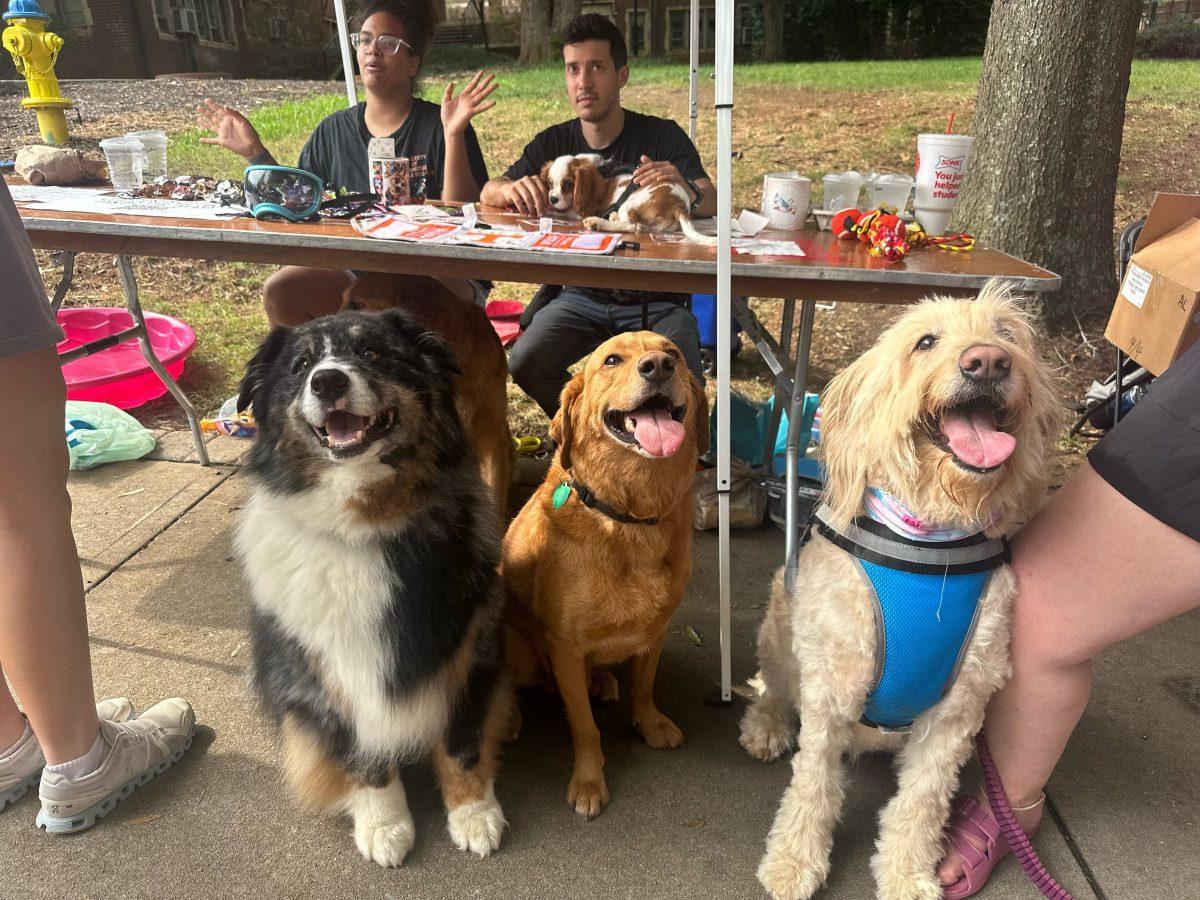
September marks National Service Dog Month. For the newly established Service Dog Club at the University of Tennessee, along with Student Disability Services, the month creates a crucial opportunity to showcase their organization and goals to educate and advocate on campus. The idea for the club had been discussed years prior, but it wasn’t until July 6, 2023, that the club became officially recognized.
The Service Dog Club at UT aims to create an inclusive and supportive environment for individuals with disabilities who rely on service animals to navigate their daily lives. The club is open to students, staff members and faculty and is not just exclusive to handlers. The club offers education and awareness about service animals, the rights and responsibilities of their handlers, service animal training resources, a support network via regular meetings and social events, campus advocacy and outreach programs.
Sofie Janssen, junior architecture student and club president, got the idea to start the club along with a fellow student in her first year, who dropped out of UT specifically because she could not physically make it around campus even with a service dog. It was not until she met Amber Carmody, a grad student and the club vice president, that the two pushed to get the club going.
For the club leaders, a multitude of negative experiences influenced them to start the club so that people on campus could become more aware and respectful of service dogs and their handlers.
“I started it after I went to a football game and a guy threw a beer bottle at my dog,” Janssen said. “I walk across the street, and I hear a bunch of guys barking at my dog. I’ll be passed out in front of anywhere, and there will be people petting my dog while he’s on top of me.”
Many service dogs are trained in a multitude of skills and tasks necessary to help their owners navigate day-to-day life. Some skills in the case of Carmody’s service dog, Brady, are medical alert, medical response and guide. A task in the case of Janssen’s service dog, Oakley, is deep pressure therapy, which involves the dog laying on top of their owner if they are passed out.
“The stadium accessibility bill was proposed by my best friend after she attended a game with me and saw the treatment: people grabbing Brady, people pouring beer on him, people grabbing him and pulling him and stepping on him,” Carmody said.
Mistreatment of service dogs and their owners extended beyond fellow students to faculty as well. Carmody expressed having her access on campus limited by many professors and students.
Speaking out about negative experiences as leaders and encouraging members to do the same demonstrated a need to address these issues on a greater scale.
“These are just a very minimal amount of things that occurred to me just being a student here in my first year,” Janssen said. “These things do still happen … a lot of our members now who have talked to us about it (said) they have also experienced it as well. We wanted to make sure we could somewhat be a group to talk about that and be a way to address it and not ‘fix’ it, because there’s no real way to fix it, but to just make it more known.”
The Service Dog Club works closely with SDS to effectively communicate and better accommodate resources on campus to students with disabilities. Much of the communication is a simple feedback system such as making SDS aware of negative experiences on campus or as simple as notifying SDS when accessibility buttons do not work.
“They’ve been great about asking for our feedback, input and ideas on how to fix these problems,” Carmody said.
As more students with service dogs came to campus and questions for their handlers arose, SDS pushed for the start of the club.
“It’s one of the most fulfilling partnerships that I’ve been able to be part of where we’re both wanting the same goals,” Carmody said.
Refuting misconceptions is also a key goal for the club as part of educating the campus community. Many students experienced not feeling heard because they did not fit the stereotypical image of a “disabled person.”
“Unfortunately, with invisible disabilities, we are less likely to be believed and listened to about our accommodations,” Carmody said.
Some of these misconceptions are also held by faculty members, hindering their ability to accommodate for their students.
“I was told by professors that I wasn’t disabled,” Janssen said.
Breaking the stigma around these misconceptions allows the public to be better informed about disabilities and thereby allows for the campus to be better adapted to accommodate for these circumstances.
Throughout the past months, the club has focused on attracting new members and creating more opportunities to educate and advocate.
The club tabled at the Student Engagement Fair for the first time on Aug. 24 where 83 people showed interest in the club. Following this, the club hosted its first meeting on Sept. 11.
While some events planned for the month were not able to happen, the club was able to establish many connections for future events and focus on the organization’s longevity.
On Oct. 12 the club will be hosting a service dog panel that will be open to students, staff, faculty and the public to ask questions about service dogs and how to be more inclusive and accessible.
The club will also be hosting a “Dogs for Dogs” tailgate before football games serving hot dogs while offering activities for handlers and educating people about service dogs and some of the club’s advocacy efforts.
Additionally, the club is in the early stages of planning events with housing. Some housing event coordinators at Hess Hall asked if the club would be willing to collaborate for an educational event to learn about service dogs.
Finally, the club looks forward to a huge opportunity on Nov. 4 to bring 10 handlers to the Dollywood theme park for dogs to get trained. This day marks the beginning of the Christmas Festival and the busiest day of the year at the park, making it an ample opportunity for training and education.
“(Service dogs) have to be trained to be able to participate in any situation and be very desensitized. And so that space with that many people and that many loud noises and different types of people and different types of situations is always a good training opportunity,” Carmody said.
The handlers will be meeting with some of the disability services at the park to discuss how they can further improve upon accessibility at their park. After the initial contact, the services at the park made it clear that they would value feedback from the club.
Throughout all their efforts, the club aims to contribute to a more inclusive campus environment and make a difference in the lives of individuals with disabilities and their service animals.