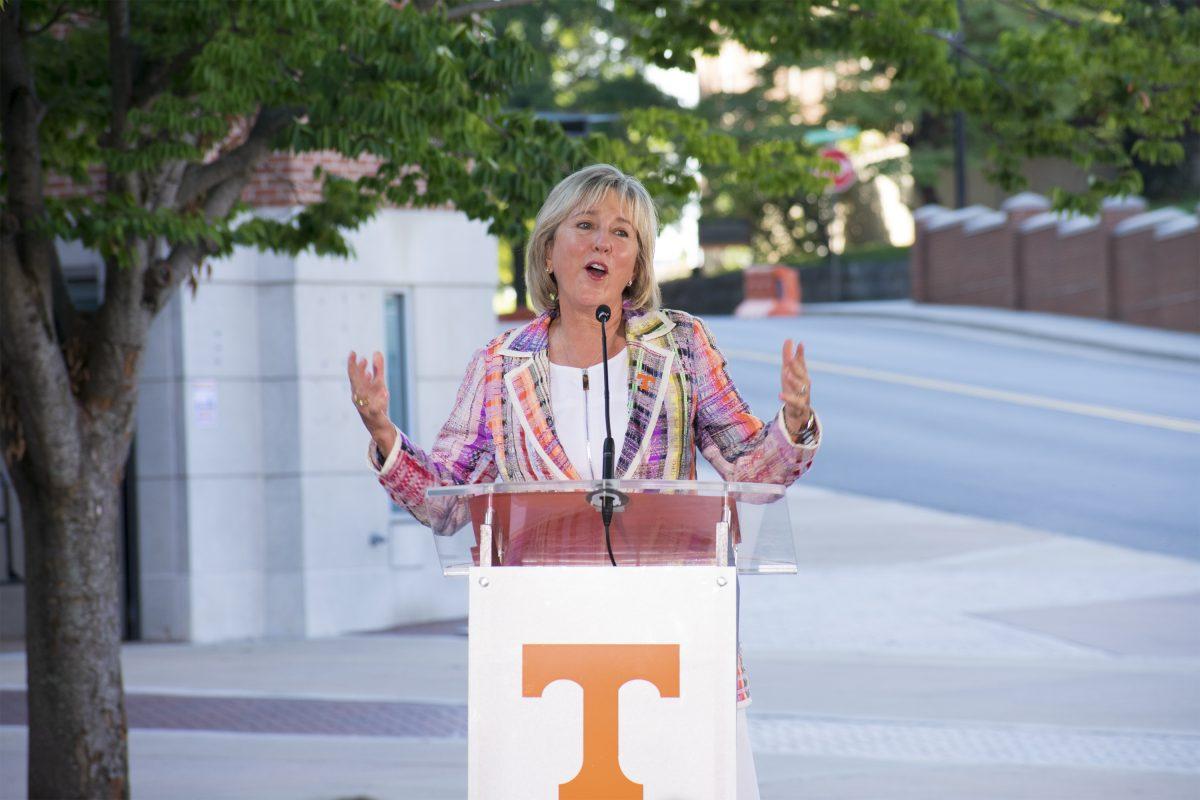
UT Chancellor Donde Plowman told NCAA President Charlie Baker in a letter that the NCAA is “morally wrong” in its investigation of Tennessee athletics regarding alleged violations of rules involving name, image and likeness.
The Daily Beacon obtained the letter, sent on Monday from Plowman to Baker, through a public records request.
The letter went on to call the allegations “factually untrue and procedurally flawed.”
“The leaders of intercollegiate athletics owe it to student-athletes and their families to establish clear rules and to act in their best interest,” Plowman wrote in the letter. “Instead, two and a half years of vague and contradictory NCAA memos, emails and ‘guidance’ about name, image and likeness (NIL) has created extraordinary chaos that student-athletes and institutions are struggling to navigate.
“In short, the NCAA is failing.”
A source with direct knowledge confirmed to The Daily Beacon that Tennessee is being investigated by the NCAA.
In her letter, Plowman referenced the possibility that Tennessee could face a charge of lack of institutional control — the most serious charge against a university.
“In fact, just last year, the Division I Committee on Infractions as well as the NCAA enforcement staff cited exemplary cooperation by the University of Tennessee and said we set the standard other schools should follow,” Plowman wrote. “It is inconceivable that our institution’s leadership would be cited as an example of exemplary leadership in July 2023, then as a cautionary example of a lack of institutional control only six months later.”
The letter also confirms that a team from the University of Tennessee met with members of the NCAA enforcement staff on Monday.
Plowman insists throughout the letter that no violations occurred.
“We appreciate your staff listening to our arguments and agreeing to evaluate them,” Plowman wrote to Baker. “The NCAA’s allegations are factually untrue and procedurally flawed. Moreover, it is intellectually dishonest for the NCAA enforcement staff to pursue infractions cases as if student-athletes have no NIL rights.”
NCAA declined meeting with
Tennessee in December
Tennessee representatives attempted to schedule a meeting with Baker in December. Susan England, assistant to the chancellor, provided the NCAA with flexible dates and the chance for the meeting to be remote.
Baker declined the meeting.
“It would have been my preference to discuss my concerns with you in person,” Plowman wrote. “Your recent testimony before Congress indicated you wanted to meet with as many member institutions and student-athletes as possible to discuss issues associated with college sports.
“I am sharing my perspective in writing since my December request for you to meet with me and our athletics director, Danny White, was denied.”
There are no specific athletes named yet in the investigation, but the original report from Sports Illustrated indicates that the violations stretch across multiple sports.
The NCAA first allowed college athletes to receive NIL benefits on July 1, 2021. Since then, the governing body has changed laws and made it difficult to pin down exactly what legislation to follow.
The NCAA also holds the power to retroactively enforce its rules, even if violations were made before the rules were in place.
“As you acknowledged in the recent congressional hearing, the NIL guidance from the NCAA to student-athletes and institutions has been ‘inconsistent and unclear, and the ambiguity has filled schools, student-athletes, and collectives with uncertainty about how to follow the rules,’” Plowman wrote to Baker.
“Regrettably, in this chaotic environment, the NCAA enforcement staff is trying to retroactively apply unclear guidance to punish and make an example of our institution,” Plowman wrote before going on to say the NCAA is “trying to bully institutions.”
She also writes that no Tennessee employee has been named as committing NIL violations.
Plowman ends her letter by calling the NCAA enforcement staff’s actions “contradictory” to the vision Baker has laid out.
“We have been held up as a model for how institutions should handle infractions,” Plowman wrote. “We have complied with NIL guidance as it came out. We will be resolute in protecting the rights of our student-athletes and in upholding the integrity of our institution.”