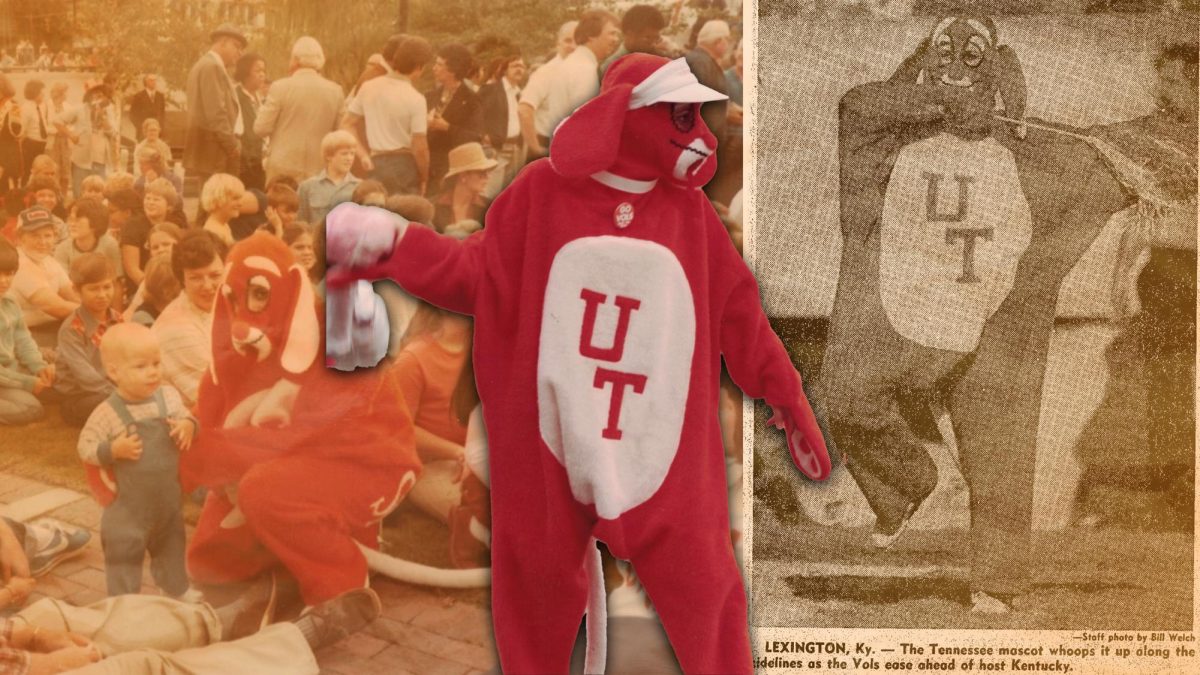
Linda Williams was sitting in the stands at Stokely Athletic Center on Feb. 17, 1979.
When the regular Smokey mascot did not show up for Tennessee basketball’s regular season matchup against Kentucky, Candice Callum, a cheerleader on the spirit squad, and her next-door neighbor, located Williams in the crowd. Callum knew that Williams had been the mascot during her time as a student at nearby Halls High School, and called upon her to fill in as Smokey for the night.
“She said, ‘Could you do it tonight?’ And I don’t think I said anything intelligent after that, because I was so excited,” Williams said.
Tennessee went on to defeat Kentucky 101-84, and Williams solidified the gig for the remainder of the basketball season. Williams’ stint to close the 1979 basketball season, however, did not earn her the title of the first female Smokey in Tennessee history.
That belongs to Nancy Nelson, the daughter of the renowned broadcaster, Lindsey Nelson. Nelson is tagged as the school’s first-ever costumed Smokey, but she was not voted on for the position. Williams claims to have come across Nelson on a Knoxville News Sentinel message board, where she recalled a particular interaction that settled the debate.
“I have always said I was the first voted on elected female Smokey, but there was a girl that wore the costume a couple of times,” Williams said. “… and I gave her the credit, and she saw that, and she was like, ‘I’m surprised anybody even knew that.’”
“… She was like, ‘I don’t really count myself as having been the mascot,’ but she said, ‘I did do it for a couple games before I could move up to the (cheer) squad.’”

Linda Williams in costume with kids at a Chattanooga park in 1979.
When the fall of 1979 rolled around, it was Williams’ chance to earn the spot. Alongside 23 other Smokey contestants — all other guys — Williams had to show up prepared to perform a skit. She was assigned a day in the life of Smokey, from waking up, to getting ready and then running out on the field.
Her familiarity gained a leg up in the process, and eventually she was selected — becoming the first female to earn the Smokey position through a tryout process. Then it began, traveling with the 1979 football team to Chestnut Hill, Massachusetts, for the season opener against Boston College on Sept. 15.
Williams had attended a party the night before with Boston College’s cheerleaders, where they warned her to ‘be careful’ and to ‘relax’ at the beginning of the third quarter. Unbeknownst of what was to come, Williams brushed it off.
But when the third quarter of the game began, Williams was ‘kidnapped’ by the Boston College students. They began passing her up the rows toward the top of the lower bowl, ripping off her tail and her shoes in the process. But as Williams made her way up, the students tossed her in the air.
“‘Let’s throw him again,’” Williams recalled. “And I went, ‘No.’ And they were so funny, they went, ‘Oh, my gosh, it’s a girl.’ And they put me down, and they found my shoe and my tail, and they slowly passed me back down. Every time they threw me up in the air, I could look out at the football players on the football field just looking up, going, ‘What are they doing to her?’”
That was her introduction to Tennessee football, from Smokey’s perspective.
Her stories continued throughout the season, but the most pressing came during rivalry week on Dec. 1 against Vanderbilt. Growing up a Tennessee fan, Williams already possessed a dislike for the rival Commodores. But her experiences on that December day furthered to hatred.
As Tennessee’s band formed the infamous pregame “T” on the field, Vanderbilt ruined the operation. The Commodores had run through it backwards, Williams claims, breaking instruments in the process. A scuffle broke out.
‘The Vanderbilt players are on their side, laughing at our players,” Williams said. “Our players are livid, and one of them screams, and I have no idea who, but one of them screamed, ‘That’s the last time they’ll run through our damn band.’ And a free-for-all broke out, and I was right in the middle of it.”
Williams said she was swinging her fists, forced to fend for herself.
“My mom said it was the funniest thing she ever watched, because she could just see my head bobbing and my fists flying, like I thought I was going to hurt somebody,” Williams said.
Through all the stories she had during her time as Smokey, the stint lasted that lone year. Across her nine years of college, Williams wanted to dabble in everything offered. She moved on to join the Pride of the Southland band the following year, mending friendships she created as a mascot. She also spent time as an intern with the athletic department, working alongside legendary Pat Summitt.
But her days as Smokey encapsulated her college experience more than anything.
“It was bigger than the mascot,” Williams said. “It was me getting to be a really small, tiny, minuscule part of the story of the University of Tennessee. And that is something that can never be taken away, and I wouldn’t trade it for anything on this planet.”
Her services were needed once more after moving on, however. When the acting Smokey could not make the trip to Eugene, Oregon, for the AIAW National Championship in 1981, Williams was called again. Though the Lady Vols lost to Louisiana Tech in the championship game, it was another memory in the collection for Williams.
“I’ve been really blessed,” Williams said. “I’m sitting here in a room now that has all these pictures hanging up from over the years … It’s something that you carry with you forever.”
Once her tenure concluded, she was fortunate enough to bring the costume home with her for display. The handmade costume, fit to size for Williams, is now used once a year.
As a now-resident of Bowling Green, Kentucky, she pulls it out for Halloween.
“It scares them all,” Williams said.
Despite living 3.5 hours away now, Williams still makes the commute to Knoxville on the regular. She is in her 57th year of attending Tennessee football games, holding season tickets with her husband, Doug.
When she returns to Neyland Stadium each Saturday, the memories come flooding back.
“Whether anybody ever remembers it or not,” Williams said, “I can look on that field and say, ‘I was on that field.’”
Though it was just one chapter in her life, it’s one that Williams continues to see unfold.
“Looking back on it, it has become a point of pride for me now that I was the first,” Williams said. “But at the time, it just was, ‘Oh, my God, I get to be on the field. I get to run out of the T.’ Every time they open that T, I go, ‘I got to run out of that T.’ I mean, how many people can say that?”