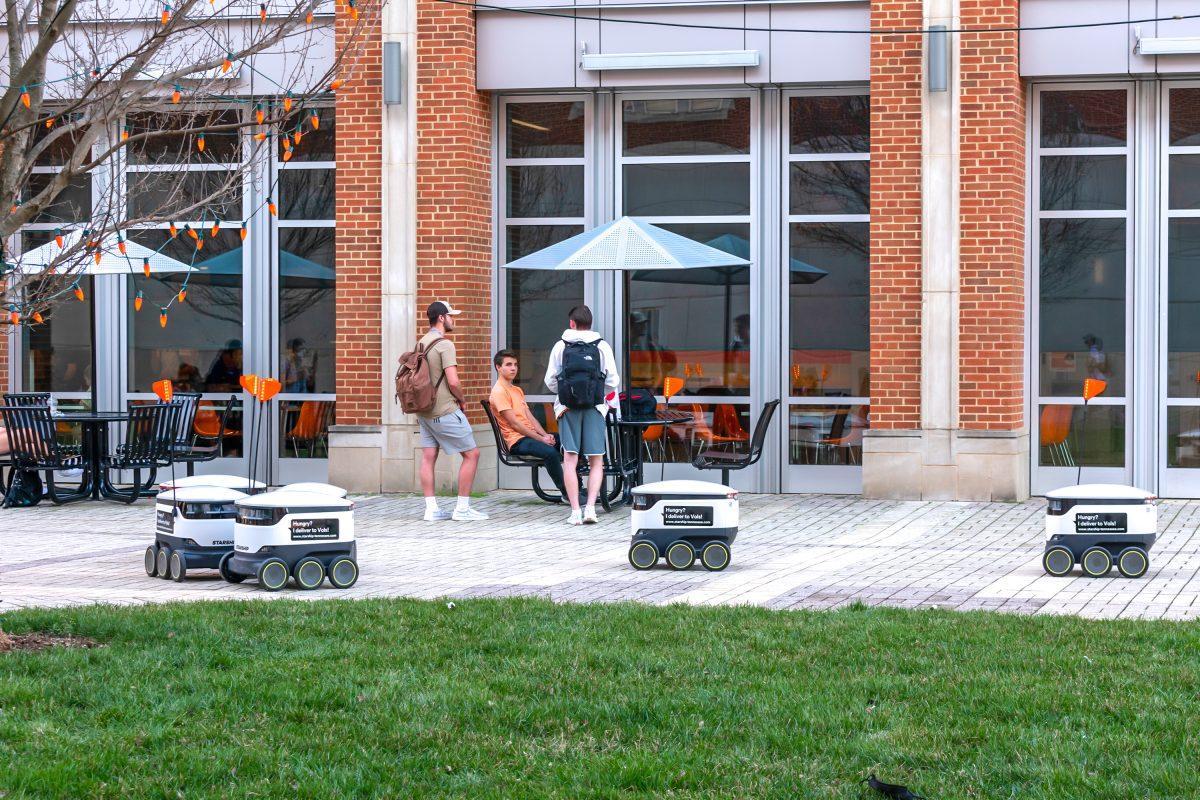
It’s official. Robots are taking over the world, one food delivery at a time.
If you have been anywhere on campus within the last few weeks, it is likely that you have encountered a small, food-carrying robot scooting alongside you. The delivery company behind the robots, Starship, was originally founded by two Skype co-founders, Ahti Heinla and Janus Friis, who saw a need for more convenient food and package delivery services.
On March 8, The University of Tennessee officially started offering robot deliveries to multiple locations on campus, including popular spots such as Fred D. Brown Hall, Ayres Hall, Neyland Stadium and many more.
In a video with senior Drew Hyler, host of UT’s “Drew on the Street” web series, Chancellor Donde Plowman spoke of her pride in being able to provide this advanced resource to students on campus.
UT is one of only 20 universities that are currently offering Starship delivery services, and Plowman believes this innovation, while allowing for quick-paced food delivery, also ensures an overall better dining experience for students.
Students will have the opportunity to pay for food through Starship with dining dollars, VolCard or credit card, just as they would at dining locations on campus.
Since their arrival on campus, the robots have amassed great popularity because of their indescribable cuteness, as well as people’s fascination with the technology behind them.
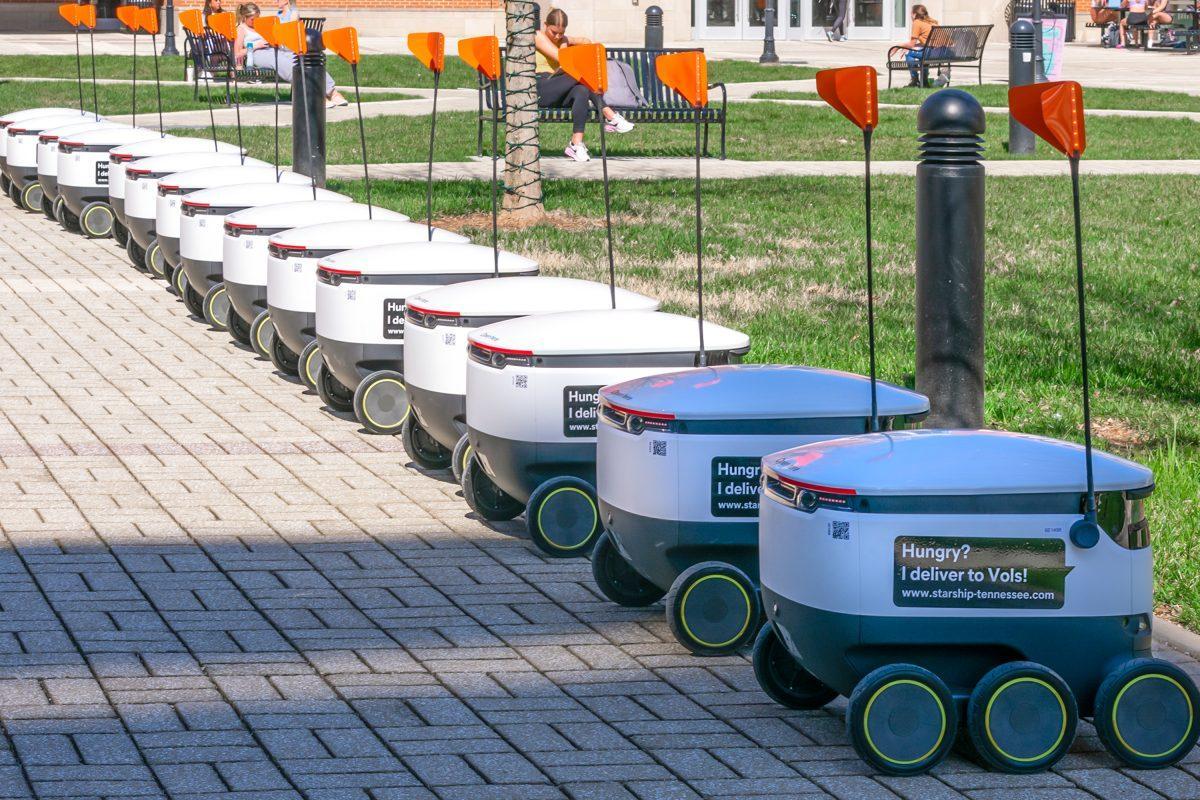
Satire: The university announced a plan to create a $20 million triage station for food delivery robots who have become overwhelmed by their responsibilities.
Sophomore Allison Williams described her first encounter with one of the robots, and their prevalence on various social media platforms.
“I was sitting by the Student Union and all of a sudden I saw this little white robot rushing toward me. At first, I was very confused because I hadn’t seen anything about the robots before, but after a couple weeks I started to see stuff about them all over my Instagram,” Williams said.
Not only have the robots been very useful to students in terms of a wider range of delivery options, but they have also become a media craze among students at UT. With videos and posts on the official UT Instagram pages, as well as memes created by the student body, members of the Knoxville community have had a fun time upon the arrival of the robots.
The Starship robots come along with a wide range of positive opportunities for students, but they also pose many new, foreign challenges.
Lily Monet, a barista at the Starbucks in Hodges Library, provided her perspective of the robots as a food service worker.
“There definitely was a learning curve at first and it took a second to understand how to work the system. However, once we got it, the system worked really well. It definitely adds another task that complicates the job, but it’s worth it to see something innovative and futuristic come to our school,” Monet said. “The loading process is simple: the order comes in, the label maker prints a label for each item, we get and make the items, scan the items, bring them outside to the robots waiting, scan the robot, open it up, put the food or drinks in and the robot does the rest.”
“It’s so funny watching the little things. It’s almost strangely human-like, we all think. But it’s so cool to see a little piece of what the future of robotics looks like.”
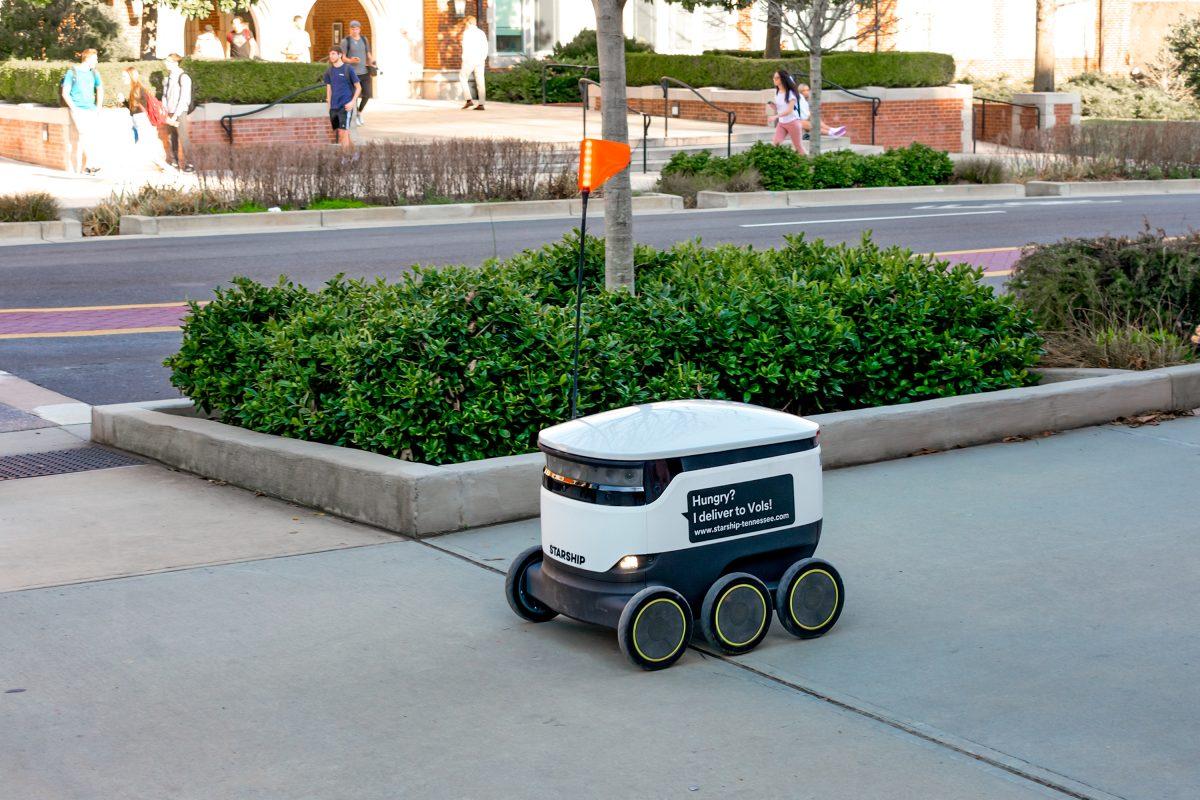
Starship Technologies launched its food delivery robot innovation on UT campus, allowing the robots to deliver food and packages to students across campus. The pictured robot is on route in front of the Haslam Business Building on Thursday Mar. 3, 2022.
Many have questioned the reliability of the robots in terms of avoiding traffic and stolen goods. The robots are made extremely safe through Starship’s advanced technological security measures.
The robots navigate from place to place using satellite imagery, which determines the best path for the robot to take for efficiency and safety. Each robot has its own specific situational awareness bubble, which involves twelve cameras, sensors and radar to ensure that it can avoid obstacles such as cars, animals and pedestrians.
For those who are worried about their food potentially being stolen, do not fret. Many have been deterred from attempting to steal from the robots because of a high-pitched screeching noise that is emitted when unauthorized individuals try to pick them up.
During their running time of nearly 8 years, not a single food item has been taken from a robot wrongfully, although there have been numerous attempts.
I decided that I would set out to try Starship for myself. After seeing a ridiculous amount of robot memes on my Instagram timeline, I could no longer resist their oddly human-like cuteness, or their ability to play Beyoncé as they delivered my morning Starbucks order.
I downloaded the highly-rated Starship app on my phone, and I was immediately surprised at the simplicity of placing an order. Overall, the in-app experience was comparable to that of Doordash or GrubHub. With picture-filled menus and openly displayed prices, it was easy to decide what I wanted, and it felt as though I was in the store ordering normally.
After placing the order for my favorite Starbucks drink — a grande cold brew with oat milk — I was promptly alerted that my order was being prepared.
Throughout the process I received multiple notifications about the status of my order, and once the robot headed towards my location, I had the ability to watch its movements on a campus map, which I appreciated because of my eagerness to receive my order, and my curiosity about the routes of the robots.
After a wait of only 22 minutes, I received my order, which was as cold as it would’ve been if it had just been handed to me. The pickup verification process was a bit tricky at first — which might have been a side effect of my inability to operate technology — but I quickly got the hang of it, and I was able to retrieve my order.
My delivery experience was seamless, thanks to Starship’s comprehensive technologies, and their immense attention to detail in every aspect of the order processing system.
As my delivery robot scooted away, saying “Go Vols!” I knew that Starship technology would now be a crucial part of the UT dining experience.