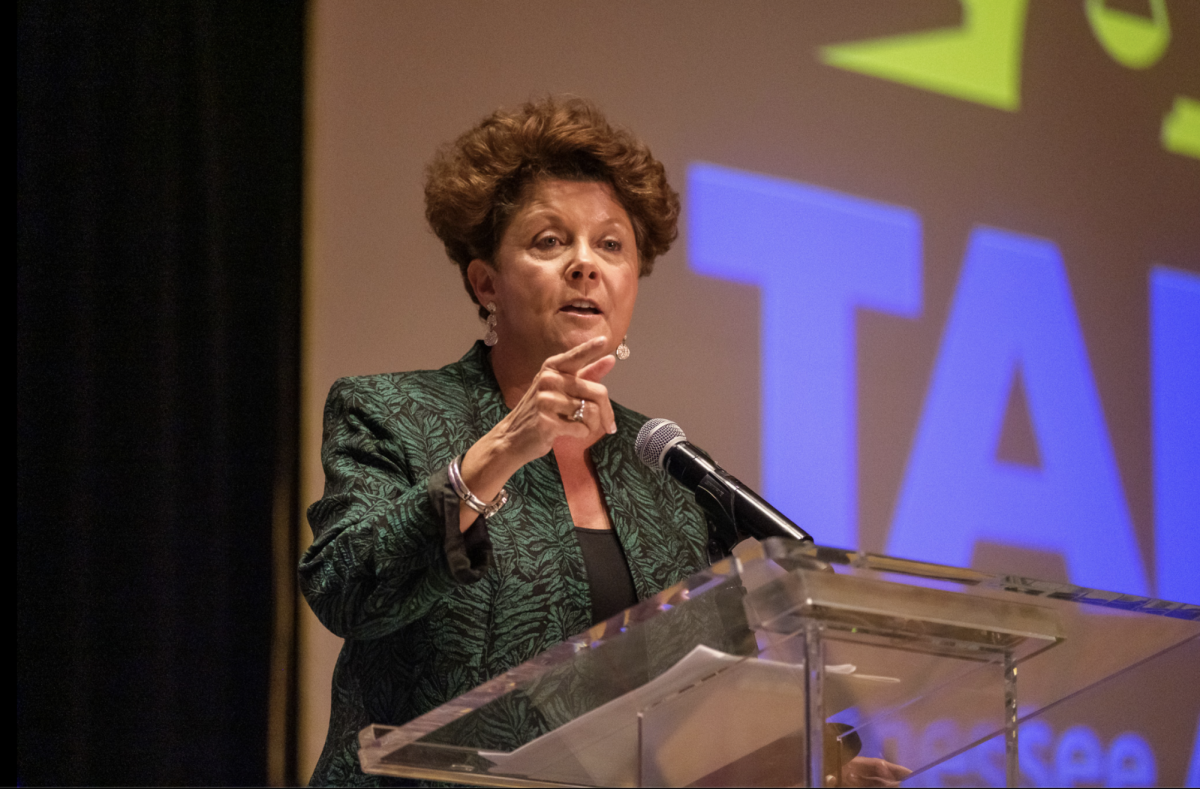
“If it was biologically possible to put Pat Summitt with Dolly Parton, that is what it is like working with Commissioner Williams,” said Matthew Parriott, director of communications for the Tennessee Department of Mental Health and Substance Abuse Services.
Marie Williams, commissioner of TDMHSAS, began her journey long before leading one of the state’s largest departments.
The first in her family to attend college, she graduated from Dyersburg State Community College and Austin Peay State University before pursuing graduate studies at the University of Tennessee, Memphis, and obtaining a master’s in social work from the University of Tennessee, Knoxville.
Her time at UT Memphis ignited her passion for social work and inspired her to pursue a masters degree at UT Knoxville.
After attending UT Knoxville, Williams worked as a part-time professor and taught courses in UT’s college of social work.
During her studies, Williams found mentorship and guidance from several key figures. She expressed gratitude for Lori Messinger, the dean of UT’s college of social work.
“She’s amazing,” Williams said. “She’s been expanding what that college does and how they train students … because they are producing the helpers of tomorrow.”
She also reflected on Dr. Hugh Vaughn, founder of and professor at the UT school of social work who helped propel her career forward.
“He was so wonderful … the other thing was he truly cared about all his students — that was always evident,” Williams said. “He stayed as long as we needed him to stay … to go over school assignments that he gave us. He just always was accessible.”
Williams spoke on the ways in which mental health advocacy changed in the time after her studies at UT, saying that “mental illness in general was very, very stigmatized.”
Today, she sees a shift in younger generations.
“It is amazing how much we have created a society where struggles with mental illness are more accepted and quickly responded to,” she said. “So, seeing that shift really meant a lot.”
For those struggling with mental health, Williams’ number one piece of advice is to ask for help. Williams said that “having the courage to say you’re struggling is a big deal. So pat yourself on the back.”
TDMHSAS directly impacts UT students through collegiate recovery work, which supports those facing addiction and mental illnesses.
Under Gov. Bill Lee, Tennessee increased its budget from about $380 million to $730 million, outperforming most other states in budget growth, according to Williams.
Despite this budget expansion, gaps remain — Williams said there is still a huge need to serve all communities.
“We know that we compete with other very important needs, like children’s services and even services and education, but the challenges would be not having the money to serve all the needs,” Williams said.
Despite these challenges, Williams remains hopeful. She said that Tennessee’s governor, legislature, hospital staff and community providers give her hope in Tennessee’s mental health landscape.
“Everybody’s on board to do the best we can to serve people in need. And I need everybody,” Williams said.
The internal culture of TDMHSAS further inspires her as the department values trust, transparency, integrity and partnership.
“Any challenge that comes forward, we got it,” Williams said. “You see stories about us coming together to really solve a problem that affects every socioeconomic status, every racial status, any status, any group. The hope is in that people want to do something about that and that we are doing something about that.”
Williams oversees nearly 1,850 employees, most working in their four Regional Mental Health Institutes, and manages about 1,250 contracts supporting mental health services statewide.
“I’ve got the best team at state government, and I did not say that lightly,” Williams said.
The department’s operations include approximately 5,600 annual admissions into their four mental health institutes, along with contracts with three private psychiatric hospitals that serve an additional 1,800 people annually, according to Parriott.
Williams also handles legislation. On Nov. 21, 2025, Williams attended a hearing alongside her team, presenting several proposals to Gov. Lee, including item 10 in phase one: a $20 million plan to add a mental health inpatient facility in Knoxville in response to Jillian’s Law. The project aims to address ongoing bed shortages for patients in crisis.
“I will tell you that I’m very excited about the proposal,” Williams said. “I’m very hopeful about the proposal, and I really hope we can get the funding to do it. Helen Ross McNabb’s CEO, Mona Blanton-Kitts, is one of the best in the state — so I know it’ll be a great project if we can get the funding for it.”
According to Williams, Knox County requested research and sent a letter to her team asking if they could create a plan for this facility.
“The research identified a need in that area and we do believe it’s gonna continue to grow unless the laws change,” Williams said in the hearing.
At this time, the department cannot comment further on the proposal as Gov. Lee reviews the items. Parriott said they expect to learn what is included in the budget by late January or early February.