UT System President Randy Boyd referred to the days after Tamar Shirinian’s controversial termination as “a firestorm” in records recently acquired by The Daily Beacon.
A mix of text messages and emails shed light on the moments before and after the assistant anthropology professor’s termination.
The Beacon obtained 3,027 pages of documents Nov. 18 in response to a public records request.
Public swarms to voice opinions
Emails from the general public flooded UT administrative inboxes starting Sept. 14 after Shirinian’s social media comment that “the world is better off without” Charlie Kirk began to garner the attention of conservative influencers like Robby Starbuck.
Emails called Shiranian an “evil woman” and labeled her comment as “vile,” “absolutely disgusting” and “hateful, diabolical, bloodthirsty, gruesome rhetoric.”
Requests for further investigation mixed with demands for Shrinian’s termination made for a barrage of emails.
“I’m up to about 95 emails to my mtindell email address,” UT System Assistant Vice President of Communications Melissa Tindell emailed Chancellor Donde Plowman at 9:35 p.m, just hours after Shirinian’s comment began circulating online.
An applicant to UT’s Aerospace Engineering master’s program told the Board of Trustees he redacted his application due to Shirinian’s comment, saying that he values professionalism, civility and ethical conduct. The applicant sent the email Sept. 14 at 5:59 p.m., before the university made any comment on the situation.
“As someone who deeply respects the academic profession and aspires to become a professor one day, I believe that those entrusted with educating the next generation should uphold themselves to the highest standards — both in and out of the classroom,” the applicant said.

Charles Weaver Jr. — son of UT’s first chancellor, Charles Weaver — emailed Plowman demanding Shirinian be fired.
“My father was the first chancellor at UT, and if alive would be sickened by her posts,” Weaver said.
Texts between Zomchick and Plowman reflect initial concern
Shirinian’s comment made its way to administration quickly.
The Daily Beacon acquired text messages from Plowman and Provost John Zomchick in which Plowman said, “I’m holding out hope that it is fake and she didn’t actually do that.”
Zomchick played a key role in communicating with UT faculty once Plowman initiated termination proceedings. Read more about his discourse regarding Shirinian and academic freedom here.
Plowman’s texts continue at 10:48 a.m. Sept. 15, when she wrote to Zomchick: “I’m sorry we are at this point but appreciate your Leadership more than I can express. We will get through this.”
Zomchick replied, “I have full faith in you and will do all that can be done to help our university.”

Concern escalates to termination proceedings
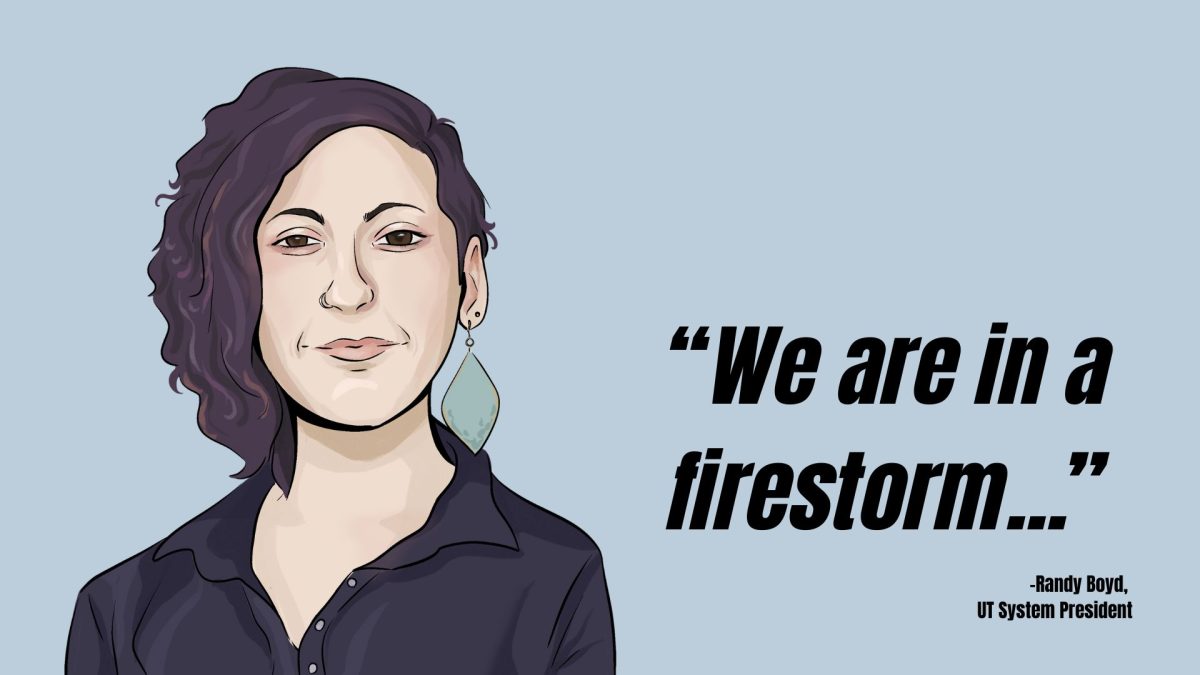
“We are in a firestorm ever since,” Boyd said in an email to the Board of Trustees on Sept. 15 at 9:14 a.m. “We are discussing faculty hand book, board policy, and legal ramifications. I’d welcome a call if you would like to discuss more.”

Boyd followed up at 9:16 a.m., attaching Shirinian’s post and again asking trustees to communicate over the phone.
“If you would like to comment, please call rather than email,” Boyd said.
Plowman placed Shirinian on administrative leave Sept. 15 at 12:59 p.m.
At 2:04 p.m., Zomchick provided Robert Hinde, interim executive dean of the College of Arts and Sciences, with the letter notifying Shirinian she would be placed on administrative leave pending termination.
“I am sharing with you the letter notifying Dr. Tamar Shirinian that she has been placed on administrative leave pending termination,” Zomchick said. “You may share the letter with the divisional dean and department head, but please instruct them not to share with anyone else.”
Academic community rallies to support Shirinian
The administration also received emails from professors across the nation, expressing their concern over Shirinian’s termination and asking that she be reinstated.
On Sept. 23, a professor of religious studies from the University of Wisconsin-Madison wrote, “(The disciplinary action) not only undermines the foundational principles of academic freedom but also constitutes a troubling violation of her First Amendment rights. … It is deeply troubling that UTK appears to be capitulating to pressure from far-right actors who have lionized Mr. Kirk despite his documented record of racist, Islamophobic, homophobic, and transphobic rhetoric — including statements made during his appearance at UTK earlier this year.”
One email sent by a student asked Plowman to reconsider her decision to terminate Shirinian.
“The implications of her termination are very unsettling to the students she leads and mentors,” the student said.
A UT professor also voiced his opinion to the chancellor, urging her to reconsider her decision to terminate Shirinian.
“I write to express my deep concern for the chilling of free expression and freedom of speech on campus given this recent decision to initiate termination proceedings against a professor for comments on social media,” the professor said.
Shirinian receives harrassing emails
“Good riddance.”
That’s the title of an email sent to Shirinian by a UT student Sept. 15 at 3:36 p.m. In it, the student writes, “This university is already a much better place without you. Thank you for exposing yourself as a parasite to not only UTK, the city of Knoxville, but the United States of America. … Adios, you vacuous excuse for an educator.”
Shrinian forwarded the email to Department of Anthropology Head Barbara Heath, calling it a hate message and saying, “This is harassment.”
Heath forwarded the email to Interim Divisional Dean for Social Sciences Gina Owens, asking if it could be referred to student conduct. Owens responded that she thought so.
At 6:05 p.m., Heath emailed Shirinian and anthropology professor Graciela Cabana.
“Thanks,” the email reads. “I reported (redacted) to Student Conduct, but obviously that was the wrong place to reach out to. I’ll make a report about employee harassment.”
At 6:09 p.m., Heath emailed Shirinian again.
“Hi Tamar, I believe that you as the complainant need to file the complaint against (redacted) with Title IX. Their email is [email protected],” Heath said. “I believe you can just forward (redacted) email to them and ask them to investigate it as a case of bullying.”
Shirinian later wrote in a letter of appeal to the chancellor that she received “a significant amount of hate mail.”
On Sept. 16, at 9:56 a.m., Plowman updated Boyd via text on threats the department of anthropology had received.

Later that day, at 4:06 p.m., Plowman sent the official letter of termination proceedings to Shirinian.
The faculty senate committee of faculty affairs brought up harassment in a memorandum written for a meeting of the faculty senate Sept. 19, saying it is “deeply concerned that the University’s response to a faculty member being targeted with violent, bigoted harassment through its own official channels has created a perception that the University is failing in its duty of care and is instead penalizing the target of the harassment.”
Read more about the Faculty Senate meeting below.
Plowman and Zomchick prepare for senate discourse
Faculty Senate President Charles Noble warned Plowman and Zomchick in an email titled “Faculty comments for Monday’s Senate Meeting” on Sept. 19, three days before the faculty senate meeting.
“In the interests of giving you some opportunity for reflection (and to add some order to questions) before Monday’s senate meeting, I asked the faculty affairs committee to gather and organize faculty concerns related to the recent commencement of a faculty termination procedure,” Noble said in the email.
Noble attached the Cowell and Butler’s Faculty Affairs Committee memorandum.
“You may want to address some of these things proactively in your formal comments, or you could wait until they are asked during the Q&A periods after your two talks,” Noble said. “The plan now is to have you each have a normal campus update slot then an opportunity for questions.”
Noble also warned Plowman and Zomchick to be prepared to face heightened emotions.
“I’m sure you realize that faculty emotions are high (at least among some) on this issue, and there may be more tough questions than I have included here. We will do all we can to maintain professional decorum throughout what may be a challenging meeting,” Noble said. “Please remember that senate meetings are “open”, meaning that any faculty, staff, students, the general public, and even the press are allowed to attend. We greatly appreciate you two attending to offer your perspectives on this situation and to engage with faculty and others.”
Backlash from the UT community hit Plowman and Zomchick at the meeting.
Later in the day, Plowman messaged Boyd with an update.

Misinformation trips up UT fans
Misinformation ran rampant through social media in the weeks following Kirk’s death.
Boyd received an email Sept. 24 that read, “Randy, We are very disappointed that a seat has been honored for Charlie Kirk in the stadium. I am so sorry that this happened to him. … BUT please keep politics out of sports! … We are considering giving up our season tickets that we have had over 20 years.”
Boyd emailed Plowman, “We did not do this did we?”
Plowman responded, “Not that I know of. … Let me check with Danny.”
Plowman confirmed roughly 10 minutes later that the confusion could stem from a fake post on Facebook, and that “there was one last week saying Danny was so sad about it that he had volunteered to pay for the college education of Kirk’s Kids.”
Emails highlight potential security concerns
Kirk’s assassination outside at a public university poses safety and security concerns for campuses that might wish to host political activists in the future.
In an email exchange with UT Board of Trustees Secretary and Special Counsel Cynthia Moore, Tindell communicated that UT held a neutral position and would stay silent on social media for 24 hours. Tindell said Kirk’s death might be an “opportunity for our campuses to come together to review security protocols internally and determine what potential gaps are when outside speakers come to one of our campuses. So tragic.”
Executive Vice President for the Foundation for Individual Rights and Expression Nico Perrino told the Associated Press in September that universities will likely choose to move large outdoor events into campus buildings, which are already the typical venue for controversial speakers.
Content of the Beacon’s records request
The Daily Beacon’s public records request, submitted Sept. 26, included requests for Plowman’s letter outlining the termination and appeal process, Shirinian’s teaching and performance reviews, her curriculum vitae and any disciplinary records.
Certain documents underwent redaction in adherence to federal and state law and to omit certain information protected from disclosure. The university confirmed Shirinian had no previous records of discipline regarding her teaching career at UT.
The Beacon additionally requested all correspondence including the words “Charlie Kirk,” “Tamar Shirinian,” “Anthropology,” “social post” or “free speech” sent or received by the UT Board of Trustees, Plowman, Boyd, Zomchick or Heath.
Many of the 3,027 pages of returned public records involved irrelevant information and correspondence.
The Beacon has an outstanding public records request with the university for similar search words for records from Sept. 27 to current date.