When plans were first announced to demolish the Ula Love Doughty Carousel Theatre, there were predictably cries of outrage.
The Carousel Theatre, built in 1952, was the beginning of theatre at the University of Tennessee.
It had a long legacy but eventually, due to outdated technology and safety concerns, the building was finally closed down. Rather than refurbish the theatre, it was decided that it would be more efficient to just build a new one instead.
“The sentiment in the community was originally a, ‘What the hell are you doing? Are you kidding me?’”, Tom Cervone, managing director of the Clarence Brown Theatre, said.
Cervone has been involved in Knoxville’s theatre industry and in the UT community for quite some time. He, along with a team of others from the Knoxville community and UT, have been working tirelessly to make this project come to life.
Another member of that team is Calvin MacLean, former artistic director for the Clarence Brown Theatre and former head of the theatre department. Like Cervone, MacLean has also been involved in the theatre industry for quite some time.
“The Carousel was always intended to be a temporary theatre,” MacLean said. “All places have a lifespan. Even many people who were emotionally connected to the old space understood that the space had outlived its old life.”
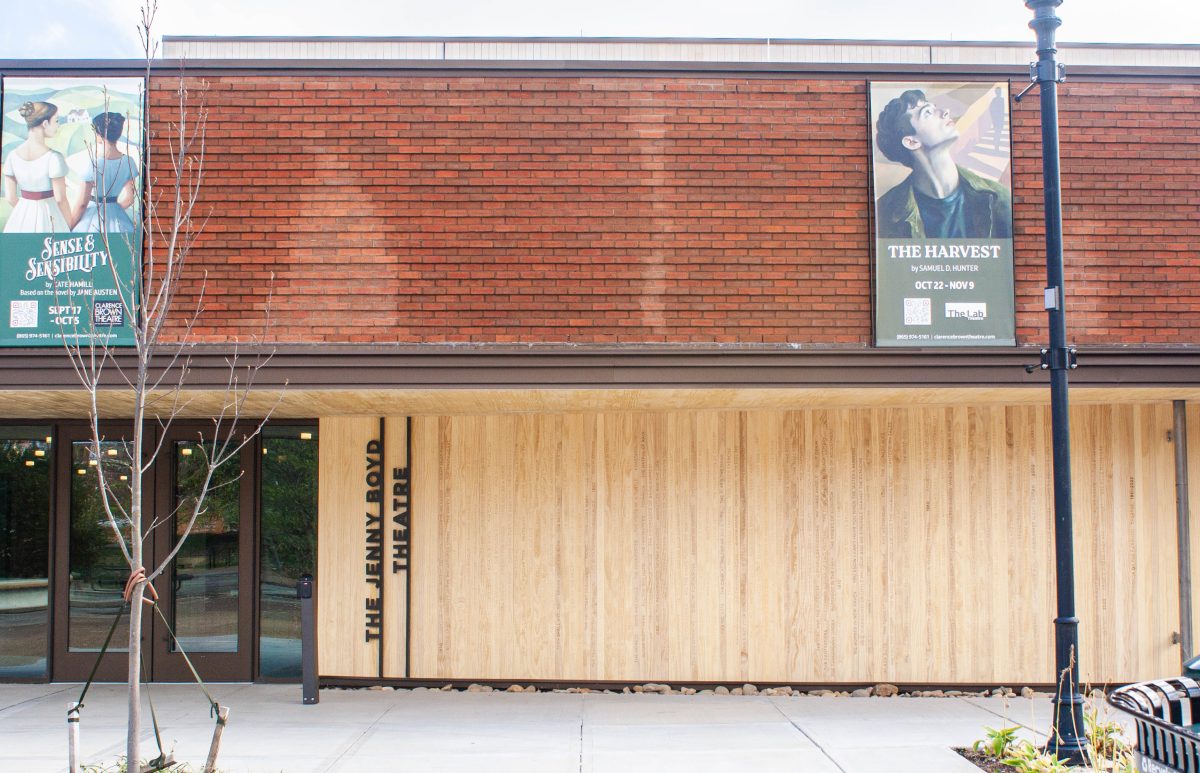
The Jenny Boyd Theater on campus on Wednesday, Dec. 3, 2025.
A dedication ceremony was held for the Jenny Boyd Theatre on Nov. 7 and included a tour of the new space. The new theatre will be located right where the Carousel once was and have state-of-the-art facilities.
Ethan Swatzell, a freshman theatre major with a concentration in design, attended the ceremony and was very impressed with the interior of the theatre. He has been told by some of his professors that it may even be too “high-tech” for a university theatre.
“I think the Jenny Boyd theatre is so different because it’s so focused on giving the audience the best experience,” Swatzell said. “I’ve never seen a theatre with that much space in the ceiling. They also have the patron lounge for longtime fans. It’s very clear that they care about their audience and patrons. ”
Audience comfort was one of the biggest concerns when it came to the old Carousel theatre. Due to its limited space, there were no lobbies for people to assemble in or wait to purchase tickets.
“If there was rain, the audience would get wet, waiting to get into the theatre,” MacLean said. There was no place to assemble indoors during intermissions. There was no way for actors to wait behind the scenes except for some small dressing rooms.”
Cervone described the space as “limitless.”
“The technology is 21st-century, from the sound to the lighting to the box office to the backstage areas to the dressing rooms,” Cervone said. “There’s even a loading dock in the very back of the theatre to easily transport scenery. There’s even a scene shop in the new theatre as well as washers, driers and steamers. It is an opportunity for our students to work in a really interesting space.”
The theatre doesn’t only promise a new, innovative way to engage an audience. It also promises new, innovative ways to train students in the art of theatre.
“The faculty members who steward and supervise these students in various areas are very enthusiastic about affording their students, both graduate and undergraduate, to get adjusted to a new space,” Cervone said.
While the new space may take some time to get adjusted to, in the long run it is projected to be game-changing in how theatre classes are taught.
“It’s like getting a new car,” Cervone said. “You’re behind the wheel and you’re going to see how it works. There will be challenges and mistakes but that’s why we’re here. We want our students to learn experientially, rather than just from a book.”
The additional space will also be more convenient for students, staff and faculty.
“The theatre department’s classes were all over campus,” MacLean said. “There was no real adequate rehearsal space and no place for undergrad and grad classes other than the theatres themselves which made it a problem to produce in those theatres when we would have to bump classes out of them to build sets.”
One of the primary goals of the Jenny Boyd Theatre is to increase experiential learning opportunities for students.
“The best way to train young actors is to have them train with experienced professionals,” MacLean said. “There are two kinds of productions that the community at large and the theatre try to address. The first is a kind of professional theatre with student participation. The other kind is student-focused production with professional contribution.”
Cervone and MacLean are hoping the new space can enhance the relationship between actors and the audience by providing a more intimate experience.
“Jenny Boyd is perfect for plays that are focused upon community and interpersonal relationships,” MacLean said. “Where the Jenny Boyd will really show its value is when the focus can be on interpersonal relationships between actors. That’s where I think the future of theatre will go and the Jenny Boyd is positioned to do that. It’s got a flexibility that will be exciting for artists of all ages.”
The play lineup for this season includes two shows at the Jenny Boyd Theatre, ‘Cabaret’ and ‘The Royale’. According to Cervone, ‘Cabaret’s’ lineup will feature a predominantly student cast. Student tickets for shows in the new Jenny Boyd Theatre will be $5, the same price for shows in the Clarence Brown Theatre.
“Our responsibility is to get students engaged in theatre,” Cervone said. “We don’t want any barriers to entry to be in dollars or cents. We have a mission to produce world-class theatre and train the next generation of theatre artists, but we also have a commitment to making sure our students have access to that.”
Swatzell is excited for what the future holds for the Jenny Boyd Theatre, and hopes it will spark an increase in interest for the art of theatre in general.
“I think that theatre is generally important because it has the power to make people think and change perspectives,” Swatzell said. “Most playwrights don’t write shows just for the fun of it, they write to impact people’s lives and make people think about a message. Theatre can bring on new perspectives in times of hardship and distrust. Even if you’re not majoring in theatre, I just feel like being part of theatre is incredibly important because it’s a great way to connect with others and express yourself in a place that is safe.”