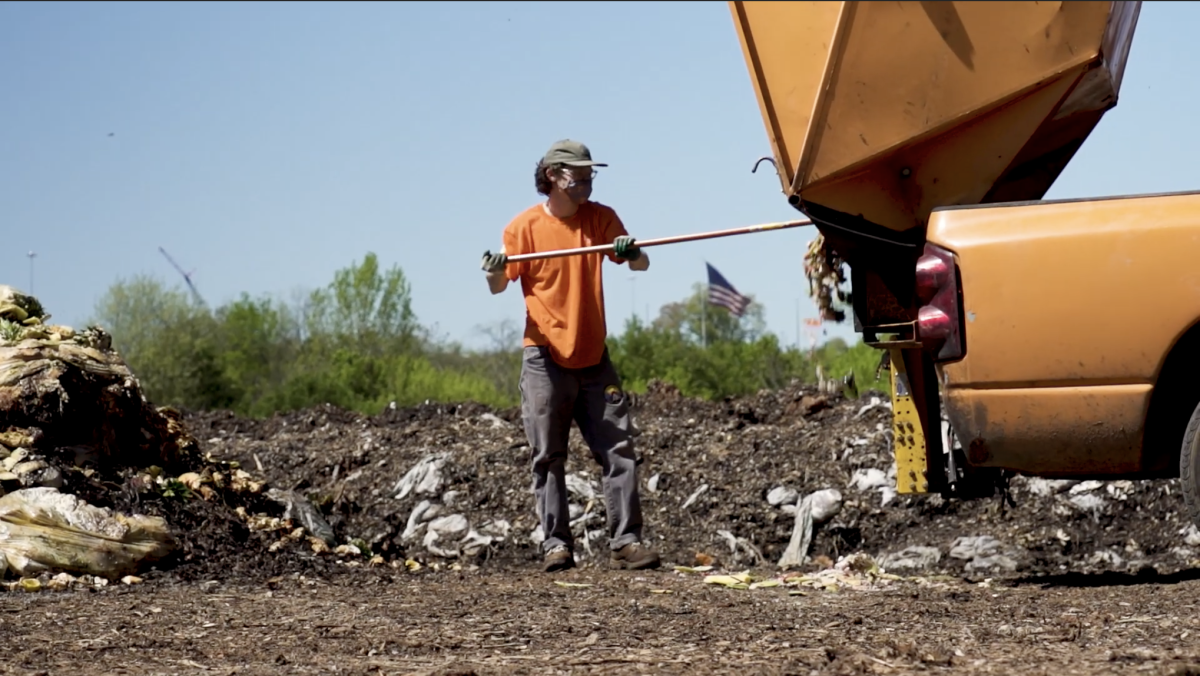
At the large UT compost facility across from the UT Medical Center, more than 10,000 pounds of food waste and coffee grounds are collected from campus each week.
The food waste is turned into compost, a natural soil additive. To do this, the material is layered in windrows, 80 foot long and six foot tall rows, with two layers of browns and one layer of greens. Greens are nitrogen rich materials, such as grass and vegetable waste. Browns are carbon rich materials, such as dead leaves.
Once it is in the windrow, the mixture is rotated about once a week to provide oxygen. This process is repeated for five months. At this point the compost is identical to potting soil.
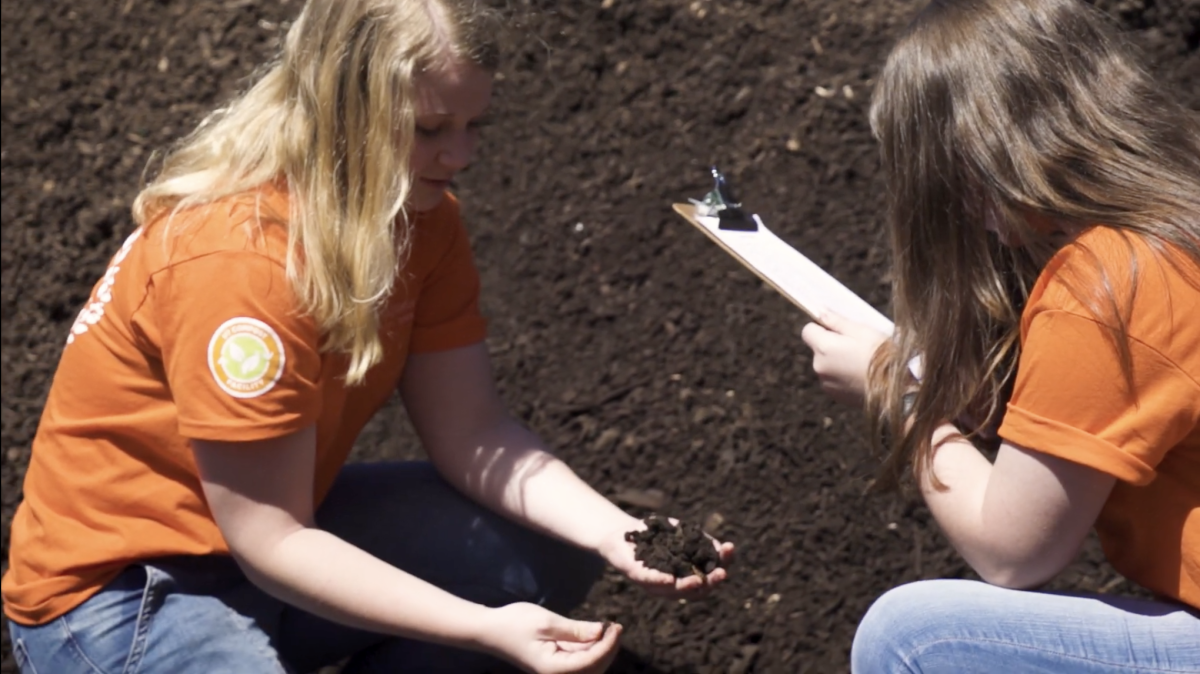
Rachel Stewart (left), president of the Compost Coalition, pictured in UT's Office of Sustainability "Growing Every Day at UT Compost Facility" official YouTube video. https://youtu.be/QoXki7-qjUw
Finally, the compost is put through a screening process to rid it of any remaining metals or plastics.
The compost is then sent to UT gardens, the Office of Sustainability’s growth lab and various flower beds. Compost operations specialist Wayne Mason said the Office of Sustainability hopes that one day the compost will be used by the Anthropology department.
“The more we involve ourselves with campus the more we are kind of irreplaceable with campus,” Mason said.
Mason, a UT alumnus, has worked at the facility since 2019. He said when he arrived at the facilities, they were in a “sort of disrepair.” Since Mason’s arrival at the UT compost facilities, the organization has steadily grown.
In 2019, over 500 tons of food waste was composted. In the 2021 fiscal year, 739 tons, or 434,000 pounds, of general waste was composted. Food waste was 217 of those tons, of which 90-95% was non-recoverable. 936 tons of general waste is projected to be composted this coming year.
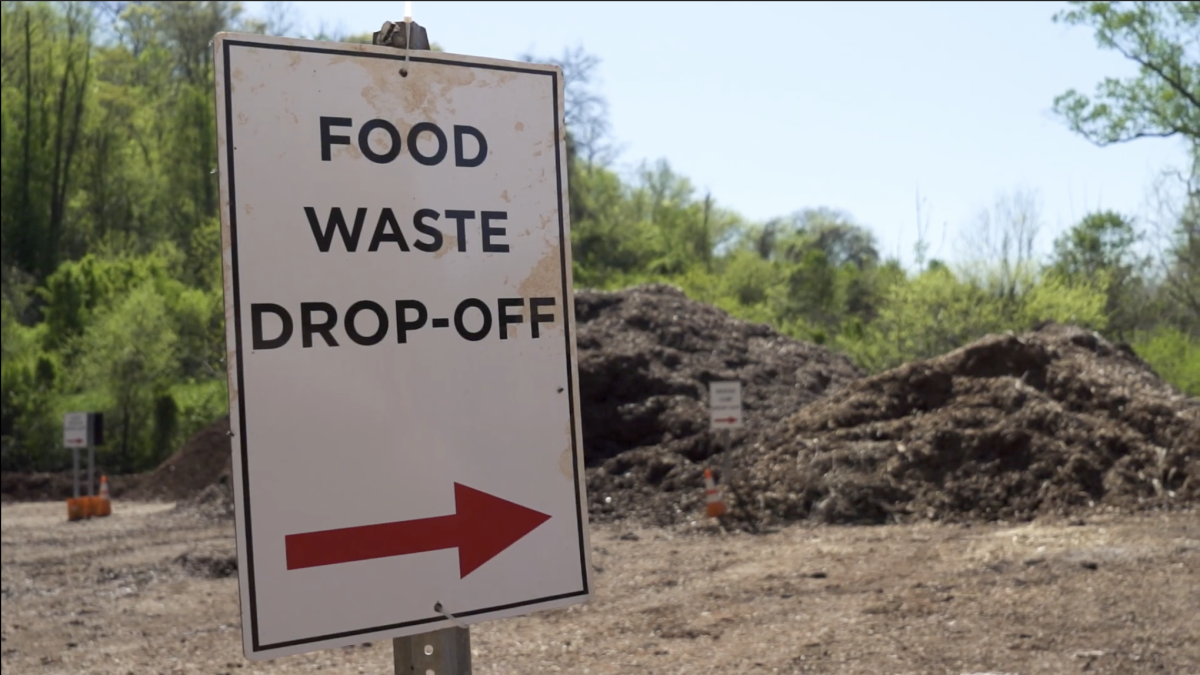
Still image from UT's Office of Sustainability "Growing Every Day at UT Compost Facility" official YouTube video. https://youtu.be/QoXki7-qjUw
Food recovery, the practice of recovering perishable, safe food that would not be otherwise used, is done before food waste is added to the circulation into compost. This food is then donated to Second Harvest Food Bank of East Tennessee, Knoxville Area Rescue Ministries and the Love Kitchen.
Recovered food from the school could potentially feed 250,000 people, according to the Food Recovery Network at UT.
“We continuously try to grow with the community and grow with its needs, and those needs are continuously growing everyday, so hopefully we grow everyday,” Mason said.
If the school’s food waste was not sent to a composting facility at UT, it would be sent to a landfill. There the food waste would rot under mounds of trash. This produces methane, a greenhouse gas that is 21 times more potent than carbon dioxide.
Chancellor Donde Plowman said in January 2020 that UT has “committed to divert 50% of its waste from the landfill by 2030.” The school currently diverts 33% of its waste, according to the UT Zero Waste initiative.
Students can get involved with composting by joining the UTK Compost Coalition. The coalition’s main goal is to bridge the gap between composting and the general campus public. They are currently pushing for composting bins on campus where there are already recycling and trash cans.
“It’s really exciting that we could get compostable materials everywhere on campus, like you see at other universities across the states,” Rachel Stewart, the president of the Compost Coalition, said.
“One of the biggest challenges that the compost site faces, as we expand to more people the amount of contamination increases, which are non-compostable things like plastic and styrofoam. Right now it’s not easy for students to compost, but if it was easy, I think a lot of students would participate, because they genuinely do care about environmental impacts.”
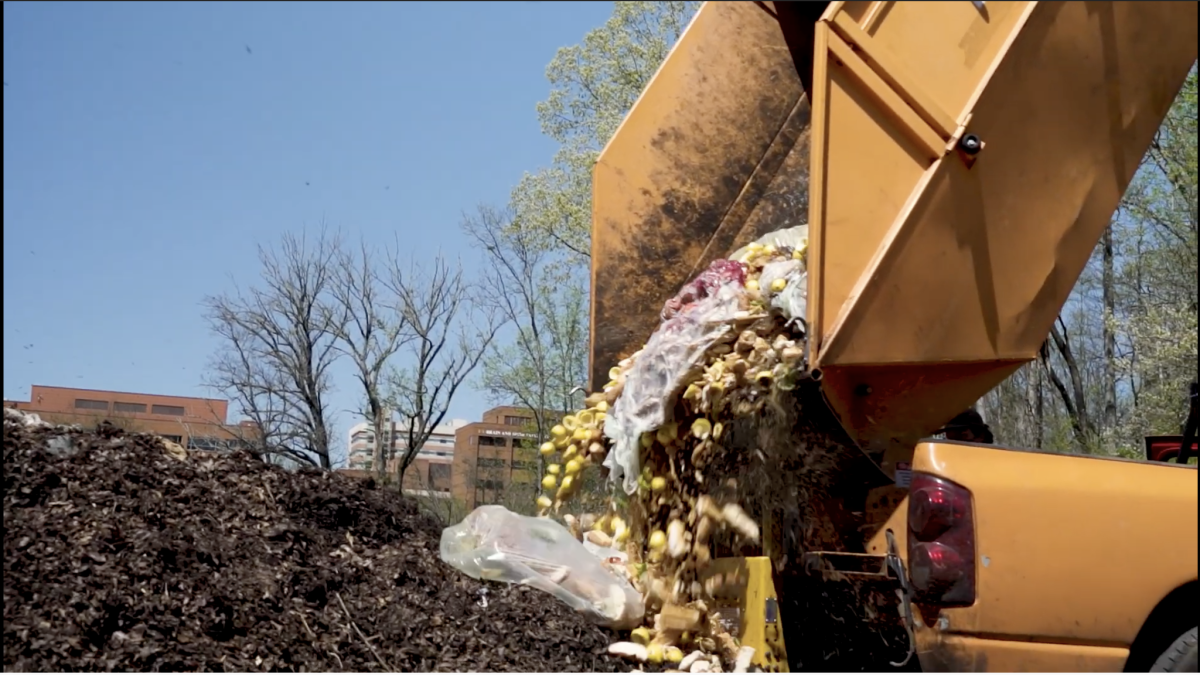
Still image from UT's Office of Sustainability "Growing Every Day at UT Compost Facility" official YouTube video. https://youtu.be/QoXki7-qjUw.
The Compost Coalition hopes educating students can help make composting easier. The Office of Sustainability offers a free game, “Waste Warrior,” to help students learn how to throw away waste. The game has five levels, and as it progresses students can earn rewards in-game.
“We have a lot to do in terms of hopes and dreams, if you will, but all of those things are very accomplishable in the next year and a half or two years,” Mason said.
Students can find the UTK Compost Coalition on Instagram. Students can also schedule a free tour of the compost site by contacting compost operations specialist, Wayne Mason and can find more information at the Office of Sustainability’s website.