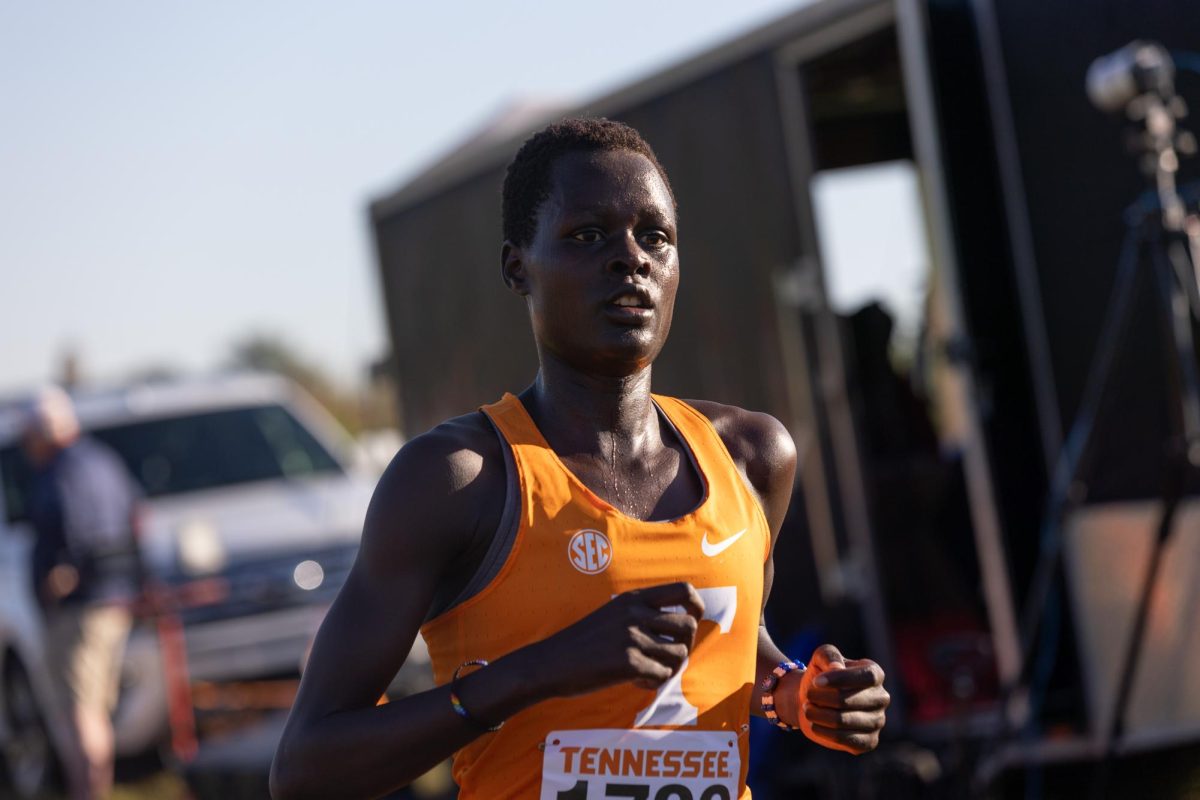
Breaking and rebuilding barriers is never easy, but for Tennessee’s first-year director of track and field/cross country Beth Alford-Sullivan, overcoming hurdles has defined her career.
The first hurdle? Becoming the first woman to coach a football bowl subdivision men’s track and field program.
The second hurdle? Facing rebuilding projects at nearly every coaching destination.
Alford-Sullivan graduated from the University of Minnesota in 1989 with a degree in social work. While at Minnesota, she competed in cross country and track and field for the Golden Gophers under then head coach Gary Wilson, who was a coach of a program in the midst of a rebuilding phase.
Wilson’s rebuilding efforts at Minnesota foreshadowed Alford-Sullivan’s own coaching career.
Yet, how did her own coaching career begin? It started after some encouragement from her friend and her coaches
Entering her last semester of college, she had never thought of becoming a track coach until a friend told her to think about it. At the time, Alford-Sullivan realized she had never seen a woman coach except at the Division III level and even then wasn’t sure if the woman was a coach or not. After a discussion with her coach and a stint coaching spring track at her high school, Alford-Sullivan knew she wanted to be a coach.
“That got me started finding a GA-ship (Graduate Assistantship),” Alford-Sullivan said. “It was really the shoe that fit.”
Alford-Sullivan landed a Graduate Assistantship at Southern Illinois University at Carbondale where she spent the next two years. During her time at SIU she met her now husband Jim. Following Southern Illinois, she landed her first job at Southeast Missouri State.
“I had my first paid job,” Alford-Sullivan said. “As the men’s and women’s cross country coach and assistant track coach. It was outstanding.”
Then NCAA Division II school Mankato State came calling.
“It was just the women,” Alford-Sullivan stated. “I debated that but I took the chance on it and became a head coach, I was probably 27 or 28 years old. Took over that program and had a good stretch for two years there, got me back closer to my family.”
Alford-Sullivan left Mankato to go to Stanford. She spent the next five years at Stanford and had her first taste of a rebuilding job. Hired by Vin Lananna, Alford-Sullivan helped establish the Cardinal as a powerhouse in track and field/cross country.
She coached more than 30 All-Americans and one NCAA individual champion as the women’s coordinator at Stanford.
“Vin Lananna out at Stanford had a vision for what that place can be,” Alford-Sullivan said. “They had some success in the 80s but we were in the mid and late 90s and early 2000s. It was a great revolution of bringing back American distance running, bringing back the Stanford program to the level that it was.
“I was there at the highlights of their time in terms of their athletic department being successful and being outstanding, it was almost a Camelot-feeling of time out there.”
Taking what she had learned at Stanford, Alford-Sullivan returned to the Big Ten to become the women’s head coach at Penn State, where she encountered yet another rebuilding project.
Alford-Sullivan coached 158 All-Americans and claimed nine Big Ten team titles in 15 seasons at Penn State – also, 88 Big Ten individual championships, 19 Big Ten Champion relays, and four individual NCAA champions. Alford-Sullivan, using her experience at building track programs, rebuilt Penn State and turned it into a contender on the nation level year after year.
In the summer of 2006, Alford-Sullivan broke down barriers for women coaches. She became the director of track and field/cross country at Penn State. In reaching that position, she became the first woman to be the head coach of a men’s program in the FBS.
“The uniqueness for me, in this position that I hold,” Alford-Sullivan said. “I was the first director of track and field in a BCS, when it used to be the BCS I should say, program for men. That was a big step that Penn State took and opened the door for a lot of my colleagues. Then Tennessee hired me as the first women in the SEC to coach men of any sport. Kind of breaking down some barriers and trying to do some unique things and have had some great opportunities and mentors along the way that have helped facilitate the opportunities that I’ve had.”
Since Alford-Sullivan became director of track and field, seven other women have also reached the same position.
“One of my best colleagues is the director of track and field at Sacramento State,” Alford-Sullivan stated. “We actually started at Carbondale together in graduate school. We both have made it through the ranks and she and I rely heavily on each other in terms of process and support and perception, understanding everything that is going on. Over the years we have definitely had an opportunity to mentor a lot of young women in coaching.”
Alford-Sullivan takes pride in her former women athletes who have pursued coaching careers. She has watched eight to ten female student athletes in her program become coaches.
The track and field coaching association has taken major strides to aid women in the sport. At the annual convention, a women’s summit is held with great support from the coaches association. The summit, Alford-Sullivan opined, has done a great job of opening the sport up even more for women and given them a chance to network and get to know each other.
While women have difficulties in breaking through glass ceilings in other careers and in sports, Alford-Sullivan is proud that the sport of track and field doesn’t have some of the gender stereotypes that other occupations have. She said that schools look for coaches who can get the job done and who are resourceful to hire, regardless of gender. Also, the structure of track and field breeds inclusion.
“We are combined in our sport from pee wees through the Olympics,” Alford-Sullivan said. “We are truly the only sport that is. When you start at the grass roots level of track and field it’s the boys and girls together and the teams are combined at most places all the way through high school and now in college, I know at the D-1 level, it’s probably 85-90 percent of the D-1 schools are in a combined setting.”
“We have the opportunity to be exposed to both the men and women as you go through the coaching ranks and be together in the colleague sense of things. I’m really proud that I haven’t faced some of the stereotyping that other sports have to face. Yet at the same time at the end of the day out of the 320-some division one track programs there is, I think, eight of us that have this position.
“You can still see we are in a very male dominant field and with that you are always exposed to some of the issues that come up but it pretty much just rolls off our back.”
In the summer of 2014, Alford-Sullivan was hired by UT Athletic Director Dave Hart to become the new track and field and cross country director at Tennessee. The challenge of the SEC and the chance to once again rebuild a proud track program attracted her to Tennessee.
“The resources are here, the history is truly here,” Alford-Sullivan said. “It is a phenomenal group of alumni that have embraced the change that has happened. The leadership is truly on board with wanting to bring track back and get it rockin’ again.”
Her current student athletes have bought in as well.
“With the new people coming in and the foundation she is building,” captain Jake Blankenship said. “She is doing a really good job and we’re really excited to see what happens the next few years.”
Captain and junior Cassie Wertman said the biggest difference she has seen from her first two years to this year is that the team has a goal.
“She has made it very clear what her intentions are here,” Wertman said. “Everyone is kind of ramped up and alright we are going for that too.”
Junior Cameron Brown mentioned passion several times in describing what Alford-Sullivan has brought to the Tennessee track and field team. Brown also said she has brought a belief that they can compete and win every weekend.
All three, Blankenship, Wertman and Brown believe Alford-Sullivan will rebuild the Tennessee track and field will return to championship winning program.
“Every job I’ve been fortunate to have I’ve come into a rebuilding faze of it,” Alford-Sullivan said. “You look at my career and I’ve pretty much taken over when it needed a rebuilding phase and I think that stems back to the fact that my coach took over at the University of Minnesota when I was in college and it was a rebuilding phase at that point. I think that’s my nature off of what I experienced as a student athlete and I really feel the reward of taking something from where it is to where you want it to be at the top of the ranks. Luckily I’ve had a great stretch of doing that everywhere I’ve gone and we’re in the midst of doing that here at Tennessee.”