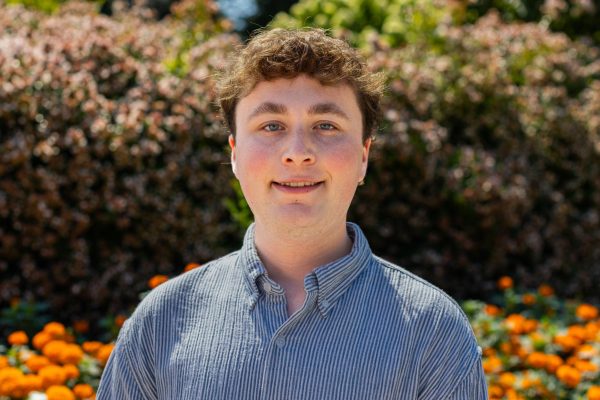
“Make friends with people that you disagree with,” UT professor Josh Dunn said.
In the wake of the high-profile assassination of conservative influencer Charlie Kirk at Utah Valley University, UT’s community questions rising political temperatures and attacks on free speech, especially on college campuses.
Many at UT found Kirk’s death particularly impactful because of his visit to campus in March, as a part of his American Comeback Tour. Dozens of students spoke to Kirk at the event, and the HSS amphitheater overflowed with attendees.
Have high-profile acts of political violence become more common? Trump’s July near-miss with an assassin in Butler, Pennsylvania, the killing of Minnesota state Rep. Melissa Hortman and her husband Mark the same month, the October 2022 assault of Rep. Nancy Pelosi’s husband, Paul, the violence at the Capitol on Jan. 6, 2021 and the 2017 Congressional baseball shooting in Virginia are all examples of recent acts within the last decade.
Dunn, who serves as executive director of the Baker School of Public Policy and Public Affairs’ Institute of American Civics at UT, provided historical context on political discourse.
“It’s hard to think of something within the last 30 years where … emotions have run this high,” Dunn said.
He made note that there have been times of high political turmoil in the past.
“Obviously, it’s a pretty tense time right now,” Dunn said. “But we’ve had periods where it’s been, I mean, maybe even more tense than now. Back in the 60s and 70s … there was a lot of conflict then. There were literally thousands of bombings by domestic terrorists in the 1970s.”
In the late 1960s and early 1970s, violence broke out across America, and college campuses served as the epicenter. Bombings in the 70s were committed by several groups aiming to disrupt the government’s prosecution of the Vietnam War.
A record one-third of students now hold “some level of acceptance — even if only ‘rarely’ — for resorting to violence to stop a campus speech,” according to a September report by The Foundation for Individual Rights and Expression. This number is up from the reported one in five found by FIRE in 2022.
Kody Cooper, an associate professor at the Institute of American Civics with specialties in American political theory and philosophy, described the foundation’s report as concerning. Cooper expanded on the state of political speech in the country and on college campuses.
“Legally speaking, we’re at a place where there’s clear and strong protections for free speech, and some of the strongest we’ve had,” Cooper said. “… You can’t just paint with a broad brush, but let’s say that there are some campuses where free speech is more valued and embraced by the culture and the administration, and there are some where it’s not so much, and then there’s a lot in the middle.”
Free speech is potentially at risk after Kirk’s assassination, according to Dunn, who predicted that some universities will respond to the violence by declining to give controversial speakers a platform on their campus.
“But I think some other universities will say, ‘We can’t surrender to this and capitulate to it, and we’ll do what’s necessary to make certain that controversial speakers can still come to campus, and that they can do so without this kind of violence,” Dunn said.
According to the same report by FIRE, UT ranked 36 out of 257 for free speech overall, based on student surveys, campus policies and speech-related controversies.
For Cooper, civility within political debate in his classes is critical.
“I think what we’re doing in our classrooms and events is fostering civil discussion, deliberation, discussion of ideas, of our founding principles, of our founding documents, in a way that is open to perspectives across the ideological spectrum,” Cooper said.
Continuing, he spoke to the effect Kirk’s assassination might have on the temperature of campus.
“I think that makes this all the more tragic because students ought to feel free across the political spectrum to invite people on campus, to seek truth and to speak to them without fear — without fear of what happened, without fear of political violence,” Cooper said.
Jeff Larsen is a psychology and neuroscience professor at UT. He specializes in social psychology and has done research for nearly two decades. Larsen leads the Affect and Emotion Lab at UT and also runs studies on the nature of disagreement.
“It’s the way the university works,” Larson said. “It’s this place where people can disagree with each other. It’s supposed to be a place where people can disagree with each other and explain why they feel the way they do.”
UT’s success in maintaining an environment that protects free speech could spring from the variety of events it hosts to foster healthy, civil debates and open conversations about political issues.
There are many political events for UT students to engage in on campus. The IAC is hosting a lecture by American political analyst Yuval Levin on Sept. 18 in honor of Constitution Day. The IAC has previously hosted debates, with the intention of bridging the political divide, about topics including the electoral college, the American Dream, free speech and polarization.
With such a wealth of information and education on being productive political participants, UT students have an opportunity to take these experiences and apply them to their political practices.
Avoiding negative partisanship, Dunn said, is step one. Negative partisanship involves voting for a candidate not out of support for their ideas, but out of hatred for the opposing candidate. Negative partisans may even sacrifice constitutional principles for the sake of political gain against their opponent.
“If the other side is so uniquely wicked, then why would you let constitutional niceties stand in the way of keeping those people out of power?” Dunn said, “That’s a very dangerous place to be.”
Negative partisanship can be countered with rational voting, according to Dunn.
“Go and research candidates and parties,” Dunn said. “And decide that you want to vote for them because you think that their agenda and platform is better than the other one.”
According to Dunn, if voters see their candidates and government officials slipping into negative partisanship, they have the power and responsibility to call it out.
“I think candidates will listen to that,” Dunn said.
The rest of Dunn’s advice for avoiding increasing political polarization, extremism and violence was simple.
“Engage in good faith conversation with people that you disagree with. Don’t assume the worst in people that you disagree with. Try to find some common ground,” Dunn said. “I think those things will go a long way.”