Faculty members are committed to a future of asking questions of senior administrators, according to a free speech teach-in on Monday.
UT’s chapter of the American Association of University Professors hosted the teach-in. Todd Freeberg, president of the association, began the event by explaining its purpose and relevance.
“AAUP formed in 1915 to support faculty mainly on two lines, on one hand, increasing shared governance, and on the other hand, strengthening academic freedom,” Freeberg said.
In the event’s opening remarks, Freeberg earned nods from faculty members after expressing concerns over where academic freedom at UT is headed.
“Like most, if not all, assistant professors, I am worried about my job prior to getting tenure,” Freeberg said. “I have to say I am now more worried about my job and all of our jobs.”
The event comes after a year of national turmoil over academic freedom following a surge of professor terminations related to the death of political figure Charlie Kirk. Since then, academic freedom has been at the center of faculty concerns as free speech and tenure face threats from university administration and the state government.
“My initial reaction on seeing the news of (Kirk’s) murder was, ‘This is going to be a turning point in higher education,’” Robert Kelchen, head of the department of educational leadership and policy studies, said. “Indeed, it has been.”
Chancellor Donde Plowman terminated assistant anthropology professor Tamar Shirinian in February after Shirinian commented online about Kirk’s assassination, saying “the world is better off without him in it.”
Shirinian has since filed a complaint against Chancellor Plowman and President Randy Boyd in both their personal and official capacities.
Kelchen held a discussion about the necessity of shared governance in university policy.
“I would say that shared governance is at its most challenging point in the modern university,” Kelchen said.
David Butler, co-chair of the faculty senate’s Faculty Affairs Committee, and Derek Alderman, former faculty senate president, also spoke to faculty members about the future of free speech and academic freedom at UT.
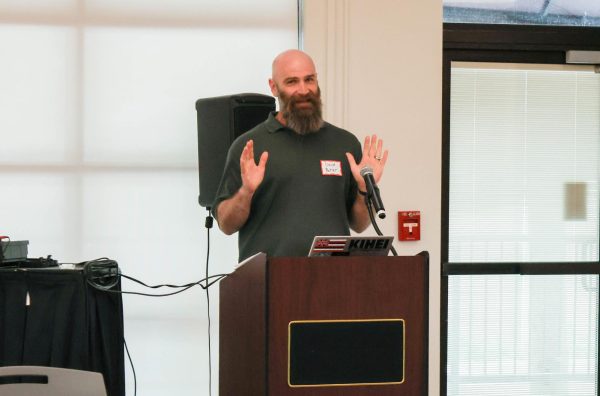
“I’ve seen a lot of moments these past couple years where I, in fact, believe shared governance has been a bit hollow,” Alderman said.
Alderman said he hopes to see a shift in the university’s priorities in addressing faculty rights.
“There’s more attention paid to how UT is perceived by legislative leaders and external power brokers than how the university is experienced by faculty, students and future scholars who may be seeing this institution as their intellectual home,” Alderman said. “I think that has to be corrected.”
Tennessee lawmakers recently passed legislation codifying the process Plowman took in terminating Shirinian, streamlining university termination policy and removing opportunities for faculty voices.
“These are stressful times for UTK and higher education in general,” Freeberg said. “Our upper administration is increasingly bypassing faculty input.”
Alderman proposed several potential solutions for faculty members to rally for, including increased opportunities for faculty members to express concerns and ask questions to Provost John Zomchick.
“The future will require active work, continued deliberation and a willingness to ask difficult questions of ourselves, but especially of the senior administration,” Alderman said.
All speakers agreed that protecting academic freedom and shared governance starts with faculty organizing and collaborating.
“There’s a lot going on right now. Much of it is not positive,” Kelchen said. “But the fact that we’re all in this room having this conversation right now is very valuable and important.”