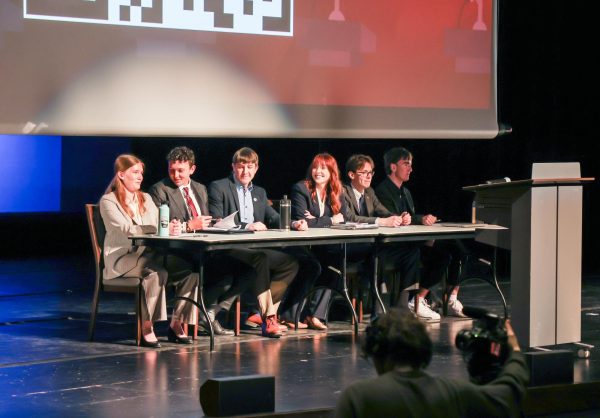
Several students from the Baker School engaged in a civil debate Wednesday night in what organizers viewed as an attempt to “learn from each other” and “understand the other side.”
The debate, organized with the help of campus groups like the Institute of American Civics and the Baker School Student Association, promoted civil discourse in a time of rising political temperatures.
“I organized this event as a reaction to my observation on political division in the country,” Braden Bonney, a junior political science major who orchestrated the event, said. “I saw a lot of hate towards the other side, on both sides of the political spectrum, and I didn’t want that to affect campus.”
Debaters were split into left-leaning and right-leaning groups, with three students on each side, to present and rebut arguments over current issues, including the war in Iran, nuclear energy and healthcare reform.
At the end of the debate, five faculty members voted for the winning side, and attendees participated in an audience poll. The faculty members voted for the left-leaning side 4-1. The audience poll also favored the left, with a 76.7% vote out of 219 total responses.
Border security and voter identification
The night commenced with Ella Williams, a junior public affairs major on the right, presenting the first topic, arguing for stronger border security and voter identification laws.
“Every legal vote should count, but equally, every illegal vote should be prevented,” Williams said, specifically supporting enhanced border patrol and photo identification requirements at the ballot box.
Connor Corby, a freshman political science major on the left, spoke against Williams’s argument, suggesting the employment of more immigration judges to facilitate increasing immigration rates.
“This isn’t a call for more border security, but for more, and stronger, bureaucracy that’s able to account for the growing number of people that are trying to enter into the United States,” Corby said.
Foreign affairs and soft power
“One thousand two hundred Iranians have died. Thirteen U.S. service members have lost their lives. We’ve spent over $16 billion in the past 12 days on this war, and crude oil prices have surged above $120 a barrel,” Corby said, opening the next topic about foreign policy. “This is the definition of hard power.”
Corby took inspiration from past foreign policies like the Marshall Plan to propose a shift to the use of soft power in international affairs, which he said would help America’s relationship with allied countries and ease tensions with countries like China.
John Knighton, a junior economics major on the right, said the war is being conducted with long-term international consequences in mind.
“Part of the beauty of this war right now is that China has not really come to bat for Iran,” Knighton said. “Is China really going to back its allies in hot military conflicts?”
Religious freedom
Knighton used his opportunity at the podium to argue liberalism limits religious freedom from a philosophical perspective.
“In liberalism, you can’t act as a Protestant, as a Catholic, as a Muslim,” Knighton said. “You can’t let that inform your entire political world, and I think that is the fundamental issue here.”
In his rebuttal, Corby called Knighton’s argument “counterintuitive.”
“Classical liberalism is the only system that has ever been formulated that truly guarantees religious liberty,” Corby said. “It doesn’t prescribe religious liberty, but it protects your ability to practice your own religion.”
Clean energy reform
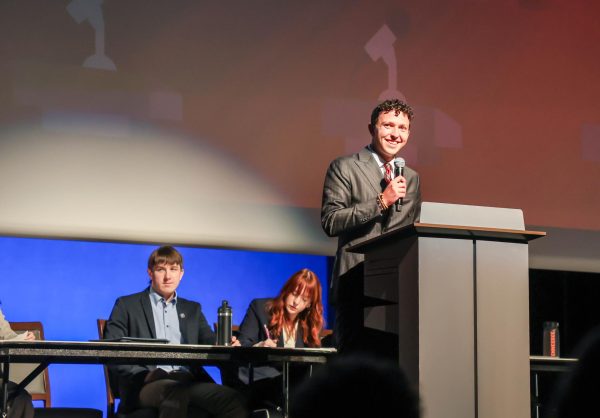
Fifty-nine percent of Americans support the expansion of nuclear power, Alex Durkee, a sophomore public affairs major on the left, said in his argument to shift toward clean energy sources.
“This level of public consensus is extraordinarily rare in modern energy politics,” Durkee said. “Nuclear energy provides large-scale, carbon-free electricity that insulates the American grid from fluctuating gas and oil prices overseas.”
Williams presented an argument against nuclear energy centered around its costs.
“Simply adding trillions of dollars to our already high debt will harm American voters,” Williams said. “We can’t afford to get behind the curve in energy, especially with the time that it would take to create successful nuclear energy infrastructure.”
The benefits of small government
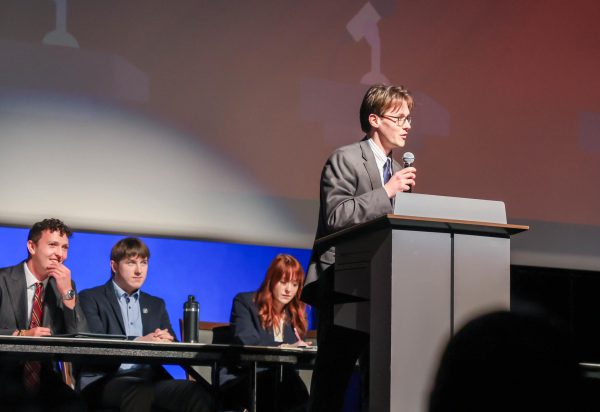
“Having a small government is having a government that is strong enough to protect your individual rights, but not large enough that it places an unnecessarily high burden on you as a taxpayer,” Nate Surdej, a junior political science major on the right, said in his argument for a small American government.
Surdej cited the economic policies of Ronald Reagan and other small government enthusiasts, who believe in cutting taxes to encourage Americans to make more purchases, stimulating the economy.
Hope Greene, a sophomore public affairs major on the left, argued that small government is a good solution in theory, not practice. Fair competition and equal starting points, Greene said, are required conditions for the success of small government.
“In reality, those conditions don’t exist,” Greene said. “Monopolies form, information gaps widen, and people without resources get left behind.”
Healthcare reform
Greene ended the debate with a presentation on universal healthcare reform from both social and financial perspectives.
“When people avoid care because of costs, they get sicker and more expensive to treat later,” Greene said. “High out-of-pocket costs and premiums hinder economic mobility, and preventative care is cheaper overall for the entire system.”
Surdej proposed current benefits of individualized healthcare policies, specifically naming innovation as a product of America’s capitalist healthcare system.
“Our free market healthcare system, the gold standard for the world, is driving healthcare forward. It’s innovating healthcare,” Surdej said. “This is potential life-saving technology that we’re missing out on.”
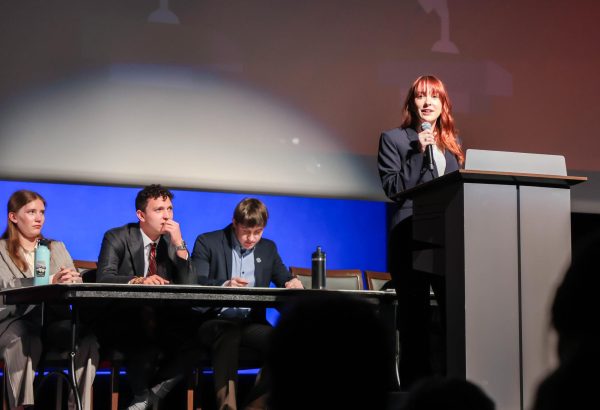
Baker School students, Kappa Alpha Pi Pre-Law and Government Fraternity members, and friends of the debaters showed up to support the event.
“I love to hear different sides of things, and I love to get my mind changed,” Danielle Saweh, a freshman public affairs and political science major, said. “It’s really important to see your student body come out and engage in respectful civic discourse.”
Though the students voted for one side at the end of the debate, the event displayed their ability to unite in support of respectful discussion.
“We as UTK students can come together and talk about politics in a civilized way, and learn something from each other and attempt to understand the other side,” Bonney said.