If you weren’t paying attention Tuesday night, you probably missed something you’ll never have the opportunity to see again.
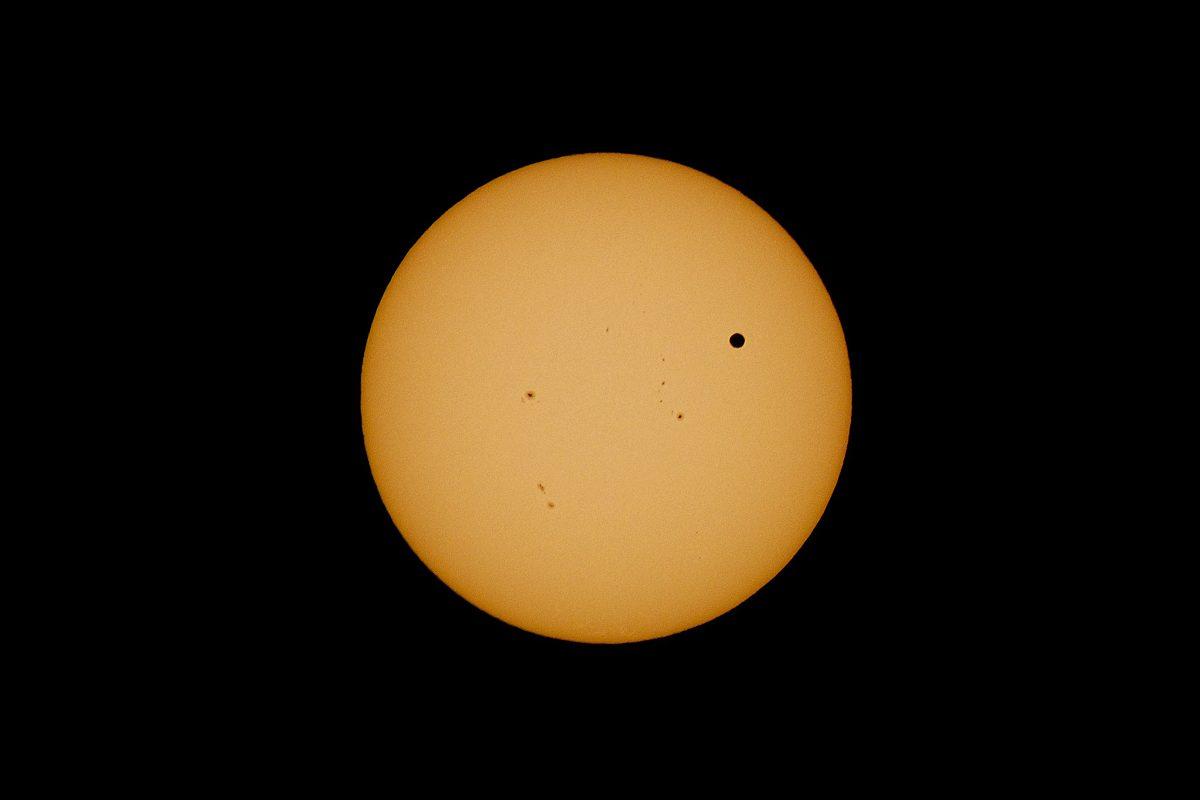
For six hours and 40 minutes, Venus passed across the sun.
From Japan to Jamaica, South Korea to Santa Monica, people across the globe stopped and paused for the few minutes that they could see, from their vantage point, the planet pass across the sun.
Only six times has this event occurred before 2004, and it will likely not occur again until 2117.
Sophomore Jordan Achs viewed it from her driveway in Illinois with her sister and a friend.
“I observed it with a pinhole camera I made out of a couple of shoeboxes,” she said.
Though Achs is a business management major, she took an astronomy class last spring, and learned about this phenomenon while covering Venus.
“I briefly forgot about it until a few days prior to the event when I read about it in an Internet article,” Achs said.
Achs said she could not find anyone that sold eclipse sunglasses, but because this was a “once-in-a-lifetime event” she had to see it.
“I researched online other ways to safely look at the sun, and many mentioned pinhole cameras which are popular with those who want to view solar eclipses,” she said.
Achs said her homemade viewing device wasn’t difficult to make.
“Just take a shoebox and cut a one-inch hole in it, and cover that hole with aluminum foil,” she said. “Then, using a tack or needle, poke a hole in the aluminum foil. Place white paper directly across the pinhole and cut another side of the box that allows you to see the paper.”
The way she built it protected her eyes from the sun while still allowing her to view Venus clearly, and the shoeboxes were used because of their availability.
Along with Venus, Mercury is the only other planet that will pass across the sun. Achs said Venus’s orbit is what makes its path cross the sun.
“Venus has a smaller orbit than Earth does, so at some points we align just right so that Venus is blocking a very small portion of the sun as viewed by the Earth,” Achs said.
When looking at this phenomenon, Achs said she had to be careful, lest the sun blind her.
Melissa Eggert, senior in anthropology, didn’t see Venus cross in front of the sun, but heard about it both before and after the fact.
“I think it’s pretty cool that they use Venus crossing the sun to measure the size of Venus, and I think they can measure other things by seeing Venus cross in front,” Eggert said.
Eggert said she saw pictures afterwards, and even though she didn’t see it, she was certainly intrigued by it.
“I think it’s a really big deal,” she said. “This coming from a someone who thinks space stuff is very interesting; just to think about how big the galaxies are.”
Eggert said she would like big events like this to be advertised more by the national and local media, especially since phenomenons like these are seen just once in a lifetime.
“I feel like the astronomy department would want to get students involved and want to at least send out a mass email to UT students about the upcoming event,” Eggert said.