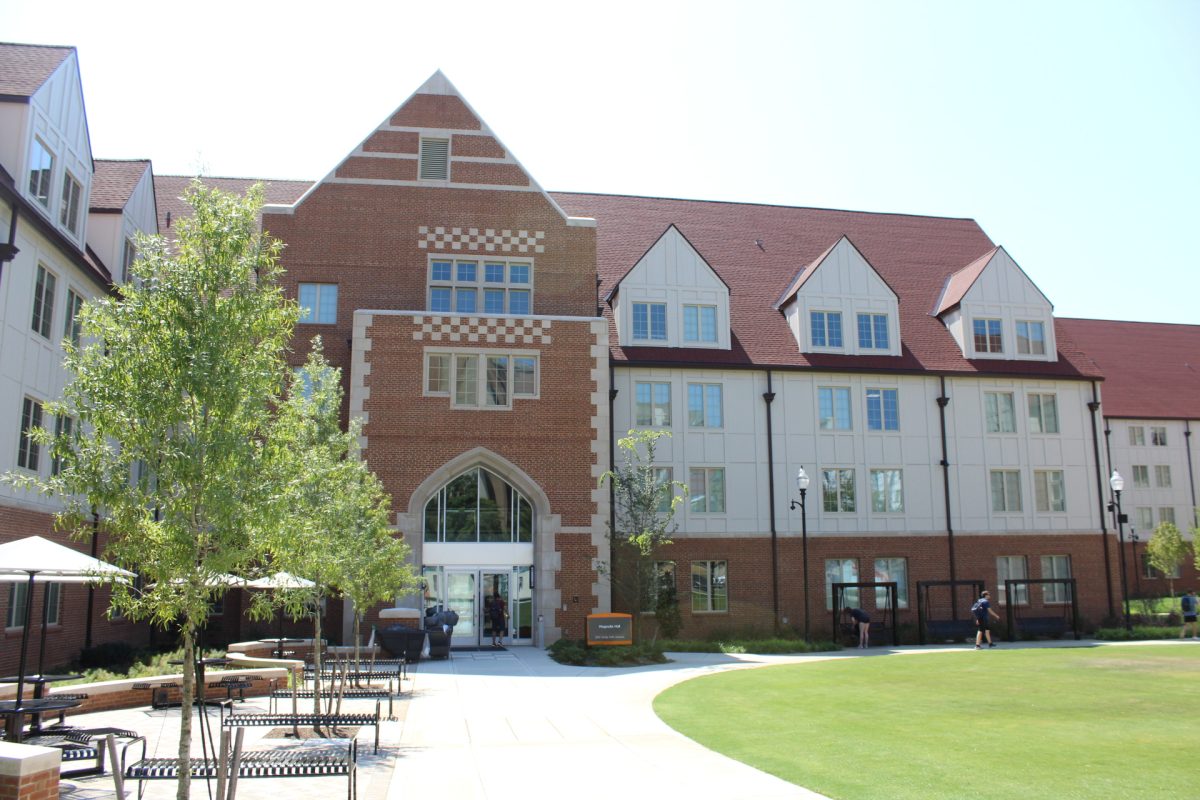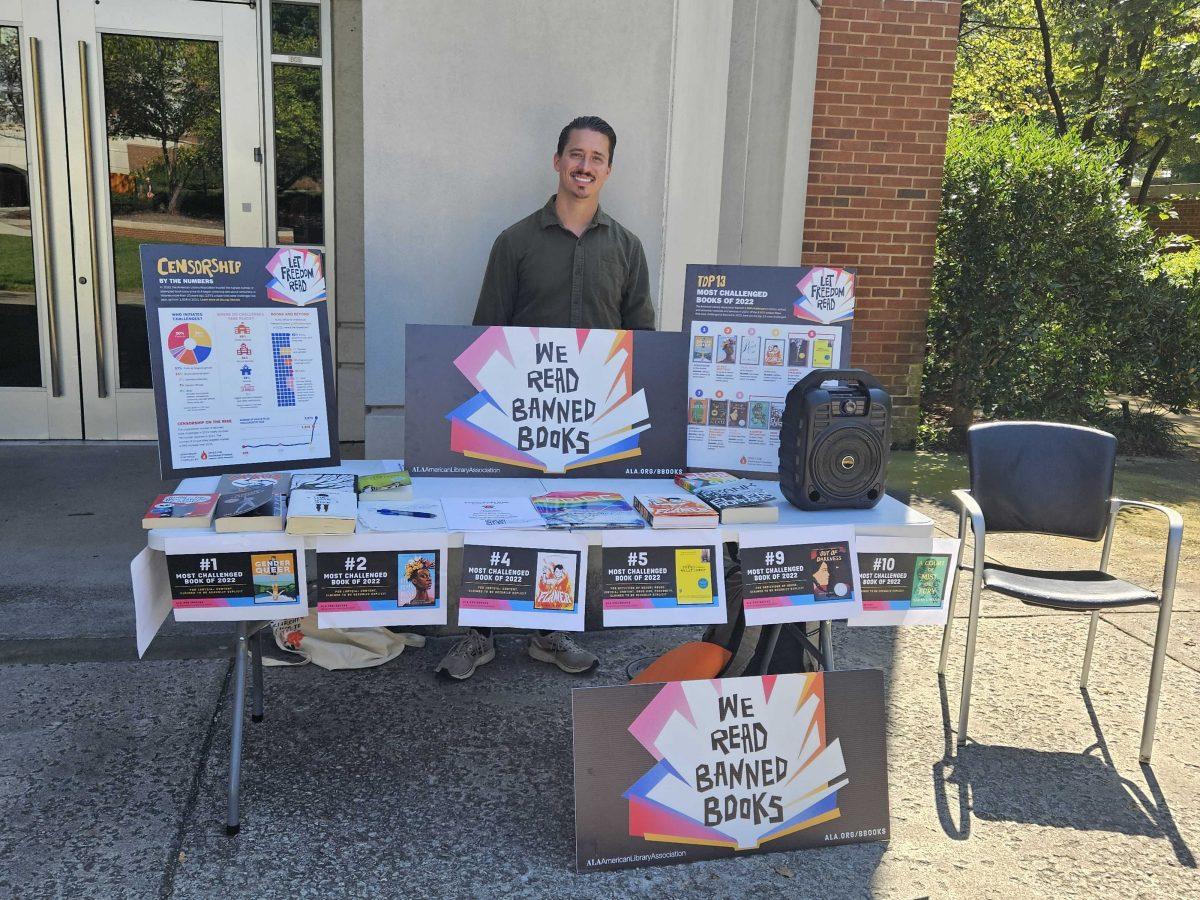
It’s officially Banned Books Week, and for the first time, members of the English department are holding Banned Book Readings this week from 12-1 p.m. outside of the Claxton Education Building. The purpose of this event is to fight against book bans and spread awareness.
Susan L. Groenke, the director of the center for children’s and young adult literature and current program advisor for the English education program, is very passionate about the topic of banned books.
“This is the first year that we have actually held a banned books reading on campus, and the reason for that is we are seeing an unprecedented rise in censorship of books, especially for children and teens,” Groenke said.
Another organizer of the event, English professor Gerard Cohen-Vrignaud, also believes in the need to fight against censorship.
“It just seems authoritarian and wrong. That’s why we’re holding this event,” Cohen-Vrignaud said.
According to Groenke, the rise in book bans and censorship is worse than it ever has been.
“About 56% of all book bans right now are books for children and teens, and we’re talking a lot of books,” Groenke said. “We’ve never really seen the kinds of things that are happening right now with the number of book bans and the way that the democratic process is just being completely ignored or bypassed altogether.”
While it may seem that book banning is the popular opinion nowadays, Groenke clarifies that it actually isn’t as big as it seems.
“It’s a small group of folks who want to ban books,” Groenke said. “In a recent American Library Association poll, the Association found that about 70% of parents are actually against book bans, so we’re talking about a 30% minority of parents who want to ban books.”
The origin of Banned Books Week dates back to 1992.
“In 1992, the American Library Association had their first Banned Books Week, and they do it nationally,” Groenke said. “It is an annual event that the American Library Association sponsors all over the country.”
So how are books banned in the first place? What qualifies as a banned book? These are questions that many have asked in regards to the rising concerns about censorship.
“What happens right now is that when parents want to challenge a book, it’s immediately removed,” Groenke said. “We’re also just seeing books removed out of fear. We’re seeing a lot of teachers and librarians just going ahead and removing things because they’re afraid that they’re going to be targeted by these would-be book banners.”
Since the bans are taking place mainly in public schools and libraries, it’s safe to say that the group most affected are kids.
“If these books are being removed from school libraries and classrooms, young people are less informed and they’re less able to get the knowledge that they need,” Groenke said. “They’re less able to read books with characters and people in them that look like them. They’re less able to read books that celebrate their own identities and affirm them. I’d rather young people tell us and learn how to create their own boundaries around things they want to read or don’t want to read.”
Groenke elaborated about parents who say that certain books should be banned from public places.
“There is no problem with a parent saying, ‘This book is not right for my child.’ But parents don’t have the right to say that every person in that school or building shouldn’t read this book,” Groenke said.
Cohen-Vrignaud said that the desire to ban books comes from a misguided desire of parents to protect their children.
“The book bans are focused on the idea of protecting children, and these are problematic ideas because you can’t protect people from being exposed to ideas forever,” Cohen-Vrignaud said. “Also, what people want to protect children from are things that are part of natural development, like learning about different ways of thinking in the world and the diversity of humankind. Banning that diversity by not giving access to books that talk about diversity is a real disservice to students, and it may in fact do more harm than good.”
Both Groenke and Cohen-Vrignaud agree that people all around the country need to be fighting for the right to keep books on public shelves.
“We really do have to fight for our right to read and write,” Groenke said. “We’ve got to fight to keep books for children and young adults in school libraries and classrooms. There are websites like the American Library Association. You can go to their website and it’ll show you state-by-state what the number of book bans are and the titles that are being banned in that state.”
“This is a country that has a very decentralized school system where all the decisions about schools and libraries are handled locally, so that’s where the activism has to be,” Cohen-Vrignaud said. “If people support the idea that books should not be banned, they should participate at the local level on the school board or run for office.”
Another group that is put under fire due to these book bans are librarians and teachers – especially public school teachers.
“We have to respect our librarians and teachers,” Cohen-Vrignaud said. “They’re out there trying to do their job, which is to teach our children and students about the world. Accusing them of trying to harm children is really counterproductive, and it’s not gonna help the public school system or our education system.”
If you want to learn more about banned books and even hear some excerpts read from banned books, consider coming out to the Clayton Education Complex to hear students and faculty read excerpts from banned books throughout the week. There is also a Google Docs form where you can sign up for a time slot or two to bring your own banned book to read from.
If you want to see a list of banned books or resources to help fight against censorship, consider checking out the American Library Association’s website.