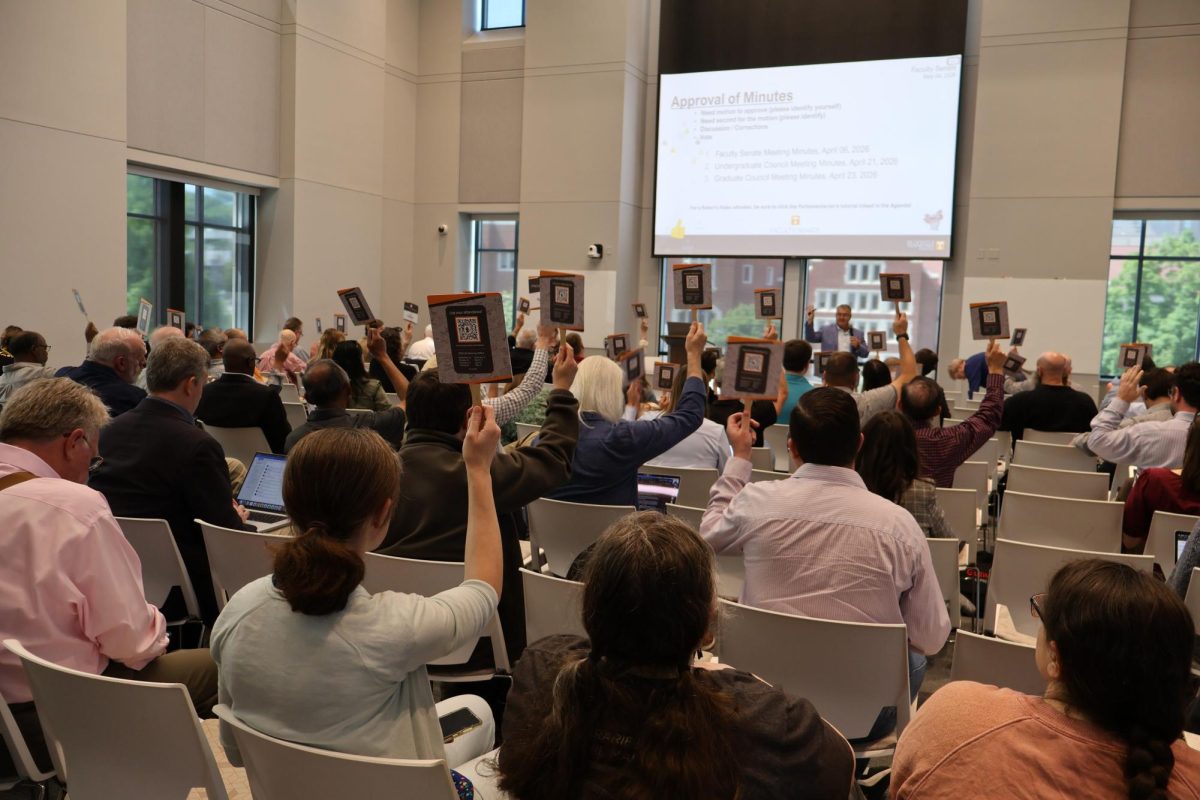
On Tuesday, Nov. 13, educators from the College of Arts and Sciences at the University of Tennessee came together to speak about their learning experiences using artificial intelligence. The purpose of the meeting was to discuss their perspectives and opinions on how AI will shape the classroom and student learning.
This collaborative discussion was led by Kirsten Benson, the director of the Judith Anderson Herbert Writing Center, and Matt Bryant Cheney, assistant director at the writing center. Other educators participating in the discussion came from the biology, philosophy and English departments. All had tested out the AI chatbot.
Generative AI is an automated robot that is programmed to respond to people’s needs through technology. As of recently, AI has become more popular over the years and is expected to grow, especially in academic areas. Professors and students must learn to adapt to AI and learn how to appropriately use it.
For this event, educators specifically talked about generative AI. They tested out a few types of generative AI platforms such as ChatGPT and discussed their interactions with it. Chat GPT was created by open AI and can respond to almost every prompt asked. However, as some of the professors discussed, there are some key things to look out for while navigating these AI programs.
Benson raised the question of when it is appropriate to have that conversation in class with the students about AI. In response to this, one of the educators mentioned that during the pandemic, professors were agitated with their students constantly cheating. Benson spoke about what instilling the students with academic integrity means in the context of AI.
“AI now has to be a part of that conversation,” Benson said.
One of the main uncertainties about AI is everyone’s opinion on it in a classroom setting. It is questionable how students or professors are going to react to AI. Cheney spoke about AI-related studies and how he saw a repeated pattern among all of them.
“Something I keep seeing in these AI studies is students are as suspicious as educators are of AI,” Cheney said. “Each student has a different view.”
This can be seen as a negative aspect of AI. Alex Feldt, a philosophy professor, spoke about the reality of having different opinions.
“A difficulty of navigating AI is that students will approach it in different ways, depending on the context and the makeup of the classroom,” Feldt said. “You are going to get different views on AI.”
There are some good qualities of AI that some of the professors experienced. For example, one educator spoke about how it is a struggle to get her students to summarize a poem. When she asked her students to give a quick summary, there were no hands raised. However, once the students saw the AI-generated summary, the students were able to talk about the poem. Benson spoke about how AI was able to make the students start summarizing.
“AI was a tool for engagement. It got the ball rolling and motivated the students,” said Benson.
Although there are a lot of uncertainties about AI, there is strong hope for AI’s future. Some of the goals the group had were to help assist students with their writing skills, increase student engagement and boost their knowledge of what they gain from texts.