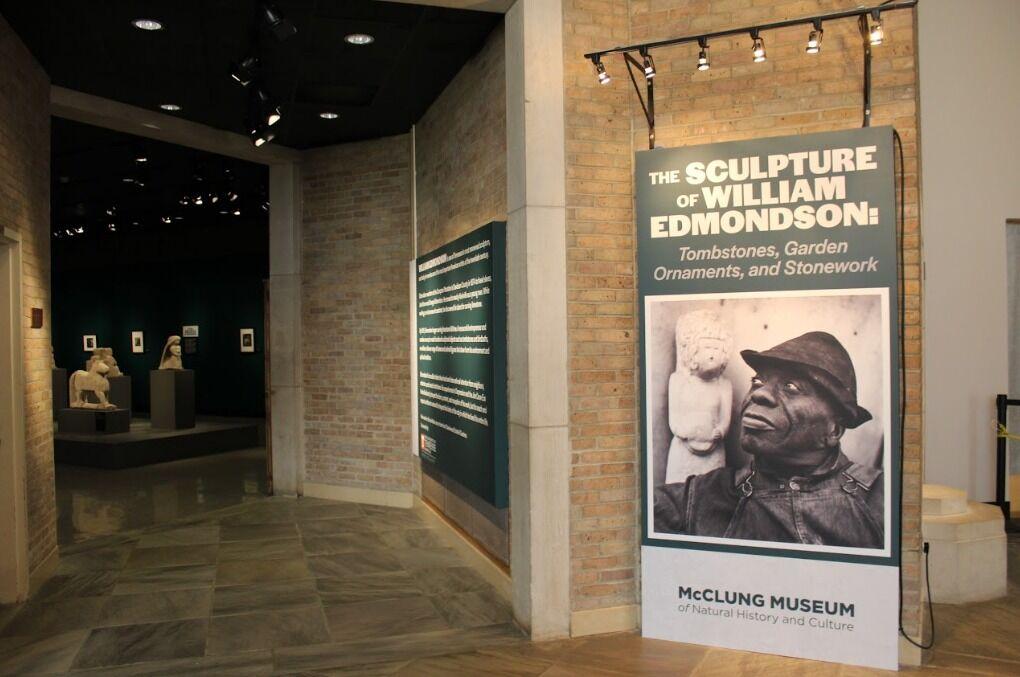
William Edmondson is one of the most important artists to have ever come out of Tennessee, but too few people know about his legacy, according to the McClung Museum’s assistant director.
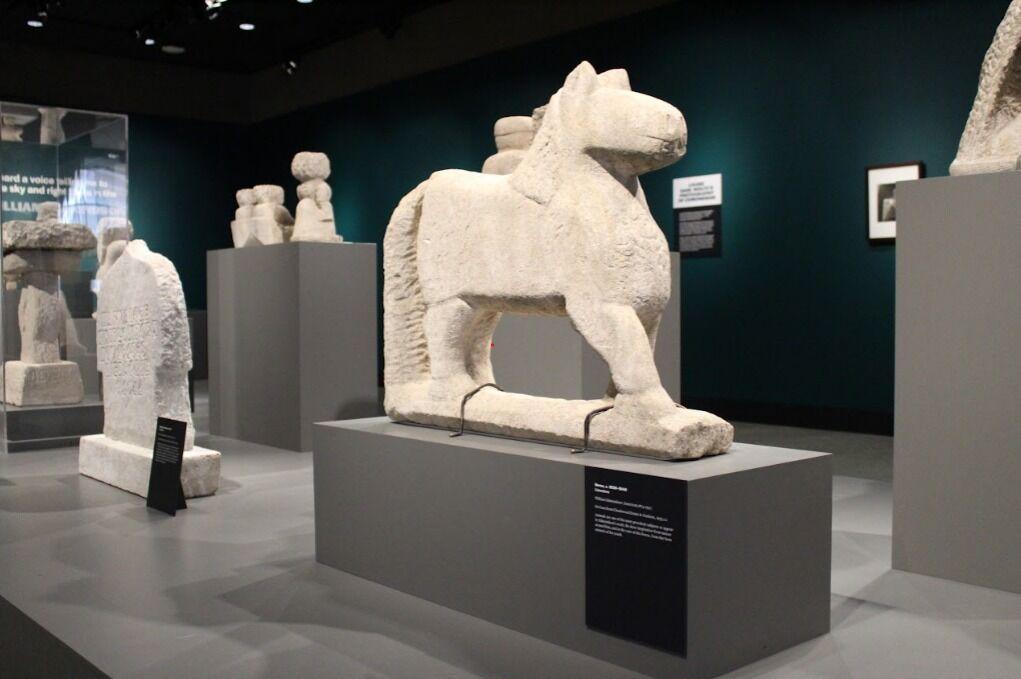
“He was incredibly prolific, hundreds … exist out there in the world,” said Catherine Shteynberg — who also curates the arts and culture collections — of the limestone sculptures ranging from one to three feet high.
A wall-size photo in the exhibit shows them filling the yard of his house, as far as the eye can see.
Several pieces can be seen at the McClung Museum through May 13. Most of them are on loan from Cheekwood Estate and Gardens in Nashville, which houses the largest permanent collection. Edmondson donated the three permanent items in the McClung collection — Bride, Preacher and Doves — himself.
Edmondson was born in Davidson County and moved to Nashville in his teenage years, around 1900. He was employed by the railroad until 1909, when he was injured, and went to work at a women’s hospital for the next 25 years. In 1913 he bought a house only blocks from Belmont and what is now Vanderbilt University.
When the Great Depression struck in 1929, the hospital closed, and Edmondson was forced to look for odd jobs, one of which was being an apprentice to a stonemason. Using the skills he learned there and the quarry three blocks away, Edmondson began to make tombstones for friends and family members, and had his own business by 1934.
Edmondson made dozens if not hundreds of tombstones, according to Shteynberg. Visitors can see a catalog, or scan a QR code, that lists all his known grave markers in Tennessee and their locations. The tombstone on display is for one of Edmondson’s relatives, donated to Cheekwood by the family to preserve it from rain and vandalism.
“They wanted this to be saved in perpetuity, they understood the treasure that it is,” Katy Malone, manager of education and community engagement and curator of academic programs, said. “A lot of his tombstones have been lost in time … looking at his lettering, looking at his skill for putting the name of the deceased on the stone, and how beautiful the shape is, if you think about carving something that delicate with hand tools, it’s really impressive.”
Malone said the curators were also interested in how the funeral industry contains cultural touchstones.
“We were really interested in how Mr. Edmondson’s work as a tombstone carver afforded dignity to people at a time when there wasn’t access to dignified burials,” Malone said.
On March 9, Robert Bland, assistant professor of history, and Multicultural Student Life peer educators will host a screening of the PBS documentary “Homegoings,” which follows a Harlem funeral director and how he hands down traditions.
Edmondson produced Christian images of lions, doves and preachers as well, and Biblical figures Mary and Martha, and Jesus. He went on to make other animals including over 10 rabbits and several eagles, one based on the Works Progress Administration, which employed Edmondson as an artist twice during the Great Depression. Some of his animals were imaginary. He also made different versions of public figures like Eleanor Roosevelt, who visited Nashville in 1934, and boxer Jack Johnson.
“Each sculpture design is entirely unique from any others he’s made,” Emma Miller, political science major from Seattle, said.
Edmondson also sculpted people he saw in his everyday life — in the community or at the hospital. Shteynberg said he made several nurses, and experts say some of the seated figures are subtle digs at hospital dietitians he didn’t like.
One sculpture, “Reclining Man,” represents Sidney Hirsch, a playwright who had become part of the Fugitive Poets group based at Vanderbilt.
“I think that the ‘Reclining Man’ is just such a beautiful example of how much control William Edmondson had,” Malone said. “He has really refined details, he has really soft curves on the sculpture, plus he has he chose to exaggerate the feet, it just shows how adept he was and how intentional his choices were as an artist.
“You can look at other sculptures and think, oh, well maybe he just didn’t know how to do this or that skill, but clearly he did.”
Hirsch, who lived six blocks away, passed Edmondson’s yard on his walks and brought him to the attention of Louise Dahl-Wolfe, a fashion photographer. Dahl-Wolfe’s photographs also hang in the exhibit, but when she showed them to her employer, Harper’s Magazine, no one was interested in doing a story on Edmondson.
From there the photographs made their way to the Modern Museum of Art, and in October 1937 the director decided to give Edmondson the first solo show of an African American artist.
The exhibit includes The Museum of Modern Art press release and other articles on that show from around the same time. Most were dismissive because of both Edmondson’s race and his style, even though he has had a large influence on what is today called outsider art.
“We wanted to put this section to bring up that, this mystery and this issue of racism,” Shteynberg said. “Also to investigate the ways in which the public media, the public press can affect the reception of an artist … It’s important in how we understand Edmondson.”
“The story of these three sculptures is kind of shameful. He helped facilitate with the university having these sculptures, but at that time we assume someone at the time didn’t care for his work,” Malone said.
“It was probably rooted in racism, and these sculptures ended up in a closet and were not seen again for years and years and years, until somebody found them in the closet. So once they were found, the museum thankfully existed and we were able to accession them into our collection so we could care for them and celebrate them properly.”
Though Edmondson was not invited to the opening of his own show at the MoMA, his work was shown in Paris the next year and has steadily been exhibited past his death in 1951 up until the 2000s, in over 15 states and Japan. His home is no longer standing, but there is a sculpture park in the Edgehill neighborhood dedicated to him, and a historical marker at the site.
Marin R. Sullivan, curator-at-large for Cheekwood and creator of the Cheekwood exhibit, said in a 2021 article, “William Edmondson did not set out to become one of the most significant self-taught artists of the 20th century, but he also did not work in obscurity, passively waiting to be discovered by wealthy, white patrons and the art world establishment.”
The museum will also present an online lecture by Renee Ater, a visiting professor at Brown University, on April 26. Ater has taught art history, archaeology and Africana studies, including courses on monuments, history and memory, and one of her essays is featured in the exhibit catalog.
“She really focused on his depiction of women,” Malone said. “Mr. Edmondson’s sculptures show women as strong individuals, stoic, people with a lot of personality, with a lot of strength. They’re not highly sexualized, they’re not seen as just an object for romantic ideals, but instead they’re important contributing members of society, which I think is something that the art world doesn’t do very often when you’re depicting women.”
The exhibit is open from Tuesdays through Saturdays 9 a.m. to 5 p.m. until May 13.