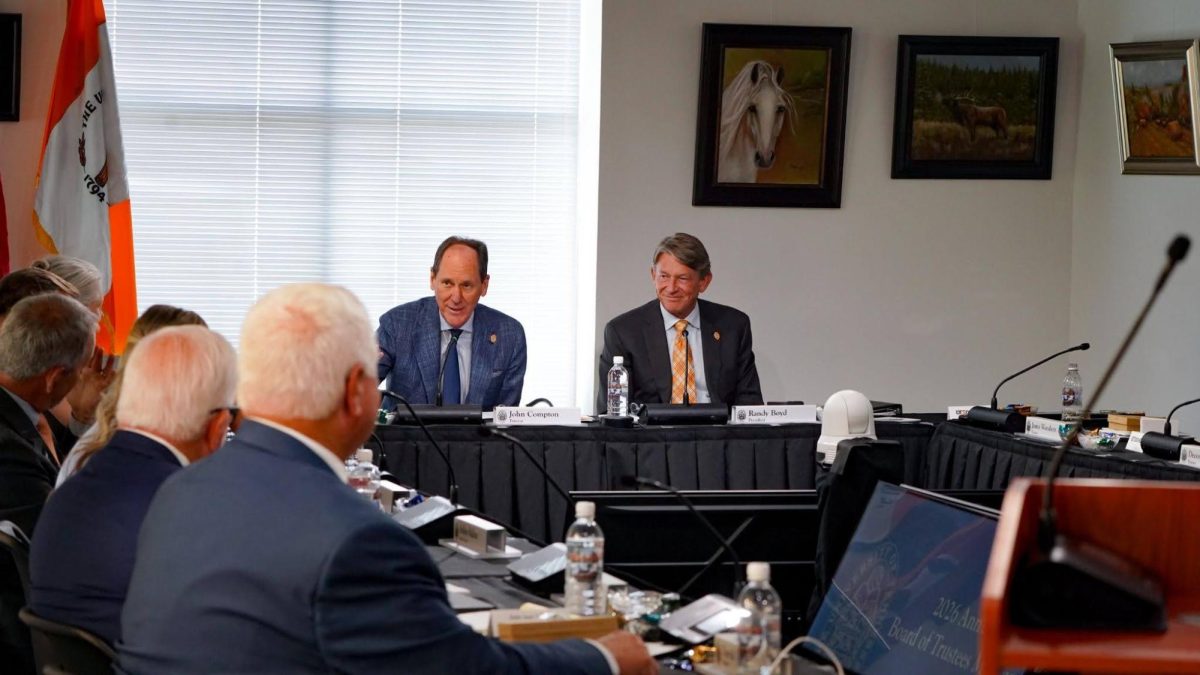
The University of Tennessee Board of Trustees Executive Committee held their spring meeting on May 5. The meeting addressed a variety of topics, including budgetary issues and state legislation that impacts UT System and higher education in general.
The bulk of the meeting was presented by UT System President Randy Boyd and began on a note of optimism. In fact, Boyd’s presentation was titled “Igniting the Greatest Decade.”
“We’ve got a record number of students graduating this year,” Boyd said. “This is our greatest decade.”
The first part of the meeting consisted of an overview of the 2023-24 budget, which also included money that was not directly awarded to the school but would be part of programs that would lead to benefits for campus. This includes the $3 billion Transportation Modernization Act, the largest infrastructure bill ever passed in the state’s history. The act aims to address present and future issues relating to mobility, especially in rural areas.
As for funds directly allocated to or approved for the UT System, the General Assembly has awarded $30 million for maintenance purposes. It has also approved the use of $12.5 million of stimulus money to construct the UTIA Protein Innovation Center, a new training facility for students looking to enter the meat processing industry. Additionally, UTK has received permission to use $6.5 million of its own money to begin work on a new chemistry building.
Other projects, both directly and indirectly affiliated with UT, will also receive money from state and local governments through a combination of recurring and nonrecurring funds. These include the Grow Your Own teacher apprenticeship program and UTHSC’s Healthy Smiles Initiative. Another notable partnership is a $20 million investment by the City of Knoxville for building a pedestrian bridge connecting UT to South Knoxville.
Another exciting budget development includes a 5% salary pool increase for faculty and staff.
“Since I’ve been around, I’ve never seen an increase that large,” Boyd said. “5% to be spread across all our employees is critically important, so we’re very very thankful for that.”
This change will also be followed with new investments in employee health insurance and 401k contributions.
The second half of the meeting went over new state legislation that would significantly impact the UT System. Some of the laws are less controversial, including streamlining the approval process for building projects on campuses and expanding scholarships.
The Higher Education Capital Projects Modernization Act reforms procedures and gives universities the freedom to pursue small-scale maintenance projects without having to go through the entire approval process from the State Building Commission. Additionally, it gives the UT Board of Trustees the sole authority to approve projects that are entirely funded through gifts or institutional funds, such as residence halls and athletic facilities.
Scholarships and loan forgiveness programs also got some love from the legislation. The HOPE Scholarship will be expanded to encompass up to five years after a student’s initial enrollment, allowing those who finish their undergraduate degrees quicker to continue to draw from HOPE for their graduate studies.
There is also a new last-dollar scholarship for undergraduate juniors and seniors who enroll in an educator preparation program and a loan forgiveness grant for family medicine residents. Both of these programs require applicants to pledge to serve a number of years in underserved communities. It is hoped these will incentivise new graduates and address critical personnel shortages in many parts of the state.
More polarizing legislation addressed at the meeting included the recent restrictions on social media platforms based in China and changes to diversity practices. Boyd briefly addressed the recent banning of platforms like TikTok and WeChat on UT’s network, as well as legislation that bars universities from having to require its employees to undergo mandatory implicit bias training or affirm to diversity statements.
Boyd called these issues “misinterpreted.” He also insisted the diversity initiatives would not greatly affect the way UT runs.
“Not saying we can’t expect them to support diversity, we’re just not allowed to require a diversity statement,” Boyd said. “We can still expect people to provide a diverse, welcoming and engaging climate for people from all backgrounds. It doesn’t change what we do.”
The UT System does have a liaison office that maintains relationships with local, state and federal government agencies. Headed by Vice President for Government Relations and Advocacy Carey Whitworth, the office works closely to support lawmakers and advocate for policy that benefits the school. It is complicated work, especially during the current turbulent political climate.
“We can see the potential headwinds during a legislative season,” board member Jamie Woodson said. “There are a lot of complex issues; it was a very stressful time for members and constituents, particularly with what happened in Nashville in terms of public safety.”
The meeting concluded with a summation of incoming new leadership. Every year, the board appoints a new non-voting student member and a new faculty member to the Education, Research and Service Committee. These positions rotate between the schools in the UT System. The new student trustee will be rising senior and medical student Woodi Woodland from UTHSC, and the new faculty committee member will be professor of behavioral management Sean Walker from UT Martin.
Another leadership issue on the horizon is the search for a new director for Oak Ridge National Laboratory. ORNL’s previous chair, Thomas Zacharia, stepped down in January, and UT will play a role in the search for a new permanent chair to replace interim chair Jeff Smith. This search is pivotal, as the contract for UT’s continued management of the laboratory is up for reevaluation this year.
Correction: This article was updated to correct the name of the Healthy Smiles Initiative.