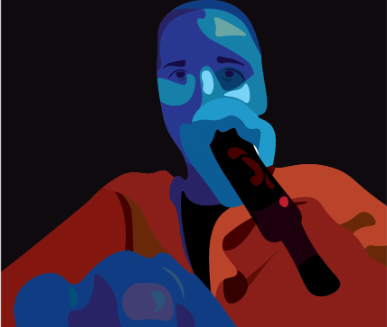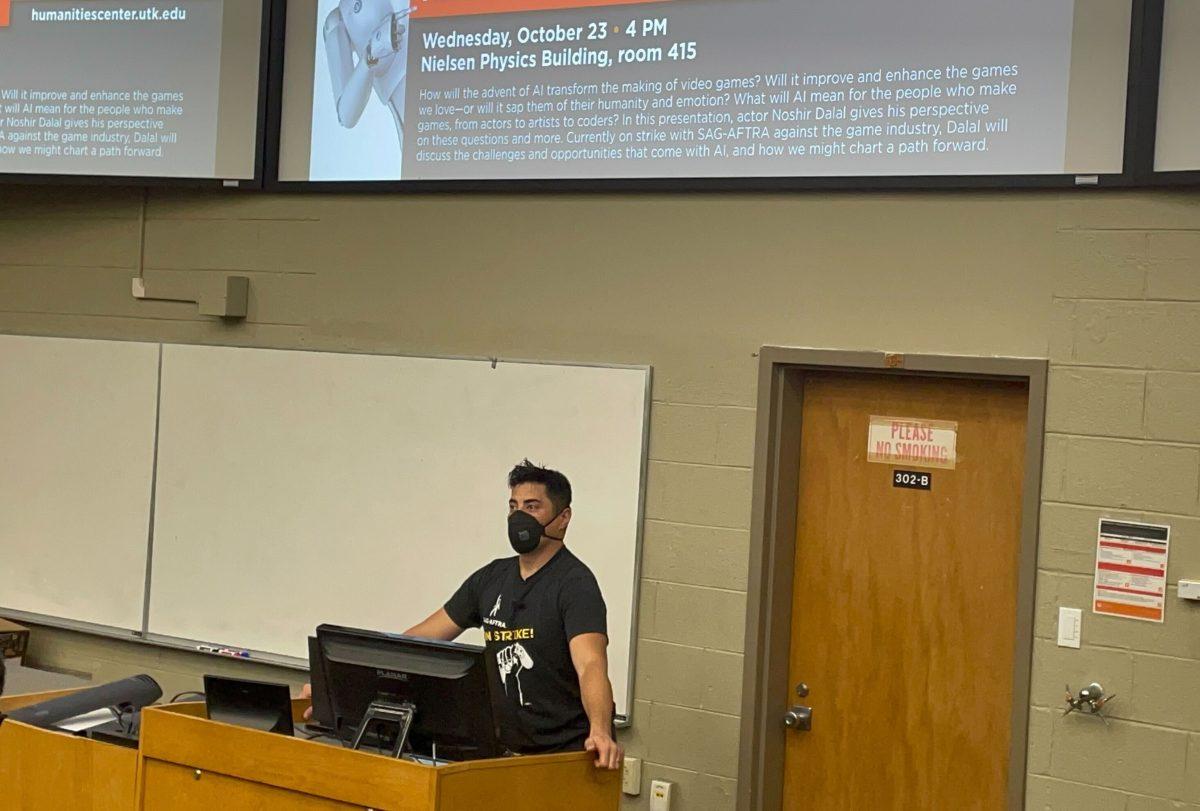
Students from various majors gathered in the Nielson Physics Building to listen to a presentation by Noshir Dalal on the usage of artificial intelligence in video games Wednesday.
What unites these students is not only the lecture topic but also the speaker. Dalal is a renowned voice and motion actor with roles such as Sekiro in “Sekiro: Shadows Die Twice,” Charles Smith in “Red Dead Redemption 2,” Bode Akuna in “Star Wars Jedi: Survivors” and many others. Dalal is also a member of The Screen Actors Guild — American Federation of Television and Radio Artists, a labor union for media professionals.
Dalal came to UT to speak on artificial intelligence — commonly known as AI — and its role in his world as a voice and motion actor. Over the last decade, AI has seen a dramatic rise in utility, and with that rise, more companies have begun to integrate its powerful computing capabilities into their own products. It’s no surprise that the video game industry has also engaged in the usage of AI. One particular usage involves storing the voices of voice actors to “hash” into new voices with the same likeness of the original actor. In this way, many new characters can be created without the time constraint of individual voice recordings.
To the gaming world, such an advancement can revolutionize the way games are produced but to voice actors like Dalal, such an advancement can spell the end of their career.
“The way I speak, my mannerisms … according to studios, that data is theirs to use as they will,” Dalal said.
He explained that once gaming companies have trained data models on the voices of the actors, the same companies have no use hiring him again.
“I’m competing against myself. I can destroy my own career,” Dalal said.
Matthew, a UT student studying geography, is an avid “Red Dead Redemption 2” fan and agrees with Dalal.
“AI can make you say whatever it wants you to say,” Matthew said. “It takes away from voice actors.”
At the same time, artificially generated voices cannot fully replicate the lived experiences human voice actors — and humans in general — bring to the table.
Dalal discussed a recording session where he went off script and reimagined a character according to his lived experiences, stating how his own experiences as a person of color influenced his redefining of Charles Smith from “Red Dead Redemption 2.” Charles Smith was originally written as the standard macho character that all other characters fear, but Dalal’s reimagining inspired a change in the writing direction. As a result, Charles Smith became a popular and beloved character of reason in which players themselves sometimes listen to.
“AI doesn’t take chances,” Dalal said. “The human experience brings something to the table that was never going to be there.”
In a way, Dalal and other voice actors are part of the “soul” behind video games. While an AI with Dalal’s vocal data can replicate the same acting that Dalal does, its programming restricts it to outputting exactly what it’s prompted to do, and its lack of lived experiences prevents it from making spontaneous decisions that create compelling characters like Charles Smith.
However, for all the downsides of AI that Dalal discussed, he placed an emphasis on the fact that the topic is not simply black and white.
“No one is trying to forbid AI in video games,” Dalal said.
He explained that there are situations where artificial intelligence can increase player immersion while respecting the work of voice actors and other creatives in the field.
“AI is neither good nor bad,” Dalal said.
Like all things, tools are determined by the user, and with AI still relatively new compared to other technology, there are fewer regulations surrounding it and the cost of that is people in the industry, such as Dalal. Still, Dalal and the SAG-AFTRA union are constantly fighting and going on strike to negotiate for more regulations in the industry so that one day, voice actors can work alongside tools like artificial intelligence without worrying about losing their livelihoods and careers to those very same tools.
“I want to have a say in what happens (with my work),” Dalal said.