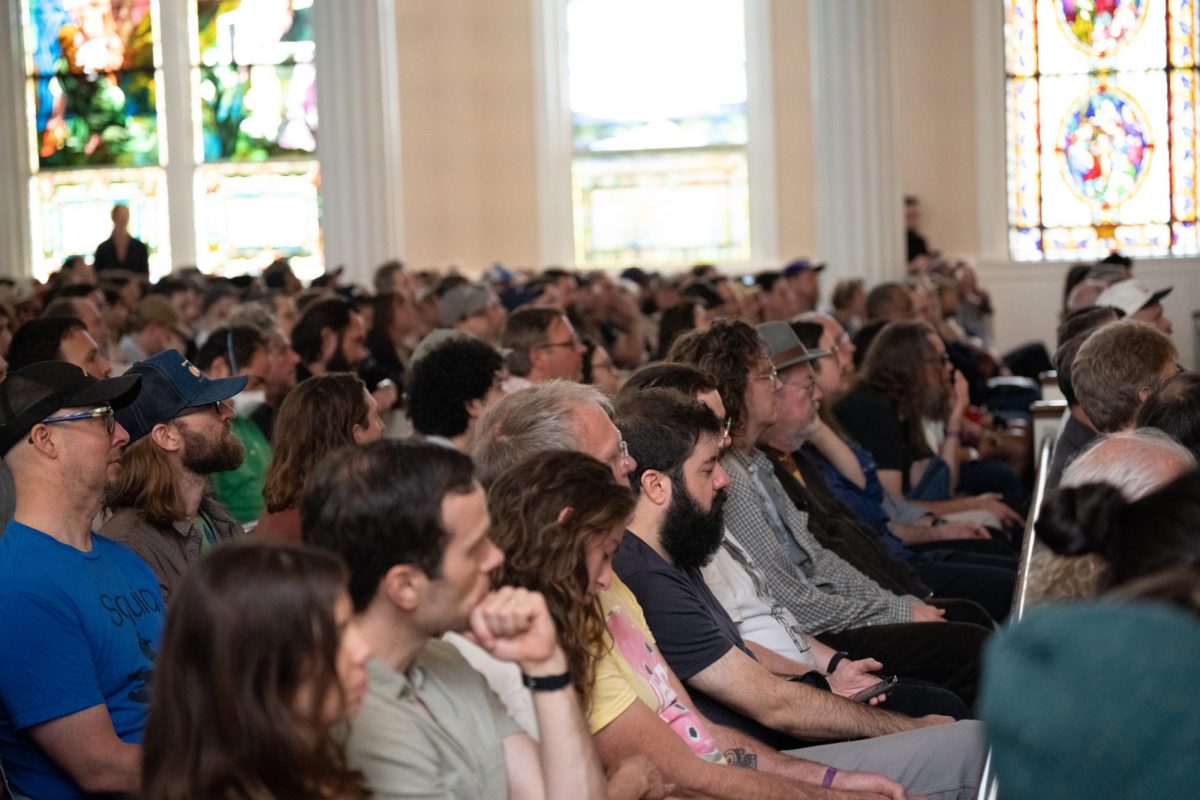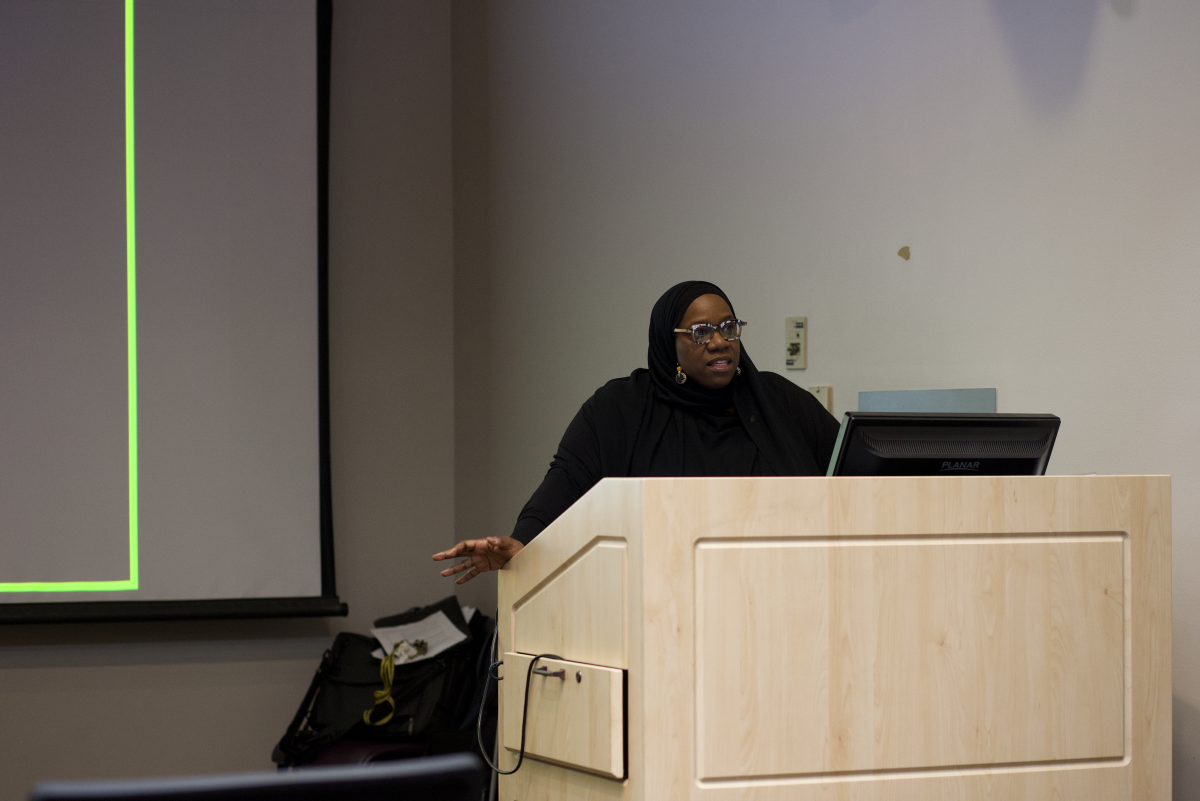
Kimberly Harper, author of “The Ethos of Black Motherhood in America: Only White Women Get Pregnant,” spoke at Lindsay Young Auditorium on Monday evening to provide insight into her work surrounding Black maternal health and her community initiatives that promote reproductive justice.
The book talk was hosted by the university’s rhetoric, writing and linguistics division in collaboration with Syracuse University. Harper is an associate professor of English at North Carolina Agricultural and Technical State University, and her book has offered important insight into Black maternal health.
According to Jamal-Jared Alexander, an assistant professor who assisted in organizing the event, Harper “is committed to helping organizations engage in socially just practices that encourage and see the value in supporting the next generation of TPC (Technical & Professional Communication) scholars.”
Harper explained that her interest in researching Black maternal health spurred when she experienced her own birth trauma. She said that she felt like doctors were not fully communicating with her throughout her pregnancy, labor and delivery. Harper ended up incurring second degree surgical lacerations and had to have a blood transfusion as a result of her first birth.
“Often our research comes from personal experiences and a desire to make sense of what happens to us,” Harper said. “And so my book, my community activism, all those things are deeply connected to my first pregnancy, labor, delivery and postpartum care.”
Her story of not knowing what to expect and not getting answers to her questions is one of countless stories of women and birthing people who experience birth trauma due to gaps in the medical system. The maternal mortality rate in America is on the rise, and Black women and birthing people are more likely to die from giving birth than any other demographic. Harper said that 60% of strokes and deaths and 90% of deaths from hemorrhaging could be prevented if hospital staff were better trained and more aware of blood loss after birth, according to an article in USA Today.
After experiencing a birth trauma, Harper knew she wanted to use her story to dig into Black maternal health and reproductive justice. She noted the power of personal narratives to unite people who may not otherwise understand an issue like maternal health.
“I think narratives humanize us,” Harper told The Daily Beacon. “A lot of times we focus too much on what makes us different and not enough on what makes us human.”
Harper’s research explores controlling images and terms associated with Black women and Black motherhood, what motherhood looks like in commercially-produced books and how that reinforces certain ideologies and how Black mothers have advocated for their needs.
She has found that stereotypical terms associated with Black mothers create unfair images that perpetuate issues surrounding reproductive justice.
“Often in society, oppressed groups have an ethos for them that’s already created and manipulated and controlled by powers that we don’t necessarily see,” Harper said. “And so all of these images are images that Black women have not created — it has been put upon them.”
To further illustrate her points about commercially-produced books excluding women of color from pregnancy and parenting tips, Harper had audience members quickly Google books about motherhood. The results were overwhelmingly full of white women on the book covers of top search results.
“So this is powerful, right?” Harper said. “Because it dictates the narrative, subconsciously, of who can be a mother, who can be seen as a mother in the larger Western context and what that means when you’re dealing with medical professionals.”
Harper laid out three points integral to reproductive justice: the right to have children, the right not to have children and the right to raise children in safe and healthy environments. Threats to reproductive justice include not only a lack of adequate healthcare but also environments that are overpoliced and underserved. Harper said that activism and organizing are a few ways she has sought to make change in her communities that prioritizes reproductive justice.
In order to create change, Harper has worked with Every Baby Guilford in North Carolina to create training for medical practitioners to figure out the power of language and how to identify with patients.
One major project Harper has been working on is titled Building Equitable Linkages with Interprofessional Education Valuing Everyone (BELIEVE). The project is a collaboration between University of North Carolina at Chapel Hill and North Carolina A&T with a grant from the American Heart Association. BELIEVE’s goal is to “assess gaps in current practice, create a curriculum to address them, and implement the curriculum across a network of hospital and community providers.”
As a researcher working with community organizations, Harper asks five different questions of herself before working with an organization, and she advises other researchers to ask them as well. Who is already doing the work and are those people trusted by the community? Do the people you hope to work with trust you? Do you and the organization have the same shared outcomes? Are you part of the problem? Are you willing and ready to redistribute power and resources in order to meet the needs of this organization?
Harper’s work focuses on what can be done in her community. She said in an interview that when we view maternal health only as the national or international issue it is, it can feel out of our control or the work we do to combat it can feel like it yields little to no progress.
“I think the local helps you feel like you’re moving the needle, and I think you need that,” Harper said. “And so if you want to do any type of activism, I always say do it at home because home is where you start.”
Ultimately, Harper’s work ties back to the idea that oftentimes the medical system is under-equipped to help people of color in America, and understanding that is necessary for promoting reproductive justice and helping Black women and birthing people. She referenced the song “911 Is a Joke” by Public Enemy — the lyrics of which she said she did not fully comprehend until her father experienced kidney failure and could not get the care he needed.
“Now I dialed 911 a long time ago,” the lyrics say, “Don’t you see how late they’re reacting / They only come and they come when they wanna / So get the morgue truck and embalm the goner / They don’t care cause they stay paid anyway.”