When the UTK Compost Coalition was founded in 2021, its primary goal was to increase compost access in dorms and across campus. However, in the last year, the club has shifted its focus to improving education and outreach, according to co-presidents Julia Craven and Kelly Su.
Craven is a senior studying the engineering of sustainability in the College Scholars Program, and Su is a sophomore double majoring in economics and global studies.
“(That) may sound a little random, but they’re like two planets revolving around the sun, which is sustainability/the environment,” Su said.
Both Craven and Su have been involved with the Compost Coalition since their freshmen years. According to Craven, the Compost Coalition recently transitioned away from its original purpose not because of a lack of interest but because of a lack of logistical support.
“It was really challenging to have a relatively small number of people take on a pretty big task,” Craven said. “So, a lot of it now has pivoted toward educational opportunities, engaging with other clubs, spreading awareness … as well as taking on more scalable opportunities to better integrate composting. In general, with composting and any type of environmental issue, (that) starts with education before change.”
Craven explained what kinds of materials can be composted and how the process works.
“Depending on the size of the compost facility, you can compost pretty much anything from meat, dairy, eggs, vegetable scraps, fruit … that kind of nature, ” Craven said. “Basically, any food waste that would normally be sent to a trash can, can go to a compost facility and be processed.”
Composting also ensures that materials can be repurposed instead of wasting away in a landfill.
“Soil is a little bit distinct from dirt because soil is going to have nutrients for different plants and such,” Craven said. “And it’s kind of like a recirculation back into our environment.”
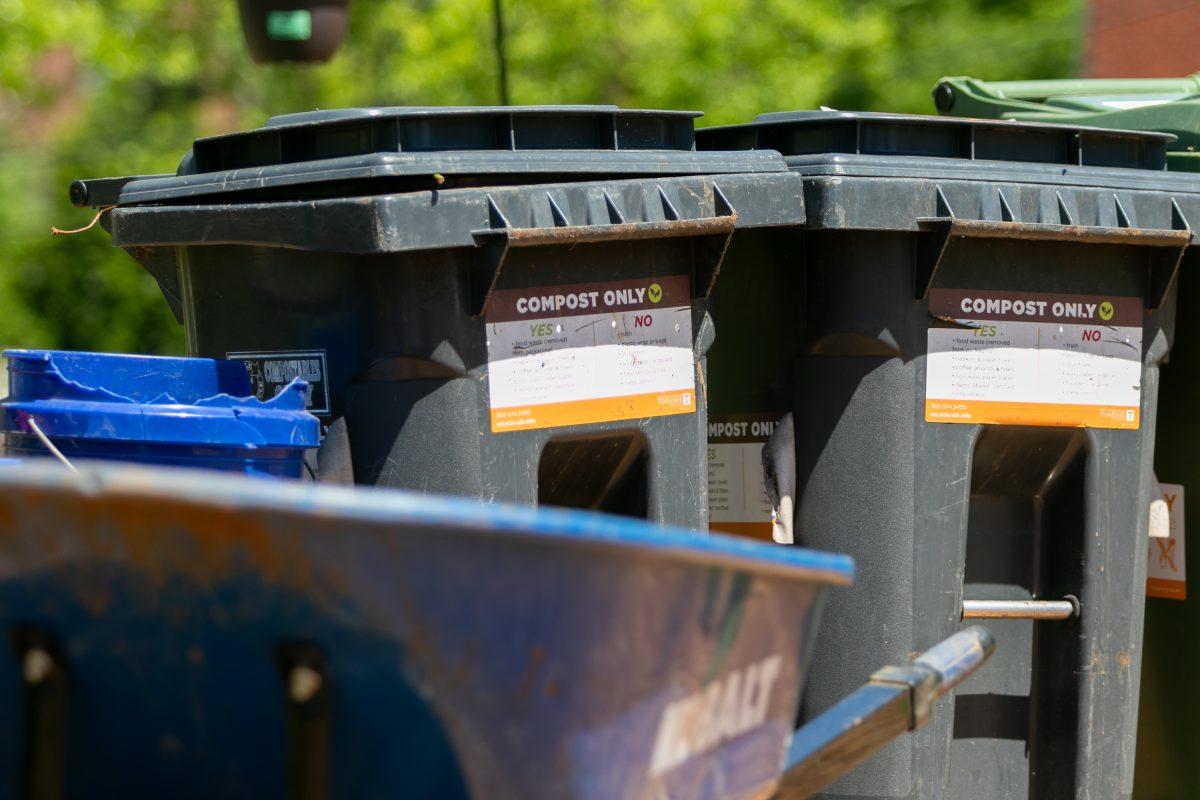
Composting at UT is divided into two categories: front-of-house and back-of-house. Back-of-house compost includes any waste that is created during the food production process on campus.
“So if you’re a worker in the back of Stokely, for example, and you have veggie scraps, that gets sent to a compost bin that’s picked at a location on campus and then driven to our compost site where it’s composted,” Craven said.
Front-of-house is produced by consumers on campus.
“There’s not really a waste stream associated with having this specific composting bin for people who may, for example, eat out at the Student Union,” Craven said. “So, we’re trying to really push for front-of-house composting as well as back-of-house.”
Craven says back-of-house composting is pretty functional as it stands, but front-of-house composting is more of a challenge because education and consistent engagement are such large components of it. To address this, the Compost Coalition has been partnering with other clubs on campus that share a similar passion for sustainability.
For instance, the Compost Coalition is currently working with the Sustainable Business Organization — the Haslam College of Business’s first sustainability club — to include more compostables at dining locations on campus. They’re beginning this process at the UT Creamery by introducing a pilot program that implements fully compostable materials with one specific waste stream.
Other organizations the Compost Coalition collaborates with include the UTK chapter of the Society of Ecological Restoration and Students Promoting Environmental Action in Knoxville — more commonly referred to as SPEAK.
One such collaboration was a food sustainability-themed event titled “Mix It Up” that took place April 23. During the event, the Compost Coalition and SPEAK shared tips on how to reduce food waste when cooking and offered affordable, environmentally-friendly recipes to try. The Compost Coalition also hopes to collaborate with Food4Vols in the future to offer additional cooking classes for students.
Craven mentioned that Ella Dohrmann was hired as the compost supervisor at the UT Compost Facility in March, and the two have already started establishing a positive relationship and communicating about how to ensure a bright future for composting at UT.
Through Dohrmann, students can request tours of the UT Compost Facility. Su said volunteering there with students in the Compost Coalition and its advisor, Chad Hellwinckel, has created some of her fondest memories with the club.
“It’s really fun turning compost and seeing the science happen right in front of my eyes,” Su said. “It’s also a joy to catch up on life with people who care about the environment! Compost tours are also really fun, and I feel like I learn something new every single time.”
With Craven graduating this semester and Su returning to the Compost Coalition for her junior year, they shared their hopes for the future of composting at UT and how the practice is regarded by the campus community.
“I hope composting can become more accessible at UT and that the administration can commit to make composting a norm at the university and in the community,” Su said. “It may not be the most pleasant-smelling natural process, but given the capacity of our university and the waste that we produce every single day, it’s our duty as stewards of the environment to make composting easier for everyone.”
Craven emphasized that students should care about composting because it directly affects the environment both on campus and in the greater Knoxville community.
“I think, I think the point of college is to learn new things about our world and think critically about the way in which we engage with it,” Craven said. “When we think about nature and the way in which we interact with it constantly, they’re really important spaces to maintain. … I think compost is a very physical component to that in the sense that it feeds the things that give us life and joy.”
While the UT Compost Facility only processes compost produced on campus, students who live off campus can take advantage of compost resources across the city. Additional information, including different compost drop-off locations, can be found on the City of Knoxville website.