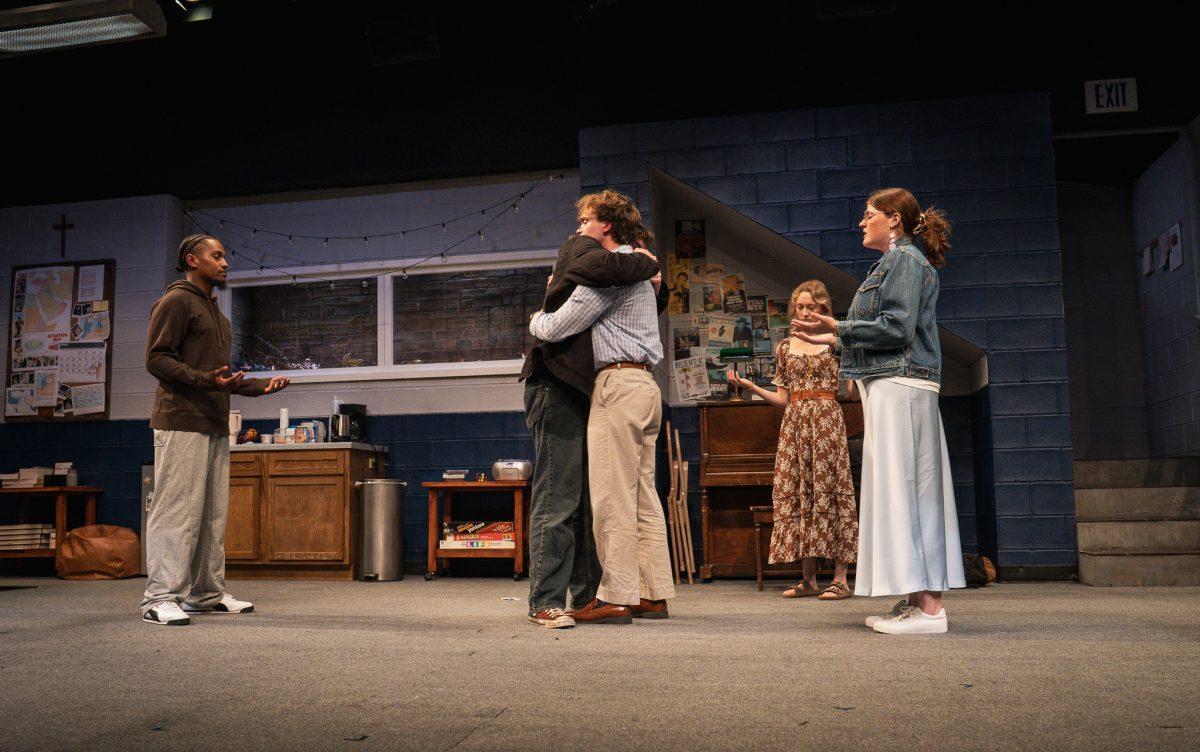
March 21 saw the unveiling of the Clarence Brown Lab Theatre’s newest venture in their production of “Anon(ymous).” Originally penned by Naomi Iizuka in 2006 and loosely based on Homer’s Greek classic “Odyssey,” the production follows a nameless refugee from a faraway place as he ventures to what we’re initially led to believe are greener pastures.
We’re greeted by a set that envelops the Lab Theatre and a cast recounting the differing yet uniformly longing retellings of what home means to them. Those recollections, as lovely as they are, are soon tossed to the wayside in favor of a bleak and realistic look at the journey it takes to leave home behind, even when there isn’t that much of home left.
As our main character, aptly named Anonymous — played by Hogan Wayland, though he refers to himself as “nobody” — washes ashore from a shipwreck, we’re immediately introduced to his first found home in the hands of an affluent senator and his daughter whose plans for her new friend extend, uncomfortably, past hospitality. While the two exchange iffy exchanges, we get a glimpse of what Anonymous thought he left behind.
When marooned due to stormy seas, both Anonymous and his mother assumed each other dead and gone. What’s quickly revealed is that the family that’s taken in this refugee has also taken a keen interest in the sweatshop in which Anonymous’ mother, played by Riya Golden, has taken up work. Here we have our central conflict set up for us — that the journey home is often far longer in effort than it is in distance.
While his mother is left at the hands of a money-hungry supervisor, played by Trevor Schmitt-Ernst, whose ignorance sometimes borders on hilarity, we’re given ample time to live the life that our main character has effectively been left to live. Early on, these parallels are made to play as more grounded simply on the account that they’re allowed to be.
There’s the initial friend made in Pascal, played by Jordan Goskowicz, as he shows his new companion the ropes of a life on the streets and how to survive tunnel-dwelling rats. Or, our aforementioned stand-in family that takes his exodus as offense rather than recognizing his strife. It’s in these moments that the vigor in analogy between long journeys home and the current state of immigration is at its most pronounced, often blatantly displaying the stereotypes and caricatures that are so often associated with the struggles facing anyone seeking a fresh start at a new life.
Students of Greek literature will be sure to notice where the allusions start to rise above reality and into insanity, and these moments often arise and appear to be vying for the most entertaining or the most extraneous scenes throughout the production. Oftentimes here, they’re the same thing.
Homer’s infamous cyclops here comes to us in the form of a one-eyed butcher that, when inquired by Anonymous and Pascal for employment, begins to put on display a very direct yet disconcerting notion that his cut of choice is maybe a little too familiar. It’s a scene that’s played wonderfully by the cast, especially Garrett Wright as Mr. Zyclo himself, yet it begins to pull at the poignancy that’s been cultivated in every moment thus far. If nothing else, the whole production in moments like these can begin to feel like actors making the absolute most of a script that often is confused about what it’s calling them to do.
The main messages, of which we’re reminded heavily throughout, remain intact despite the veers into fantasy that are made so often in “Anon(ymous).” The stories told and lessons shared by our main and supporting characters are here to remind us that our nation founded on those fleeing oppression should value those perspectives as they continue to bring insight and value to a home that’s constantly changing. Those experiences and their vastness of differences show us that there’s often a huge sacrifice in making a move to a new home and leaving far more than a brick-and-mortar one behind.