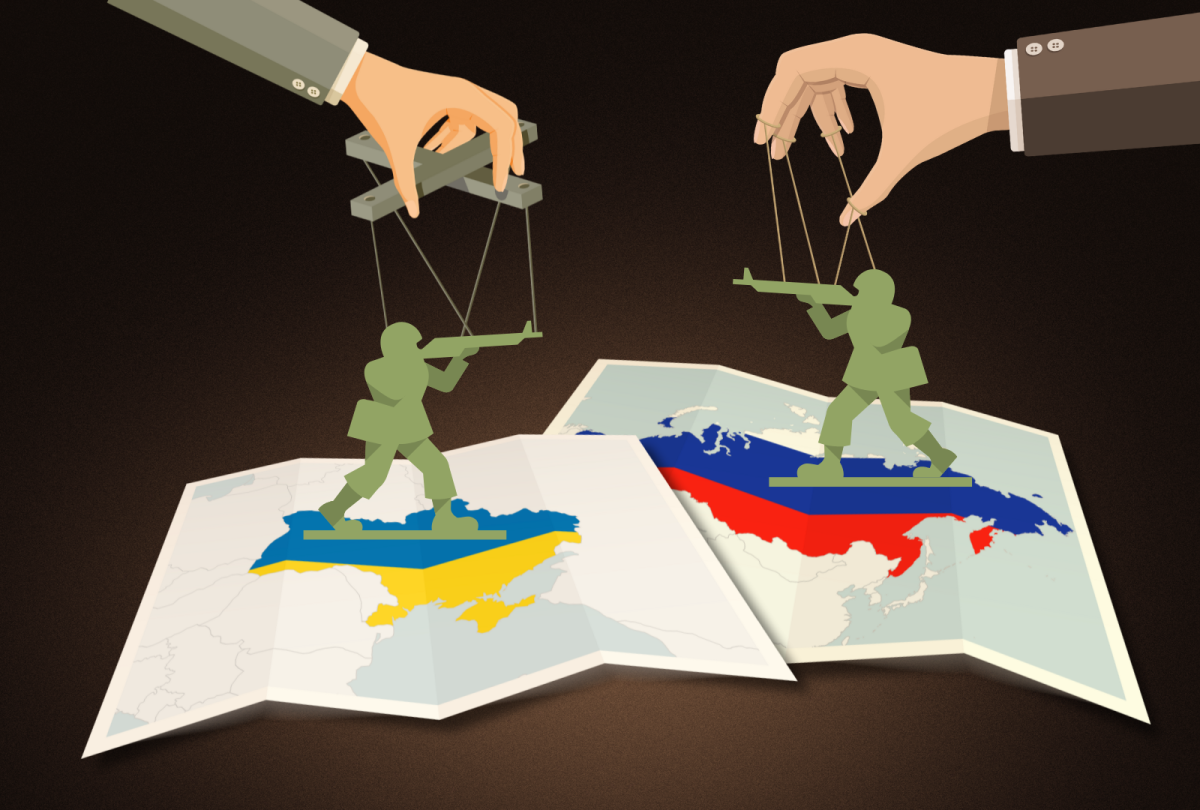

As the war in Ukraine surpasses the two-year mark, the American foreign policy perspective has largely remained the same: President Vladimir Putin of Russia is the evil dictator who invaded the sovereign nation of Ukraine because of his irrational thirst for land and power. Therefore, the United States must provide unconditional financial and military aid to the freedom fighters of Ukraine against the tyrannical authoritarians of Russia — working to defeat Putin at all costs.
This predominant narrative has been echoed by the U.S. Department of State, President Joe Biden, Democrats and Republicans in Congress, mainstream media and professors within academia. With a seemingly widespread consensus on the subject, is there really anything to question about America’s foreign policy approach?
The answer is a demonstrable yes. Critics of the official position are often cast aside as Russian agents or “Putin sympathizers” to delegitimize dissent. However, there are valid reasons why the official position should not be taken at face value.
In periods of war and conflict, governments historically use intentional language and reasoning to elicit desired reactions in the citizenry. Typically, governments will paint a conflict as a righteous fight between good and evil, the opposing side being morally inferior. These pretexts are provided to maintain popular support in what is otherwise the unflattering reality of power politics between geopolitical foes.
Are we truly to believe the allegations that Putin is a power-hungry dictator committing horrific atrocities against Ukrainian civilians for no good reason? Or should we take a step back and objectively evaluate the motives and variables at play behind this great power conflict?
The U.S. and its North Atlantic Treaty Organization allies, colloquially known as the West, need to put aside their pride and look inward toward the root cause of the decade-long struggle between Russia and Ukraine.
First, it is important to know the history of the NATO alliance’s relationship with Russia. NATO was founded after World War II for the explicit purpose of containing the spread of Communist Soviet power in Europe. When the Soviet Union collapsed in 1991, bringing the Cold War to an end, the original purpose of NATO became a moot point.
Throughout the 1990s, the pact added more countries from central and eastern Europe for the revamped reasoning of ensuring democracy, safety, stability and cooperation in the continent. After the Czech Republic, Hungary and Poland were incorporated into NATO in 1999, and with signals that NATO did not want Russia in the alliance, Russia drew its first red line against further expansion eastward.
Tension temporarily decreased following the years after the Sept. 11 attacks, as there was a mutual understanding between the two forces that expansion eastward would help bolster anti-terror capabilities.
But after the second wave of NATO expansion in the mid-2000s involving seven former Soviet countries, there were new calls from the West to include Ukraine and Georgia in the alliance, regions that share a border with Russia.
With growing concerns that the treaty organization was becoming a hostile actor against Russia, President Putin made clear his demands at the 2008 NATO summit in Bucharest, asserting that the potential military bloc of Ukraine and Georgia on Russia’s borders was seen as a direct threat to his country. Despite his demands, the alliance assured Ukraine and Georgia a pathway to NATO in the future.
When the Ukrainian government was overthrown in 2014, tension between NATO and Russia arose. Democratically elected Ukrainian President Viktor Yanukovych’s decision to take a trade partnership with Russia instead of the European Union caused chaos. A series of protests against the president’s decision culminated in the deadly five-day period of violent clashes in the capital city square known as the Maidan Revolution. President Yanukovych was unconstitutionally removed by the Ukrainian parliament and immediately replaced by pro-Western leadership.
This regime change, which was engineered and backed by the U.S. and its intelligence apparatus, did not sit well with Russia. From their perspective, this was another attempt to align Ukraine with the West and enter into NATO, prompting their annexation of Crimea.
In the 22 years prior that Ukraine operated as a neutral buffer state in its militaristic alliances between Russia and the West, Russia never invaded its neighbor. It was only after the installation of a NATO-friendly government that President Putin ordered his troops to seize Crimea — his way of telling the West that Russia would not back down on the major red line they drew in 2008.
Despite Russia’s clear message that any attempt to integrate Ukraine into NATO would be met with military force, the U.S. and its European allies continually ignored those warnings. In the years leading up to the start of the current war, the U.S. and various European countries started shipping weapons to Ukraine, training its military, and hosting air and naval exercises in the Black Sea region.
Ties between the Biden administration and current Ukrainian President Volodymyr Zelenskyy’s administration grew stronger when Secretary of State Antony Blinken signed the U.S.-Ukraine Charter on Strategic Partnership in November 2021, a crucial document outlining the “commitment to Ukraine’s implementation of the deep and comprehensive reforms necessary for full integration into European and Euro-Atlantic institutions.” With Ukraine rapidly headed towards membership in NATO, a major diplomatic standoff occurred between Russia and the U.S. the following month.
Russia demanded a written guarantee that Ukraine would never become a part of NATO, but Secretary Blinken and the U.S. did not budge. As a result, to prevent what they saw as an existential threat to the future of their country, Russia launched its invasion of Ukraine in February 2022.
Why would Ukraine joining NATO be such a big deal? As a sovereign nation, why shouldn’t Ukraine be free to choose its strategic alliances? These are all reasonable questions one may ask. While Russia appears to be the irrational oppressor against innocent Ukraine on paper, the reality is not so simple.
To any nation, maximizing security is of the utmost importance. A state’s existence is characterized by its ability to adequately defend itself against foreign threats. Without this ability, a state is vulnerable to being crushed by outside opposition at any given time.
From Russia’s perspective, the incorporation of Ukraine into NATO would be unacceptable for their security posture. If Ukraine were to become a NATO nation, hypersonic missiles could be placed on their border that reach Moscow in just five minutes, leaving Russia completely vulnerable to an air attack at any time. Russia would also be militarily vulnerable on the ground, as the widening funnel of the Great European Plain that stretches across Ukraine into Russia is strategically disadvantageous.
Stationing enemy troops on a country’s border at a moment’s notice is problematic to any country. If Mexico or Canada were adversaries of America and tried entering a comparable alliance, would our government tolerate that in any capacity?
Many try to dismiss these concerns by claiming it would be unrealistic for NATO to attack Russia any time soon, but it fundamentally misses the point. It is simply the prospect of a future attack against what would be an effectively defenseless country that makes Ukrainian NATO membership so dangerous.
As the makeup of countries and their governments can significantly change over time, it is not out of the realm of possibility that Russia could be subject to further hostility and aggression in the future. If Ukraine became firmly assimilated into NATO, there would be nothing they could do to meaningfully counter a military assault.
In fact, the security dilemma Russia finds itself in is no stranger to the U.S. A very similar situation transpired during the 1962 Cuban Missile Crisis. When missiles were found to be placed in Cuba by the USSR in the beginning stages of the cold war, the response by America was extremely aggressive. President John F. Kennedy was advised to air strike Cuba and invade the island by land, actions that likely would have triggered World War III. He ultimately opted not to, with the USSR disarming the missiles after intense negotiations.
But what the Cuban Missile Crisis showed was that the U.S. was prepared to combat a potential neighboring threat to the highest degree. For the past 16 years, President Putin has made it clear multiple times he would do the same, whether the West agreed with it or not.
One can criticize the methods used by Russia as unethical. One can contend that the invasion was premature. Regardless of the truth or falsehood of these claims, they fail to consider the true motive of the conflict. The fact is that Russia did go to war with Ukraine, but the primary fault lies with the U.S. and its Western allies for recklessly provoking Russia to do so.
In the American regime’s hubris, the endless quest to exert power over opposing spheres of influence has been costly. In the most conservative estimates, at least 100,000 civilians and soldiers have been killed in the war. Upwards of $100 billion in taxpayer dollars have been sent to aid Ukraine, effectively constituting a proxy war with Russia. Russia is strategically aligning with China more and more. The likelihood of another world war breaking out is at its highest point in decades.
These effects could have been avoided or largely mitigated had the U.S. taken steps back in its aggressive foreign policy approach, ensuring that NATO would never knock on the doorstep of Russia’s eastern border. It is now long past due for the West to come to the negotiating table with Russia and Ukraine and end this unnecessary war.
Elijah Boatwright is a sophomore at UT this year studying political science and economics. He can be reached at [email protected].
Columns and letters of The Daily Beacon are the views of the individual and do not necessarily reflect the views of the Beacon or the Beacon’s editorial staff.