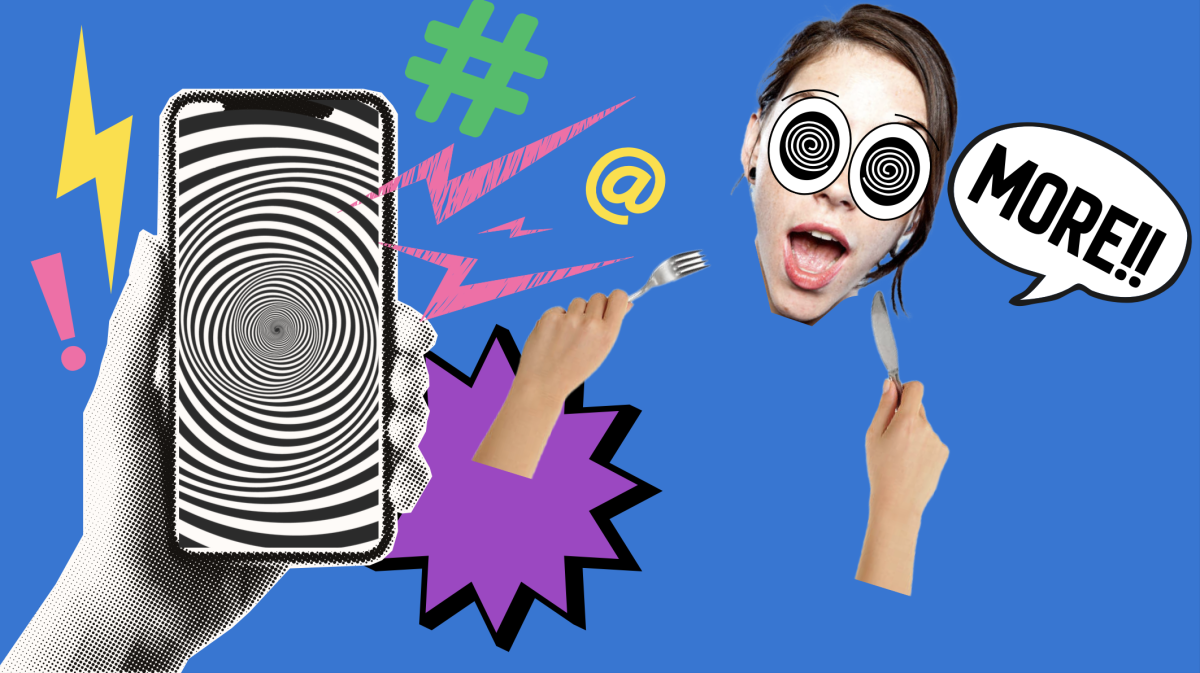
When I walked into Rocky Top dining hall this morning, I was greeted with the familiar sight of 300 students. All with their necks craned and backs hunched, over their phones.
The food was an afterthought. I watched as they mindlessly picked fruit salad, thoughtlessly shoved mashed potatoes — their eyes glazed over, too busy consuming, actually to consume. Yes, the food was being eaten. But was it being tasted?
This isn’t coming from a place of judgment. I, too, have developed the inability to eat in silence. Mealtimes require entertainment — digital or human. But as I’ve grown older, late nights get later, schedules get more hectic and I’ve found myself alone more often than not. There are no more family dinners when I get home from work at 9 p.m.
So what do I do? Sit alone in the dark? Or, should I comfort myself with the friendly glow of my cell phone to accompany my meal? One thing leads to another, and it becomes a habit. Dinner and a movie. Or a TV show. Or something super low-commitment and easy, like TikTok or Instagram Reels.
At what point does this practice discourage social interaction? At what point does this habit stop being a solution and become a problem of its own, or dare I say, an addiction?
It doesn’t take much research to uncover that there is a real factual basis to this phenomenon.
A 2021 National Library of Medicine study done on the effects of smartphone usage at mealtimes found that 85 percent of participants used their cell phones during at least one meal every day. This statistic was not at all surprising. In fact, I believe if this study were redone exclusively using college students, the results would be exponentially higher. The average American college student spends almost nine hours a day on their smartphones, about two hours higher than the national average.
The same study proved that the habit does lead to a stark decrease in mindful eating. When accompanied by a digital device, significantly more calories were consumed. Not because the participants were hungry — rather, the content on their phone distracted their brain from the “internal biological cues” that typically let the body know it was time to stop eating. Their circadian rhythm, satiety cues and chewing rate were all overpowered by the hypnotizing glow of their screens.
Your brain can’t fully invest itself in the finale of The Bachelorette and still effectively communicate with your stomach. That’s why when you go to the movies, you can finish an extra-large popcorn, a box of peanut M&M’s and a blue raspberry slushie with ease.
A 2023 study done in China revealed the disturbing correlation that the decrease in mindfulness has on an individual’s likelihood to develop an eating disorder. Women typically developed “thinness-oriented disordered eating,” and men developed “muscularity-oriented disordered eating.”
When your brain is too distracted to get full, you can eat indefinitely. Putting the fork down gets harder. It gets stressful. Maybe you gain some weight — the modern equivalent to social suicide — and bam! Before you know it, the ability to intuitively eat is a skill your body and mind are no longer able to perform and you’ve developed an eating disorder to cope with the weight gain and anxiety
At this point in my research (and hopefully your reading experience), this is starting to paint itself as an addiction — because it clearly is.
A 2019 study on the reinforcing powers of smartphones highlighted this addiction — a group of college students were deprived of both food and their cell phones for a few hours and then allowed to work for either a 100-calorie snack after a long day or 20-120 seconds on their phones. Easy choice, right?
Overwhelmingly, they chose the cell phone. The absence of their phones was literally harder to bear than the absence of food and the prospect of starvation. Well, that settles it. We would be the first to die on that desert island, right under Generation Alpha and those iPads they have glued to their faces.
But as a busy, tech addicted college student myself, I get it. It’s a distraction — and hey, that’s sometimes what I want after a long day. But at what cost?
Shouldn’t we all be able to live in the quiet? I mean, think about it — when was the last time you did something without music, a podcast or a show playing in the background? Can you completely disconnect? Or are you incapable of sitting down, having a meal and just staring at the wall? If that sounds like torture to you, maybe it’s time to make some changes.
Just something to chew on. Actually, don’t just chew. Taste.
Being present in the moment is a principle you should adopt when approaching anything. As a college student with a meal plan, having the privilege and access to three meals a day is something I often forget to be thankful for. So why not enjoy it to the fullest?
Before we know it, we’ll be budgeting for groceries and cooking our own meals — it’s only going to get harder from here. So instead of taking your phone out at the dinner table, talk to a stranger, call your mom or maybe sit near a window and enjoy the view.
Claire Thatcher is a Freshman at UT studying Journalism. She can be reached at [email protected].
Columns and letters of The Daily Beacon are the views of the individual and do not necessarily reflect the views of the Beacon or the Beacon’s editorial staff.