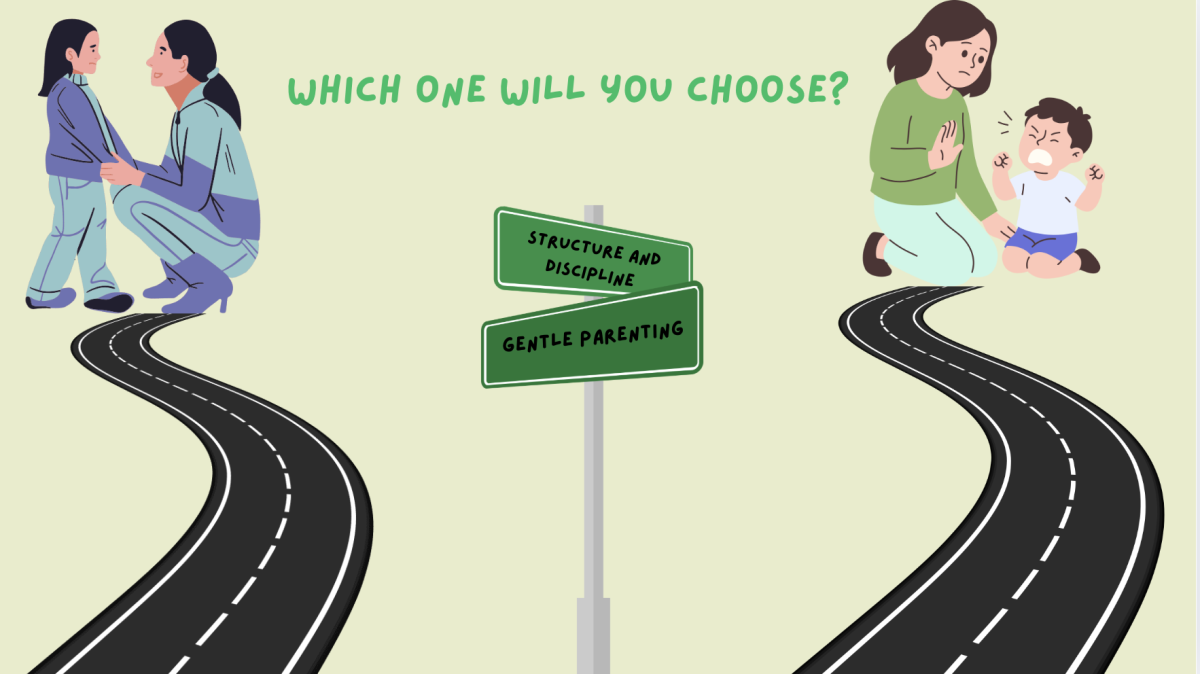
Parenting, as defined by the American Psychological Association, is all actions related to the raising of offspring. For most of us, we define parenting as the disciplinary actions parents take towards their child.
For example, parenting can be defined as a father putting his child in timeout after he or she has hit their sibling, or when a mother gives a talking to after her child has been disrespectful.
As children get older, parenting turns into mentorship of the child. This can be exemplified through a father helping his child learn how to drive, or a mother giving her child advice on friendship.
There are four main styles of parenting according to Diana Baumrind, a U.S. developmental psychologist: authoritarian, authoritative, permissive, and rejecting-neglecting parenting. However, a style of parenting that most people are stirring conversation about is gentle parenting.
According to the Cleveland Clinic, gentle parenting “raises confident, independent, and happy children through empathy, respect and understanding, and setting healthy boundaries.” Gentle parenting puts an emphasis on the child’s self – awareness of their behavior. This style of parenting has most notably been illustrated in the media with very young children and millennial parents.
On paper, this style of parenting is very appealing. Raising emotionally healthy, mature, and intelligent children is the goal… right?
In practice, gentle parenting is actually not parenting at all. The result of gentle parenting doesn’t actually teach a child to be emotionally regulated and mature, as an advocate might argue, but rather this parenting style turns children into emotionally dysregulated, self-centered children who have no real understanding of the real world and what it means to be a “grown-up.”
Gentle parenting takes a very passive approach to a child’s actual need for teaching. The primary focus of gentle parenting is understanding and empathizing with your child. Yes, you, as the parent, are allowed to empathize with your child. However, solely empathizing with your child does not teach them that their behavior is inappropriate.
Gentle parenting advocates take very adult concepts, like understanding your emotions and what motivates someone to act a certain way, and try to apply it to a child who will never be able to conceptualize their emotions in the way an adult can.
Gentle parenting completely ignores the importance of discipline, and teaching your child how to be a “grown-up,” because that’s the ultimate goal of raising a child, right? Teaching them how to be an adult, and eventually learn how to go through life on their own? This method completely sets the child up for failure.
Gentle parenting not only affects the child negatively, but also cultivates stress and anger for the parent. Gentle parenting demands perfection from the parent, and when the parent isn’t perfect — surprise, a sense of inadequacy and shame over their lack of perfection takes over the parent. This can lead to resentment towards their child, and is disruptful to the parent-child relationship.
Furthermore, gentle parenting, or rather a lack of parenting, leads to a very disagreeable child, in most cases, and this is not the most desirable of environments to be in as a parent, and in general.
Although I am a college student with no personal experience of parenthood, I have experienced the consequences of gentle parenting as a babysitter, family, and even as a grocery shopper in the middle of Target.
I understand that parenting is difficult. It is not easy raising a child for 18 years. I also understand that gentle parenting is not the way to go about parenting a child, either.
So, what parenting style is the “best” choice? I would argue that the authoritative parenting style is the optimal parenting style. This parenting style is defined as a parent who “encourages a child’s autonomy yet still places certain limitations on behavior.” A parent still establishes authority and rules for their child, yet allows the child to explore some options.
For example, a child may want to pick out their outfit for the day. Instead of picking out an entire outfit by themselves, in which they might pick a summer outfit during the winter, the parent chooses two or three outfits for the child to pick from. The child then gets to express their own autonomy within the limitations of the choices they’ve been given.
This style of parenting produces a social, intelligent, and confident child who learns how to be independent in accordance with their age. Although gentle parenting seems great on paper, the actual practice of it tends to lean more permissive than some would like to admit.
Children need their parents, but not just as their friends — children need their parents to discipline and mentor them in order to become successful adults, and, unfortunately, gentle parenting does not produce that outcome.
Hadley Marshall is a Freshman at UT this year studying Public Relations. She can be reached at [email protected].
Columns and letters of The Daily Beacon are the views of the individual and do not necessarily reflect the views of the Beacon or the Beacon’s editorial staff.