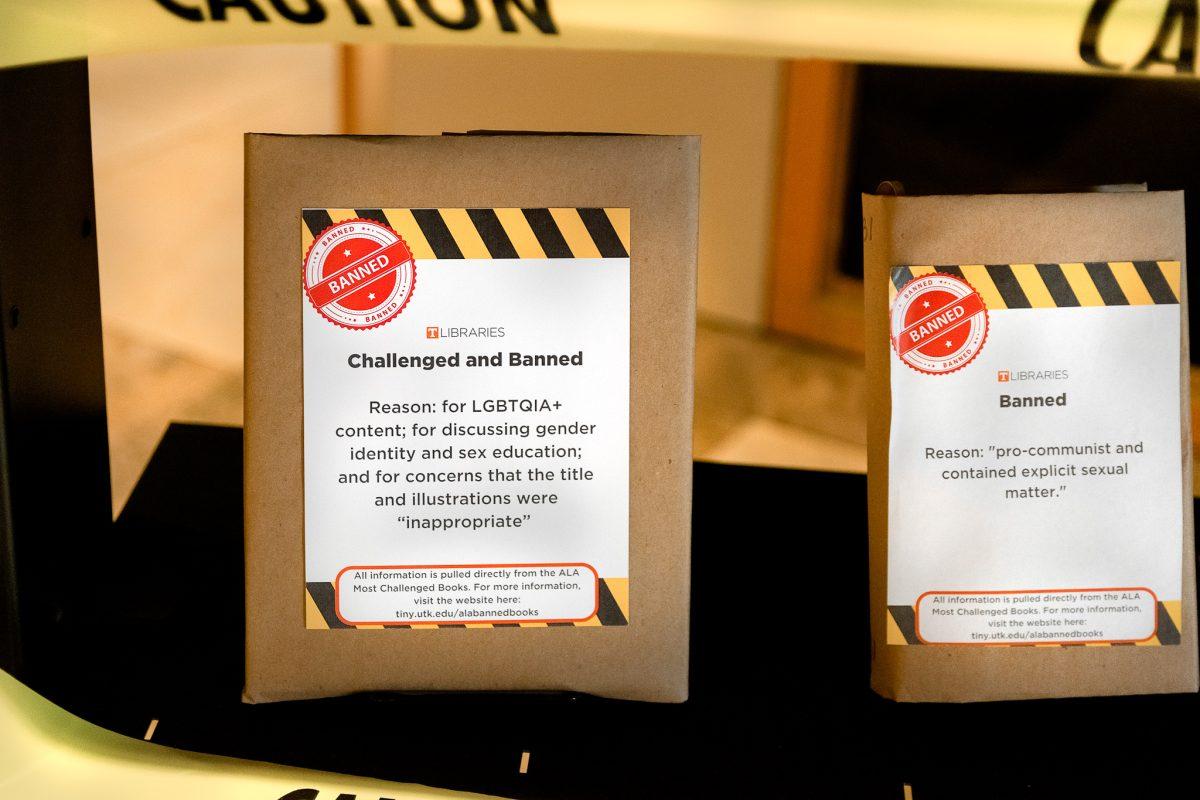
In 2022, the Age Appropriate Materials Act was passed in Tennessee, requiring public school libraries to publish and review their collections to ensure they are age-appropriate.
What does age-appropriate mean? Many school officials grappled with this question as they scanned through books to figure out what met the criteria. An amendment to the law was passed last spring with more specifics — books containing nudity, descriptions or depictions of sexual excitement, sexual conduct, excess violence or sadomasochistic abuse were deemed inappropriate to have in public school libraries.
Book banning has been a hot topic in the U.S. in the past few years, with groups such as Moms for Liberty being vocal supporters of book banning. Many believe that certain books should be banned in public schools to protect children from taking in harmful content or adopting harmful behaviors from what they read. Others are against banning books and believe all books should be kept in school libraries regardless of content, giving kids the freedom to read what they want.
Some fall in the middle, believing that some books are inappropriate for children to read, but access to them should not be restricted entirely.
Jill Wright, a former Knox County Schools teacher, shares this opinion. She was slightly surprised at some of the banned books on Knox County’s list.
“Some of them, I think, are ridiculous, and they don’t belong on that list,” Wright said. “Especially some of the lower grade ones like Eric Carle. You know, why in the world would you ban that kind of book?”
The book in question refers to Eric Carle’s “Draw Me a Star,” a children’s picture book. This book was supposedly banned in public elementary schools due to an artistic interpretation of a naked Adam and Eve.
Many of the books on Knox County’s list cover sensitive topics, such as “Perks of Being a Wallflower” by Stephen Chbosky, which contains discussions of sex and drug abuse. “The Bluest Eye” by Toni Morrison is also on the list, containing discussions of racism and child molestation. These books are also included in the top banned books in the United States.
While Wright agrees that some books on the list are inappropriate for younger children to read, she does not recommend keeping certain books out of high school libraries.
“Once you get in high school, you’ve crossed over into a whole different plane,” Wright said. “Regardless of whether or not you agree with the contents of a book or wouldn’t want your kid reading it, it doesn’t mean it shouldn’t be available to everyone else.”
Wright thinks some of the list’s books may require adult guidance. She says that families could benefit from parents sitting down and guiding their children through books instead of forbidding them from reading them entirely.
“That’s where a parent needs to step up and be a parent,” Wright said. “I know someone who will not tell their child, ‘No, you can’t read a certain book.’ They will say, ‘If you have questions about it, sure. Go check it out. Let’s bring it home. Let’s read it together.’ Sadly, a lot of parents are just not taking advantage of those teaching moments anymore. Why not encourage them to have those hard conversations?”
She also thinks part of the problem is that parents are very rarely willing to talk with teachers in person anymore.
“As a culture, so many people have become keyboard warriors, and it’s like we’ve lost the art of having a civilized conversation face to face,” Wright said. “That’s how you end up with all these books on these banned lists because people cannot sit down and have a legitimate conversation about it and get to the root of the problem.”
Kathy Shorter, a nurse in Knox County, says the recent book bans may indicate that history is repeating itself. She cites books like Margaret Atwood’s “The Handmaid’s Tale” and George Orwell’s “1984,” both dystopian novels that depict countries under the rule of authoritative governments.
“I think if you take away books and limit what people have access to, you are limiting free speech and history is repeating itself,” Shorter said.
Similar to Wright, she thinks if parents disagree with what their children are reading, they should sit down and walk through it with them.
“Watch what your kids are reading and talk through it with them, but you can’t ban it from everyone,” Shorter said. “That’s not right.”
She also emphasized the importance of allowing these books to educate people about dark topics.
“Books can educate people on all sorts of things,” Shorter said. “You have to let people see it. If not, we can repeat our mistakes in the future. You can’t just shield everyone from the truth. It will only lead to ignorance.”
She also said that banning some of these books may prevent kids from feeling seen, especially children from marginalized groups.
“Kids need to read about kids like themselves,” Shorter said. “We can’t just create these fictions that every kid has a happy life.”
Book banning seems to be on the rise in the U.S., and each passing year brings the threat of more books being removed from school libraries. Other than the 48 books currently banned in Knox County, another 67 were reviewed and ultimately kept on the shelves, including titles such as “Persepolis” by Marjane Satrapi and “Monday’s Not Coming” by Tiffany D. Jackson.
Where Knox County Schools will head with book banning remains to be seen, but parents, educators and librarians alike are apprehensive about the future of education.
Editor’s Note: This article has been updated to correct the spelling of Kathy Shorter’s name.